select one of two analog inputs

Thread Starter

halley

Joined Dec 27, 2008
11
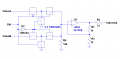
I'm mostly a digital kind of guy, and an analog dunce. In my weekend project, I want to select one of two analog inputs for an output. In another old thread (unanswered), someone included this schematic, which is conceptually what I want. I don't have major concerns about speed, but I want my part count as low as possible. Can't something like this be done with one or two transistors?


SgtWookie

Joined Jul 17, 2007
22,230
Hi Halley,
What is the signal level of your output? Voltage and current?
4066 analog switches work OK for high-impedance low level stuff, but they have a fairly high resistance (around 150 Ohms) so aren't suitable for anything more than a couple of mA current.
 

Thread Starter

halley

Joined Dec 27, 2008
11
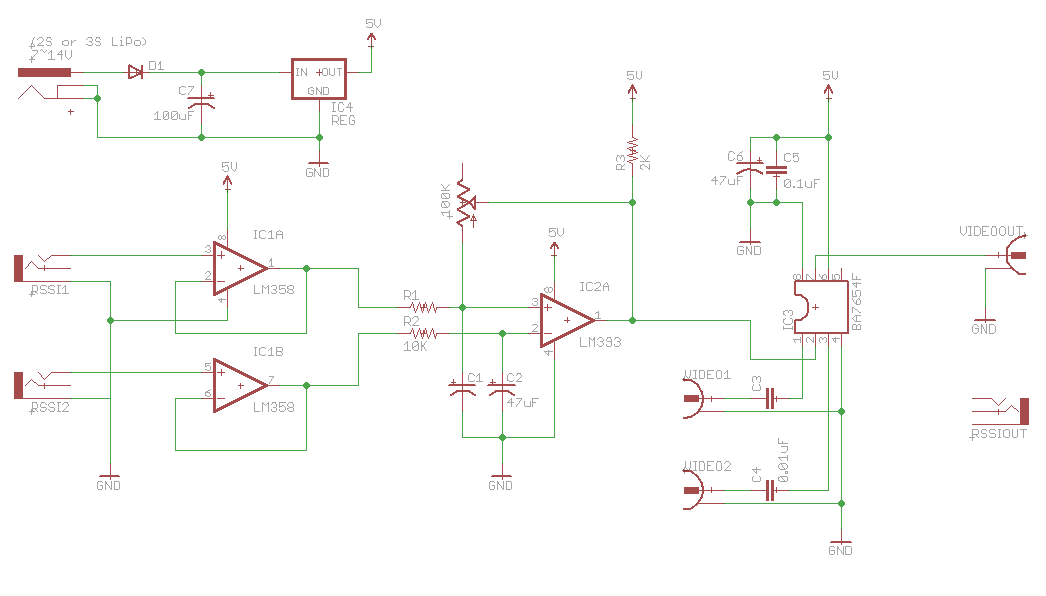
I'm putting together a video switch. I take two video-ins, and two rssi-ins that indicate their relative quality. These go through a comparator opamp to get a crisp "vote" for which is the better video source. I'm using a video switch IC to pass the winning video out already; I was hoping not to have to use a second package or a quad variety to pass the winner's original rssi to go out too. I guess it really is simpler to go the IC route. (By passing the winning rssi out, I can stack these for more video pairs.)


SgtWookie

Joined Jul 17, 2007
22,230
You should look at Dallas/Maxim's video multiplexing IC's. You'll get much better performance from them than the old 4066. With video, you really need a current feedback amplifier; the 4066 wouldn't be adequate.

Linear Technology also has video multiplexers; here's a 4-into-1 mux:
http://www.linear.com/pc/productDetail.jsp?navId=H0,C1,C1154,C1009,C1022,P1402
LT's offerings tend to be a bit pricey, but they are very good.

You can simulate your circuit using the free LTSpice IV software, downloadable from their site:
http://www.linear.com/designtools/software/
 
Last edited:

Ron H

Joined Apr 14, 2005
7,063
You should look at Dallas/Maxim's video multiplexing IC's. You'll get much better performance from them than the old 4066. With video, you really need a current feedback amplifier; the 4066 wouldn't be adequate.

Linear Technology also has video multiplexers; here's a 4-into-1 mux:
http://www.linear.com/pc/productDetail.jsp?navId=H0,C1,C1154,C1009,C1022,P1402
LT's offerings tend to be a bit pricey, but they are very good.

You can simulate your circuit using the free LTSpice IV software, downloadable from their site:
http://www.linear.com/designtools/software/
His video switch is the BA7654F. The way I understand it is he wants to send out either the winning rssi, or the audio the corresponds to the winning rssi. I'm guessing the latter. In either case, a 4066 should be OK.

EDIT: Or maybe I'm full of crap.
 

SgtWookie

Joined Jul 17, 2007
22,230
Gee, I didn't notice the BA7654F. :rolleyes: That would work for a video switch.

But, I really don't think a 4066 would work; it's impedance would change too much over temp for video I think... and the variation from IC to IC would make it tough to Z-match without a lot of fiddling around. Ghost city?
 

Ron H

Joined Apr 14, 2005
7,063
Gee, I didn't notice the BA7654F. :rolleyes: That would work for a video switch.

But, I really don't think a 4066 would work; it's impedance would change too much over temp for video I think... and the variation from IC to IC would make it tough to Z-match without a lot of fiddling around. Ghost city?
I agree that a CD4066 is a poor video switch, but my impression is that he is not planning to pass video through it. If so, why not just use more BA7654Fs?
Having said that, you don't have to Z-match the switches. The switches can drive a high-Z load and be followed by a buffer amp. The big problem with most analog switches at video frequencies is crosstalk due to capacitance. You can make a 2:1 video switch that has decent performance with 6 HC(T)4066 sections, arranged in T-fashion, as in the attachment. The vertical switches shunt the crosstalk to GND when the associated channel is deselected. You have to deal with switching glitches, so this arrangement is probably not good for switching within the active picture area, such as picture-in-picture.
I don't recommend this approach. I just posted it as an illustration. It obviously requires a lot of hardware compared to more highly integrated solutions. The circuit also does not deal with DC biasing considerations, which will require even more circuitry.
 

Attachments

Top