That pulley is commonly known as a "variator". It's a pretty common thing used in MTD lawn mowers. And even though you JD is badged as a JD it was probably made by MTD.
It didn't change. Got a little off topic with the CVT modifications, but everything is still inline with what I said in the OP. I don't blame you for not reading it, I know I can be long winded.
I want to make it faster AND be able to govern it. So that my children and I can all drive it at speeds appropriate for our individual experience levels.
Personally didn't mean to go off target myself about the variator setup... they are different, but share some common traits. In the end the springs and weights and such only make up a small portion of the puzzle while the amount of power to move the object at the desired speed actually dictates more of how it will act than anything.
i don't want to be a bad weather bird ... but the speed limit alone does not define "safe" ... 1 of the frist things in the martial arts school you are taught is falling
Right. And I'm not a parent who runs ahead of the children spraying disinfectant and making sure they wear their knee pads. I allow them to be exposed to manageable amounts of danger as I believe that is essential to learning how to deal with it. But there are limits. I don't let them handle firearms unsupervised or drive at highway speeds. I believe if danger could be quantified, we would find that it rises at some exponent of speed, so that is where my efforts are focused at the moment. Next will be improvements in handling and braking.
Personally didn't mean to go off target myself about the variator setup... they are different, but share some common traits. In the end the springs and weights and such only make up a small portion of the puzzle while the amount of power to move the object at the desired speed actually dictates more of how it will act than anything.
i've been truly dead 16+ times , non of the recoveries from was sure in advance = you most always had to "work your guts out" to get or fool the sys. to "restore" . . . e.g. there is by default no any warranty of any kind you survive/resurrect . . . (( in other words "i was just too stupid to get i'm dead at the past" ))
i suggest knowing more self-aid options does not hurt
It didn't change. Got a little off topic with the CVT modifications, but everything is still inline with what I said in the OP. I don't blame you for not reading it, I know I can be long winded.
I want to make it faster AND be able to govern it. So that my children and I can all drive it at speeds appropriate for our individual experience levels.
OK got you, but I have read it from the beginning.
To control speed the easiest way without actually having the cart in front of me, I'd look at controling the movement of the driving pulley in the CVT. Something like a roller that would be moveable/adjustable for each driver. That would keep the speed in check much better than an engine governor.
The engine governor would work if the cart didn't use a CVT, but with the CVT as speed picks up the engine speed doesn't have to be as fast. It is like an automatic transmission in a car, it takes lower RPM at 50MPH than it does to go 25MPH, because the gearing is different at both speeds.
OK got you, but I have read it from the beginning.
To control speed the easiest way without actually having the cart in front of me, I'd look at controling the movement of the driving pulley in the CVT. Something like a roller that would be moveable/adjustable for each driver. That would keep the speed in check much better than an engine governor.
The engine governor would work if the cart didn't use a CVT, but with the CVT as speed picks up the engine speed doesn't have to be as fast. It is like an automatic transmission in a car, it takes lower RPM at 50MPH than it does to go 25MPH, because the gearing is different at both speeds.
I agree that limiting the movement of the CVT pulleys would be more predictable and exact speed governing method, however it would be like locking a car in 1st gear as the speed control. I can picture my daughter cruising around wide open throttle everywhere going only 10mph.
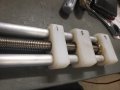
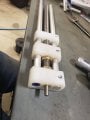
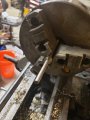
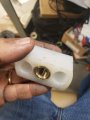
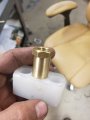
I started on the governor today. I wanted some kind of linear slide like maybe a drawer slide, as the interface between a servo and the cable sheath. I went to home depot looking for something quick & dirty, didn't see what I wanted. Drawer slide were all too long and I convinced myself that they would get rusty and seize up anyway, so I opted to roll my own linear actuator out of nonferrous materials. I came home from HD with the 1/2" aluminum round bar and 1/2-13 stainless threaded rod. The brass hex and UHMW plastic I already had. I originally threaded the plastic, and the plastic was supposed to be a self-lubricating, wear resistant bearing & nut, but it didn't work out that way. I forgot what a P.I.T.A UHMW is. Don't try to thread into the stuff. It's weird. If I had known I was going to end up making brass inserts I would have started with aluminum instead of plastic.
It occurred to me that effecting the movement of the sheath relative to the cable inside, does not have to happen at the end of the cable where it terminates at the engine. It can happen anywhere between the accelerator and the engine. So I'm going to cut about 2" out of the sheath in the middle of the cable, where it passes through the tunnel between the front seats. If any wannabe mechanics decide they're going to bypass it, they'll have to hunt for it, and probably won't know what they're looking at if they find it.
You mean like people that mow grass with a riding lawn mower? Small engines are made to run at a set speed, four strokers are ~3600RPM, the engines governor keeps it there, so unless you disable the governor it's not going to hurt the engine. But without the engine governor, yes, it could be a problem.
Unless the CVT is restrained from changing past a certain point of movement the speed will increase even at a certain engine speed. Unless it is going up a grade. As the force needed to overcome ground friction decreases speed will increase. Did you ever ride or have a Honda Trail 90 type of bike? They had a CVT and that's what happens when riding them.
You mean like people that mow grass with a riding lawn mower? Small engines are made to run at a set speed, four strokers are ~3600RPM, the engines governor keeps it there, so unless you disable the governor it's not going to hurt the engine. But without the engine governor, yes, it could be a problem.
Unless the CVT is restrained from changing past a certain point of movement the speed will increase even at a certain engine speed. Unless it is going up a grade. As the force needed to overcome ground friction decreases speed will increase. Did you ever ride or have a Honda Trail 90 type of bike? They had a CVT and that's what happens when riding them.
I am planning to do some work to the engine down the road, after the suspension, steering, and braking are up to snuff. Among those engine modifications will be removal of the governor. This engine is sold as a 22HP engine but with the right modifications it can make 60-70HP. I don't think I need that much, but a doubling of factory HP is a goal.
I am planning to do some work to the engine down the road, after the suspension, steering, and braking are up to snuff. Among those engine modifications will be removal of the governor. This engine is sold as a 22HP engine but with the right modifications it can make 60-70HP. I don't think I need that much, but a doubling of factory HP is a goal.
Unless the CVT is restrained from changing past a certain point of movement the speed will increase even at a certain engine speed. Unless it is going up a grade. As the force needed to overcome ground friction decreases speed will increase. Did you ever ride or have a Honda Trail 90 type of bike? They had a CVT and that's what happens when riding them.
What happens when you let off the throttle? It slows down doesn't it? Unless I misread something lately I thought that is where this project was going.
Yes I've spent more time on that guy's channel than I can justify. I really should grow up. But I would rather race go carts against my manchild friends.
What happens when you let off the throttle? It slows down doesn't it? Unless I misread something lately I thought that is where this project was going.
Yes it slows down. But if the throttle is kept steady it will slowly speed up the vehicle when a CVT/torque convertor drive is used, on level flat ground. This thread is so far off the original idea I have no idea where it's going.
What happens when you let off the throttle? It slows down doesn't it? Unless I misread something lately I thought that is where this project was going.
Yes, it slows down. That's what my governor will do: let off the throttle. Hopefully it will let off the throttle at a controlled rate in response to rate of acceleration, resulting in a smooth settling in at the set point max speed, rather than an abrupt "wall" or even worse, jerky "hunting" around above and below the max.
This isn't the first you've said so and it looks like you're getting some nodding heads, so I must have not stated the original idea as clearly as I thought. To me, the conversation is still 100% on topic and hasn't wandered anywhere except a brief sidebar about CVT modifications. What is your interpretation of the original idea and how is the current conversation divergent?
That you wanted to control the speed of the cart/utv. Then you didn't want to run it like a "lawn mower', full throttle on the governed engine speed. If the drive pulley isn't restrained to a certain point, the speed won't be slowed down to a certain point. The newer CVT's may be different, I'm used to the older ones, that as the ground speed gets easier to do the drive pulley will continue to close up making it go faster. This happens because the driven pulley is "back driving" the drive pulley, allowing it to open up more lowering the 'gear' ratio.
Most every one these I've worked with has to have a certain engine speed to start to engage the drive, if you adjust springs and weights to get engagement at a lower speed you will end up losing top end speed with the full engine RPM.
While some will say those links are for snowmobiles(what I worked with) they were where the possibility of ATV/UTV started, the CVT/torque drive the snowmobile used .
That you wanted to control the speed of the cart/utv. Then you didn't want to run it like a "lawn mower', full throttle on the governed engine speed. If the drive pulley isn't restrained to a certain point, the speed won't be slowed down to a certain point. The newer CVT's may be different, I'm used to the older ones, that as the ground speed gets easier to do the drive pulley will continue to close up making it go faster. This happens because the driven pulley is "back driving" the drive pulley, allowing it to open up more lowering the 'gear' ratio.
Most every one these I've worked with has to have a certain engine speed to start to engage the drive, if you adjust springs and weights to get engagement at a lower speed you will end up losing top end speed with the full engine RPM.
While some will say those links are for snowmobiles(what I worked with) they were where the possibility of ATV/UTV started, the CVT/torque drive the snowmobile used .
Thanks for those links. They were better than most I have been able to find.
"If the drive pulley isn't restrained to a certain point, the speed won't be slowed down to a certain point"
If I am driving the buggy and I wish to keep my speed below say 30mph using nothing but my foot on the accelerator, I can do that. As i approach 30mph i start to let off the gas pedal, gracefully settling in at 30. If my jaunt takes me off of level ground and down a grade I can let up on the pedal even more, to make sure I don't exceed 30. If the terrain changes again and I find myself going up a hill, speed beginning to drop, i can give it more gas, get back to 30mph. I can do all this without touching the CVT. Purely by manipulating the accelerator.
However if we want to speak in terms of pulley travel, I am restraining the movement of the pulley. By controlling the engine RPM. By manipulating the accelerator. With my foot.
Now I replace the good judgement coupled to my foot, with a device that performs the same task of backing off the accelerator when approaching a predefined unsafe speed, and returning freedom of speed control to the operator below that set point.
This thread was born in discussion of that device and remains so. I do not understand why you think the only solution is to physically limit the pulley travel, or why any other ideas you consider off topic.

 Facebook
 Google
 GitHub
 Linkedin