Seeking Feedback on My LED Driver PCB Design

Thread Starter

toroloco

Joined May 2, 2024
6
Hi everyone, I’m currently working on an LED driver PCB, and I’d love to get your opinions and suggestions. The design incorporates the LM3414HV LED driver and a voltage regulator using the LMR38020SDDAR. Here are the main specifications:
  1. LED Channels:
    • 5 channels, each supporting 700mA.
  2. Voltage Regulation:
    • Step-down voltage regulator: LMR38020SDDAR (52V to 5V).
    • This regulator powers both the ESP32 microcontroller and a 5V fan.
  3. Input Power:
    • Input voltage: 52V, 2A (for the LM3414HV).
I’ve also added a 330k resistor in parallel to mitigate the 6uA leakage on the LX pin, as discussed in this TI E2E forum thread.

Some questions:
  • Are my component choices appropriate?
  • Is the math behind the components (resistors, capacitors, etc.) accurate?
  • Any potential errors or improvements in the PCB layout?
Please feel free to share your thoughts, suggestions, or any potential errors you spot.
I appreciate your help!

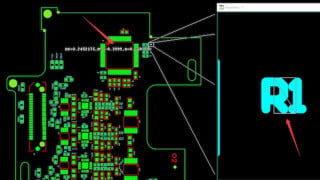
pcb 3d model
driver schematic
voltage regulator schematic
copper layout
math behind the components
 

Thread Starter

toroloco

Joined May 2, 2024
6
I forgot to add that my existing MCPCB layout features a blue channel with 16 XB-D LEDs in series at 700mA, resulting in a total forward voltage (Vf) of 51.2V. Since I couldn’t find 60V 2A, or 54V adapters, I’m considering using a 52V 2A PoE adapter or something similar. Do you think that using a PoE adapter or a regular adapter would be a suitable alternative?

To stay within the input voltage range, I’m also thinking about running the LED string at a lower current (around 500mA), reducing the Vf per LED to approximately 3V. With 3x16 LEDs (48V).

I’m also using 2 red LEDs with a Vf of 2.6V and 2 green LEDs with a Vf of 3.2V (mostly XB-D Cree LEDs). For the red channel, it totals to 5.2V. Since FS is the switching frequency of the driver, with 48V in and 500kHz switching frequency (40K Rfs) the minimum output voltage is 9.6V, and If I raise the frequency to 1MHz the minimum voltage is 19.2V, or 250kHz is 4.8V. So I'd have to calculate the inductor value for any given frequency based on how much ripple current I’d need. So I changed the switching frequency for the red channel to 250hz instead of 500hz to be able to run fewer leds.

Would that be a good idea? I would appreciate any help ...
 

Sensacell

Joined Jun 19, 2012
3,767
Many details here, but zero information about what this is?
Perhaps a bit more context will help draw in other opinions.
 

Thread Starter

toroloco

Joined May 2, 2024
6
Many details here, but zero information about what this is?
Perhaps a bit more context will help draw in other opinions.
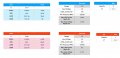
I’m designing a PCB for an aquarium light. The PCB will include a microcontroller to manage five LED channels. Additionally, there’ll be a step-down voltage regulator to power the controller and a 5V fan for cooling the LEDs. You can click on the links to see the schematics and Pcb design.

pcb 3d model
driver schematic
voltage regulator schematic
copper layout
math behind the components

Please let me know if I’m being clear, I would appreciate any help with the circuit.
 
Last edited:

Thread Starter

toroloco

Joined May 2, 2024
6
I'm seeking a cost-effective alternative power supply for the LM3414HV LED driver. I've found a 56V adapter on AliExpress that might work, but I'm unsure about deviating from the original design.
https://a.aliexpress.com/_mLhYJuG

So my project consists of 5 LED strings, one of them has 16 Cree LEDs in series. With a forward voltage (Vf) of 3.2V per LED, that string requires 51.2V. I originally planned for a 52V supply, but I'm now considering this 56V option.

However, changing the power supply would affect the LED current ripple (originally max 500mA) and input voltage ripple (originally max 200mV). It would also necessitate changes to inductor and capacitor values.

Is it feasible to use this 56V supply with adjusted component values? Specifically, would reducing the LED current ripple to 225mA and the input voltage ripple to 110mV cause any issues?

I'd appreciate any insights on whether this modification is advisable and what potential problems I might encounter.
 

MisterBill2

Joined Jan 23, 2018
27,159
A 56 volt supply with a suitable current limiting resistor will work quite well, if the current capability is adequate. The current ripple will probably not be noticeable if you are using the LEDs for illumination.
You mention both voltage ripple and current ripple and what is the source of those numbers??That part makes no sense at all to me.
The listing in the link is the typical with not much value at all. It mentions nothing at all about ripple in the output DC. So where do those numbers come from???
 

Thread Starter

toroloco

Joined May 2, 2024
6
A 56 volt supply with a suitable current limiting resistor will work quite well, if the current capability is adequate. The current ripple will probably not be noticeable if you are using the LEDs for illumination.
You mention both voltage ripple and current ripple and what is the source of those numbers??That part makes no sense at all to me.
The listing in the link is the typical with not much value at all. It mentions nothing at all about ripple in the output DC. So where do those numbers come from???
Thank you for your response. These numbers actually come from the LM3414HV datasheet, not the power supply listing. The LM3414HV datasheet provides an example circuit design with calculations for LED current ripple and input voltage ripple. I was referencing these values from the datasheet example, not from the power supply itself.

IMG_0009.jpegIMG_0008.jpegMy concern was about how changing the power supply voltage and potentially adjusting component values (like inductors and capacitors) in the LED driver circuit might affect these ripple characteristics as calculated in the datasheet example.

Do you have any thoughts on how using a 56V supply instead of 52V might affect the overall circuit design and performance when using the LM3414HV? Should I be concerned about recalculating these ripple values if I change the supply voltage and adjust other components?
 

MisterBill2

Joined Jan 23, 2018
27,159
A believable data sheet would be a good start. Look at the switching frequencies given. If they were given in Hertz they could be believable, but not megahertz. So at that point it seems that the presented data sheet might be a work of fiction. Certainly it does not look like any manufacturer's data sheet I have ever seen.

But as for the various ripple numbers, none of that will be visible to any living creature because of the frequency, even if it is in hertz.

So finding a real data sheet would be the first order of business. This "data sheet" looks a lot like a work of fiction!
 

Thread Starter

toroloco

Joined May 2, 2024
6
I want to clarify that the datasheet I'm referring to is the official Texas Instruments datasheet for the LM3414HV, which is a genuine product from a reputable manufacturer. (You can find it on Texas Instruments' official website).

I've reviewed the LM3414/HV datasheet from Texas Instruments again, and I can confirm that the switching frequency is indeed 500 kHz, not in the MHz range.

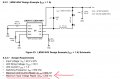
I've attached an image from the datasheet showing the design requirements, which includes:

- Switching Frequency: fsw = 500 kHz
- Maximum LED Current Ripple: ΔiL-PP ≤ 500 mA
- Maximum Input Voltage Ripple: ΔVIN ≤ 200 mV

These are the values I was referring to in my original post. My main concern is still about how using a 56V supply instead of the designed 48V ±10% might affect these parameters and overall circuit performance.

Given this clarification, do you have any insights on how I might need to adjust the circuit design to accommodate the higher input voltage while maintaining proper LED current control and minimizing ripple?
 

MisterBill2

Joined Jan 23, 2018
27,159
OK, so if you have selected the current that you want to operate the LED string at, chose a resistor to drop 8 volts at that current and put that in series with the 56 volt supply connection.
I suggest not running the LEDs at the maximum allowable current because that is a limit, not a recommended value. A lower current will extend the LED life, save power, and any reduction in brightness will only be discerned with good measuring equipment. That is to say it will not be noticeable. and it will allow for component tolerance as well.
 
Top