secrets for solenoid construction?

MisterBill2

Joined Jan 23, 2018
28,371
A fuel injector solenoid housing is the ferrous frame that completes the magnetic circuit. Asco solenoid valves are a special case because they open a port at the start of their stroke, the rest of the plunger movement is just getting out of the way. And the automotive starter solenoid also drives a fork to engage the pinion on many models. But ALWAYS that copper contact disk has a spring load that the plunger compresses a bit after it makes contact. If that did not happen then contact bounce would lead to welded contacts quite often.
 

MisterBill2

Joined Jan 23, 2018
28,371
Back when I was in the fifth grade my uncle gave me a solenoid and transformer that had been damaged in shipping to where he worked, and so they could not be used. All that was wrong with the transformer was a broken terminal strip and bent brackets for mounting it. I have no idea what the problem with the solenoid was, but it worked for me. THAT was a serious solenoid, it ran on 550 volts and 1/2 amp, according to the tag, the transformer had two tapped windings, one included 120 volts and the other included 460, which I decided was close enough to 550. And it was about a 750 watt size. So the transformer fed the solenoid power stepped up from the line. It only had a half inch stroke, and the whole thing was about 4 inches by 5 inches and 4 inches high. The stroke was a rectangular rod that poked out the top, and with it sitting on the floor and a baseball sitting over the rod, it would send the baseball up to hit the basement ceiling. It also made a bit of noise. Lots of fun for a fifth grader, indeed.
Now THAT was a solenoid!!
 

shortbus

Joined Sep 30, 2009
10,049
A fuel injector solenoid housing is the ferrous frame that completes the magnetic circuit
None I've ever changed did, Other than the seat for the pintle, it is all a molded plastic case

nd the automotive starter solenoid also drives a fork to engage the pinion on many models. But ALWAYS that copper contact disk has a spring load that the plunger compresses a bit after it makes contact.
Any starter that has an attached solenoid moves the fork. and the spring just keeps the contacts from smashing, there is none of those "magnetic stop things" at the bottom of the actual solenoid, that are supposedly needed to move the armature.

All of this I've talked about is in GM cars though don't know about other makes.
 

cmartinez

Joined Jan 17, 2007
8,862
None I've ever changed did, Other than the seat for the pintle, it is all a molded plastic case


Any starter that has an attached solenoid moves the fork. and the spring just keeps the contacts from smashing, there is none of those "magnetic stop things" at the bottom of the actual solenoid, that are supposedly needed to move the armature.

All of this I've talked about is in GM cars though don't know about other makes.
I've disassembled (and even x-rayed) diesel engine actuators, which are in charge of fuel dispensing and timing adjustment. And all of them were encased in some sort of non-conducting phenolic material. So yes, I too think that a metallic shell around the solenoid makes no difference whatsoever in the force that is induced on the plunger. It's the plunger's shape and material that matters.
 
Last edited:

shortbus

Joined Sep 30, 2009
10,049
Ive disassembled (and even x-rayed) diesel engine actuators, which are in charge of fuel dispensing and timing adjustment. And all of them were encased in some sort of non-conducting phenolic material. So yes, I too think that a metallic shell around the solenoid makes no difference whatsoever in the force that is induced on the plunger. It's the plunger's shape and material that matters.
The bigger thing than the "back iron", what the magnetic shell is called, is the amount of the armature/ plunger that is in the coil when turned first turned on. That is what makes a starter solenoid so powerful it is partially in the coil when at rest. A little thing called reluctance I think.
 
Last edited:

shortbus

Joined Sep 30, 2009
10,049
Don't know if it would work for a solenoid, since it's for an electromagnet, like in the relay shown with it in the force calculation area. While an electromagnet uses a coil it's not the same as a solenoid for movement. Though technically any coil of wire is called a solenoid.
 

shortbus

Joined Sep 30, 2009
10,049
Unless it's a toroid??
And how about a non-inductively wound resistor, its a coiled bunch of wire, but should not have any significant inductance ;)
If that is what we were talking about they wouldn't qualify.

"A solenoid (/ˈsoʊlənɔɪd/,[1] from the French solénoïde, a modern coinage based on Greek σωληνοειδής sōlēnoeidḗs "pipe-shaped"[2]) is a coil wound into a tightly packed helix. The term was invented in 1823 by André-Marie Ampère to designate a helical coil." From - https://en.wikipedia.org/wiki/Solenoid
 

cmartinez

Joined Jan 17, 2007
8,862
Well I'm back ....

@strantor , I think you will find this post of your interest. I remember you mentioning something related to this subject in the past, if I'm not mistaken.

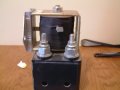
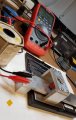
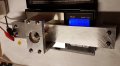
Finally, I took the time to perform this experiment. I tested a small solenoid I recently built using two different materials for the plunger. The first one is ordinary 4045 steel, and the second one is an AlNiCo magnet having the exact same dimensions as the first.

It's evident that there's an advantage when using a magnet for the plunger instead of plain steel. Especially at low voltages, the forces generated can be three times as large when using a magnet. I did not test the device with a neodymium magnet because I don't have any available at this moment, but I'm sure that could make a difference as well, although I can't guess how large.

Below you will find the results, and a few pics that should explain the complete setup. I made the measurements several times on each set point and observed a maximum difference of about 0.2 grams between tests. Also, at higher voltages (at about 6 volts and beyond), the reading peaked at first, and then went slowly but steadily down. Which was expected because as the wire warms up its resistivity also goes up, and therefore current goes down, decreasing the intensity of the magnetic field.

Next I'm going to experiment using the same setup, but this time installing an steel jacket (a cylinder) on the solenoid. I want to see if it affects its behavior.

upload_2019-7-31_15-13-14.png


Image00002.jpg

Image00001.jpg

Image00003.jpg
​
 
Last edited:

shortbus

Joined Sep 30, 2009
10,049
Finally, I took the time to perform this experiment. I tested a small solenoid I recently built using two different materials for the plunger. The first one is ordinary 4045 steel, and the second one is an AlNiCo magnet having the exact same dimensions as the first.
But using the PM for the plunger also make the coil pole sensitive, where the iron one isn't. I have also seen a true "push-pull" solenoid done with a magnetic plunger. Two PMs with opposite poles and none magnetic center section, energize the coil one direction and it pulls, energize the other way and it pushes.
 

cmartinez

Joined Jan 17, 2007
8,862
But using the PM for the plunger also make the coil pole sensitive, where the iron one isn't. I have also seen a true "push-pull" solenoid done with a magnetic plunger. Two PMs with opposite poles and none magnetic center section, energize the coil one direction and it pulls, energize the other way and it pushes.
Yes, that is an advantage in some applications, although mine does not need that feature and in fact adds the activity of having to verify the magnet's orientation prior to installing it.

Other than that, I'm quite happy because my application needs to be energy efficient and also works at low voltages. So using a magnet for the plunger gives it an important boost.
 
Top