Seamlessly switching between batteries

Thread Starter

cmartinez

Joined Jan 17, 2007
8,768
Good call. That could give you even better data.
Measuring voltage across it could tell you if it had enough voltage to fire and drew enough current to not be an open circuit, but actually measuring current could additionally tell you if it drew enough current to actually actuate (not weak) or drew so much current that something is wrong (shorted coil, plunger failed to move).


I would go with a latching relay but I've been known to favor overly primitive means with little justification. Others have suggested fets and that seems reasonable. Is there something holding you back from using fets? My apologies if this has been answered already, I might have missed it.
Nothing is holding me back from fets ... in fact I'd better much prefer to use them instead of relays. My question pertains the proper configuration for a circuit to kick in as fast as possible and with as little power draw while idle when battery bank B is connected/removed
 

strantor

Joined Oct 3, 2010
6,875
Nothing is holding me back from fets ... in fact I'd better much prefer to use them instead of relays. My question pertains the proper configuration for a circuit to kick in as fast as possible and with as little power draw while idle when battery bank B is connected/removed
Well a latching relay would use zero power while connected, but I understand your preference, and space constraints. A capacitor with enough charge to ride through the changeover seems sufficient for either scenario, or do you not think so?
 

Thread Starter

cmartinez

Joined Jan 17, 2007
8,768
Well a latching relay would use zero power while connected, but I understand your preference, and space constraints. A capacitor with enough charge to ride through the changeover seems sufficient for either scenario, or do you not think so?
Your suggestion is a good possibility... and perhaps it's also the simplest one ... gonna mull it over
 

strantor

Joined Oct 3, 2010
6,875
Your suggestion is a good possibility... and perhaps it's also the simplest one ... gonna mull it over
Take this one for example:

Screenshot_20221031-103110_Drive.jpg
Screenshot_20221031-102755_Drive.jpg

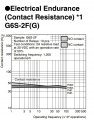
Coil requires 33.3mA for 10ms to switch. After that your power dissipation is just a function of whatever is the voltage drop across the contacts. Datasheet lists 75mΩ max, but if you check the charts further down you'll see its typically closer to 40mΩ which is equivalent to about 3" of 1mm PCB trace.

Screenshot_20221031-105237_Drive.jpg

When you compare this to the RDsON spec of MOSFETS, keep in mind that semiconductor manufacturers almost always provide this spec for the semiconductor junction alone, and it does not include the additional resistance of the package. You'll usually have to look up the specs of the package and do some math for an apples-to-apples comparison.

This was just the first result in my search. There are probably lower power options with lower contact resistance. Here are some more options.
 

Thread Starter

cmartinez

Joined Jan 17, 2007
8,768
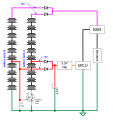
Ok, here's my first attempt at something simple and possibly workable:

1667260943240.png

The key to the schematic shown above is that the nFet I'd be using is of the Depletion Mode type.

The arrangement would draw 0.6 µA from the lower part of battery bank B, but that would be acceptable. My main concern is if the 10M resistor will be quick enough to pull the nFet's gate to ground when bank B is disconnected before the big fat cap runs out of juice while battery bank A kicks in.
 
Last edited:

Thread Starter

cmartinez

Joined Jan 17, 2007
8,768
I am assuming that the lack of comments so far about my last post mean that there's a general agreement that things might work the way I'd like them to?
 

MrSalts

Joined Apr 2, 2020
2,767
If you have a spare pin on your MCU, you can connect it to the Gate of an N-channel Mosfet. Keep it as a High Z input until you want it to quickly switch the Mosfet low.
 

crutschow

Joined Mar 14, 2008
38,520
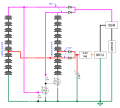
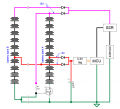
the diodes in the middle (6V) are a necessity, right?
On second thought, you do need the top diodes since there is a sneak path through the Bank A battery to the MCU regulator.
And the middle diodes prevent a sneak path in the reverse direction.
Use Schottky diodes for minimum forward voltage drop.

But if you ran the MCU from the 15V, you wouldn't need any diodes.
I see no significant difference in battery life by doing that.
 
Top