Sanibroyeur (macerator) at lower height than toilet

Thread Starter

mullingover

Joined Nov 25, 2025
25
Hi all. Given this is a question associated with sensors on an electrical device (albeit one for plumbing), I hope I have this question in the right place.

I've installed 2 macerators with success in the past. Now a friend has a problem with her normal toilet evacuation pipes getting blocked (long distance and gradient is lost = waste blocks pipes).

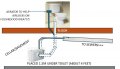
I suggested a Sanibroyeur (macerator), bypassing the poor gradient waste pipes and going into one with a good gradient. The trouble is, there's no space for it behind her toilet. However, the level beneath is the cellar/basement. So I had the idea of the toilet flushing down the normal width wastepipe but then going into the macerator in the cellar (see diagram....illustration only, not the actual toilet). This is better for noise (it's a medical practice), and solves the lack of space issue.

But the problem is, the instructions are quite clear about the macerator being at same level as toilet exit pipe, and no being lower. I don't understand why, but wonder if this may have something to do with air locks that mess up the sensors? Long shit here, but has anyone tried this before?
 

Attachments

... the instructions are quite clear about the macerator being at same level as toilet exit pipe, and not being lower. I don't understand why, but wonder if this may have something to do with air locks that mess up the sensors?
I don't think that internal sensors are an issue. I mean, air flow and sensor placement very likely were designed to prevent vapor-lock/microswitch interference, and the system passed certification.

In USA, the NEC (National Electrical Code) prohibits placing an electrical appliance directly below a toilet. As an example, the horizontal exclusion zone of a shower is 3 feet from all perimeter boundaries. A quick search shows plenty of rules governing the separation of water and electrical sytems.

Anyway, a random guess by someone not licensed to do installation work is that the manufacturer is motivated to say "NEVER" for reasons of building-code and indemnity. My opinion is that the internal sensors' performance is otherwise not affected.
 

Thread Starter

mullingover

Joined Nov 25, 2025
25
In USA, the NEC (National Electrical Code) prohibits placing an electrical appliance directly below a toilet.
Thanks for your reply. These regulations do not apply in France. There are zones to respect if devices (or electrical sockets) are in the same room, but not if in another room (the room below, in this case). Although the US regulations you mention do make good sense. I follow regulations and even go a step further as much as I can. For example, the macerator can always be offset away from above, potential, leakage. In saying that, it is a "water device" by design that will be earthed and connected to appropriate breaker. Perhaps in an electrical sense, it's even safer being away from direct contact.

I agree with you that the design takes into account airflow. Providing airlocks are accountant for to allow a quick drop of waste and water together (so, similar/same as coming straight out of the toilet), I cannot see why it would not operate as normal. In the case of EU regulations and France specifically, I believe rather than a safety factor this may be more a case the manufacturers cover themselves with an installation schema that ensures they don't get complaints from customers who end up with blocked pipework (because they didn't install with a method to prevent airlocks). I appreciate your reply as it helps re-affirm my thoughts that airflow is probably the main factor. I think it's worth the try and I'll return to this thread with an update.
 
Last edited:

MisterBill2

Joined Jan 23, 2018
27,311
I suggest installing the MACERATOR device eo that the vertical liftfor the discharge be the minimum possible, witha minimum of flow restrictions.
 

Thread Starter

mullingover

Joined Nov 25, 2025
25
I suggest installing the MACERATOR device eo that the vertical liftfor the discharge be the minimum possible, witha minimum of flow restrictions.
Thank you. With no bends in a 32mm waste pipe, it boasts of a 10 meter lift. With each bend, 1 meter is to be deducted from the lift. But it only needs to 3 meters and 2 bends to reach main soil pipe. I think this may all work out but will come back with feedback.
 

MisterBill2

Joined Jan 23, 2018
27,311
I see no electrical issues with any portion of the post, nor any questions about the electrical connections. SO, why is this post here???
 

MisterBill2

Joined Jan 23, 2018
27,311
Thank you for your clearly lovely, not at all hostile, in fact beautiful and kind message. These act on sensors, the device electrical. This is posted in the " Sensor Design & Implementation" section. Thank you.
OK, so certainly there are some sensors involved. And certainly they must be able to operate reliably for many years. While this application is quite demanding, and rather less common than most applications, the presentation of what was done to assurethe survival of the sensors is what I fail to see. THAT would be very interesting, in my opinion.
 

Thread Starter

mullingover

Joined Nov 25, 2025
25
OK, so certainly there are some sensors involved. And certainly they must be able to operate reliably for many years. While this application is quite demanding, and rather less common than most applications, the presentation of what was done to assurethe survival of the sensors is what I fail to see. THAT would be very interesting, in my opinion.
Good points. This was my worry, if there's an airlock my worry is water will drop first, leaving too much drying waste. In turn, such bolus of dry waste is going to put demand on components/sensors. I think this is a case of electrics world meets plumbing world :)
 
Top