Samsung 40" LED TV backlight issue

Thread Starter

WhoTnT

Joined Sep 18, 2016
8
Skip to the question below if you don't care about the details ;)

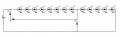
The bottom half of the backlight in my TV went off so I opened it up to see if I could fix it. I found four of the 7 bars of LEDs were not working and narrowed down the problem to one of the bars. There were two bad diodes on the bar(D1,D2 in image attachment below) so I tried replacing them with two that I took off a computer motherboard. All four bars that were not working before lit up but only the last five LEDs on the bar with the replaced diodes were lighting. After testing the individual LEDs it turned out that L1 was dead and the two "new" diodes I put in was also bad so current was only flowing through the two bad diodes in reverse and lighting the last 5 LEDs. I removed D2 and a bypassed L1 with a piece of wire and now all LEDs are lighting except the bad LED 1. What was also strange was that one bar was affecting 4 bars even though each bar has individual positive and negative traces and wires going to the circuit board behind the TV.

Question: What is the purpose of the diodes D1-3 in this circuit because they seem pointless to me? I just want to know if it would be safe to leave the diode section disconnected with the bypassed L1 until I can find a LED bar to buy.
Samsung-LED-TV-backlight-bar.png
 

R!f@@

Joined Apr 2, 2009
10,004
Go to http://www.badcaps.net/forum/ and ask this in the TV Repair forum. There are some TV repair pros who might be able to give you a good answer to this question.
Why ... ?
AAC does not have those kinda members.
I repair LCD's for living.

Did you replace with exact type of LED.
I have replaced these kinda LED's. Needs to be exact type and it's heat tab under the LED NEEDS to be soldered to dissipate heat.
4 strip might not work with a bad strip cause it might be driven by a common IC. If IC detects abnormal current in 1 strip it just shuts down the whole output.
As for diodes I never came across diodes in the LED strip.

And yes bypassing will cause an abnormal current most of the time.
So it might light with a separate supply but in TV it might just blink and shut down
 

Thread Starter

WhoTnT

Joined Sep 18, 2016
8
Why ... ?
AAC does not have those kinda members.
I repair LCD's for living.

Did you replace with exact type of LED.
I have replaced these kinda LED's. Needs to be exact type and it's heat tab under the LED NEEDS to be soldered to dissipate heat.
4 strip might not work with a bad strip cause it might be driven by a common IC. If IC detects abnormal current in 1 strip it just shuts down the whole output.
As for diodes I never came across diodes in the LED strip.

And yes bypassing will cause an abnormal current most of the time.
So it might light with a separate supply but in TV it might just blink and shut down
I never replaced the bad LED. I just bypassed it with a piece of wire to test it in the TV. I did try to replace the diodes but it seems that I replaced it with bad diodes. Removing bad diode 1 or 2 allowed the whole bar to light up except the bypassed bad LED in the TV.
A member on stackexchange suggested that the diodes are there to protect the LEDs against possible reverse voltage and it seems to make sense based on their configuration in the diagram. Note that the bar is split into two pieces and D3 is on the second part of the bar with 5 LEDs.

I'm thinking to use a diode instead of the wire to bypass the bad LED until I can find a replacement LED bar.

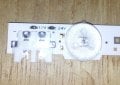
Diodes D1 and D2 on the bar:
20160918_173157.jpg

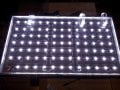
LEDs lighting with bypassed bad LED and removed diode D2:
20160918_222519.jpg
 

R!f@@

Joined Apr 2, 2009
10,004
I dunno how long the driver will survive with a bad LED. Since the LED current will increase a bit with one LED bypassed in the string.
 

Thread Starter

WhoTnT

Joined Sep 18, 2016
8
I dunno how long the driver will survive with a bad LED. Since the LED current will increase a bit with one LED bypassed in the string.
Considering I cannot see a difference in the brightness of the LEDs I expect that the increase wouldn't be much. If I replace the LED with a normal diode, would that fix the current problem? Thanks for all your input.
 

gerty

Joined Aug 30, 2007
1,305
Considering I cannot see a difference in the brightness of the LEDs I expect that the increase wouldn't be much. If I replace the LED with a normal diode, would that fix the current problem? Thanks for all your input.
If you measure the voltage across one of the good leds you should see something like 2-3 volts, give or take.. The voltage drop across your average silicone diode is approx .7 volts, to answer your question, no, a "normal diode" will not work so well.
 

Thread Starter

WhoTnT

Joined Sep 18, 2016
8
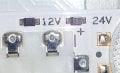
The following is a close up of the good diodes D1 and D2 from another LED bar. Is there anyone who can identify them? I looked up the SMD diode code BB assuming that was the code and that is a Zener diode but why does one have and L and the other a T on it?

DiodesCloseUp.jpg
 

SLK001

Joined Nov 29, 2011
1,549
The "T" and the "L" could signify the manufacturing plant, or date code. Do all the strips have the same T and L on the diodes in the same locations?
 

Thread Starter

WhoTnT

Joined Sep 18, 2016
8
The "T" and the "L" could signify the manufacturing plant, or date code. Do all the strips have the same T and L on the diodes in the same locations?
Yeah they are in the same position on all the bars. With my basic understanding of Zener diodes and circuits, I'm thinking that they may not be Zener diodes. When I measure the voltage across the supply to the working bars I get around 39v and 3v across each of the 13 LEDs. I'm not sure if this question makes sense but would Zener diodes rated at 3.6v in the those locations allow for 39v across the supply?
 

Thread Starter

WhoTnT

Joined Sep 18, 2016
8
If you measure the voltage across one of the good leds you should see something like 2-3 volts, give or take.. The voltage drop across your average silicone diode is approx .7 volts, to answer your question, no, a "normal diode" will not work so well.
I guess I could try to remove the surface mount LED and replace it with a covered normal LED so I don't get a bright spot. Do you have any suggestions as to what I can use other than an LED to get the same voltage drop?
 

R!f@@

Joined Apr 2, 2009
10,004
Putting another LED will cause the screen to have a different colored spot around that area. The LED has specific color temperature. It is best to salvage one from a similar TV. Or by the part from china. Keep in mind that this is the beginning. The LED's will die out one by one in due time
 

gerty

Joined Aug 30, 2007
1,305
Putting another LED will cause the screen to have a different colored spot around that area. The LED has specific color temperature. It is best to salvage one from a similar TV. Or by the part from china. Keep in mind that this is the beginning. The LED's will die out one by one in due time
If you can live with what R!f@@ said, and it'll fit in the space you could try that. But ultimately the right thing to do is replace with the proper led.
 

Thread Starter

WhoTnT

Joined Sep 18, 2016
8
Hey guys. I just wanted to say thank you for all the input. I ended up stringing together 4 diodes in series to bypass the bad LED and I found two diodes to replace d1 and d2 even though the strip was working without them. Now all the strips have the same voltage drop of about 39v and the TV has been working for a couple hours now. There just a barely noticeable dark area on the bottom left of the screen so I will use it like that until I find an LED strip to buy. If I don't find the same strip, I saw a guy on youtube replacing the bad LED with an easy method that I might try. Here's the video that may help others with this problem. He's basically removing the old LED, cutting the new strip on both sides of an LED and stacking the piece of strip with the LED on top of the strip with the bad LED and connecting them with wires.
 

Stb75

Joined Dec 27, 2016
3
Hey guys. I just wanted to say thank you for all the input. I ended up stringing together 4 diodes in series to bypass the bad LED and I found two diodes to replace d1 and d2 even though the strip was working without them. Now all the strips have the same voltage drop of about 39v and the TV has been working for a couple hours now. There just a barely noticeable dark area on the bottom left of the screen so I will use it like that until I find an LED strip to buy. If I don't find the same strip, I saw a guy on youtube replacing the bad LED with an easy method that I might try. Here's the video that may help others with this problem. He's basically removing the old LED, cutting the new strip on both sides of an LED and stacking the piece of strip with the LED on top of the strip with the bad LED and connecting them with wires.
What device did you use to replace D1 and D2?
I have the exact same set and have not found what to replace them with.
I replaced the LEDs using a donor set

Thanks!
 
Last edited by a moderator:

JUNELER

Joined Jul 13, 2015
183
Hi,

I think even w/o D1/D2/D3 those led will lit on. Not like in the any inductor coil (relay) needs it .
very rare to experience a reverse voltage happened due to the supply is at dc level.

And also D3 is not a zener if the schematic is D3 label see the cathode ( / ) not like (z )look like.

Thanks for the video clips it seem good to me.
 
Top