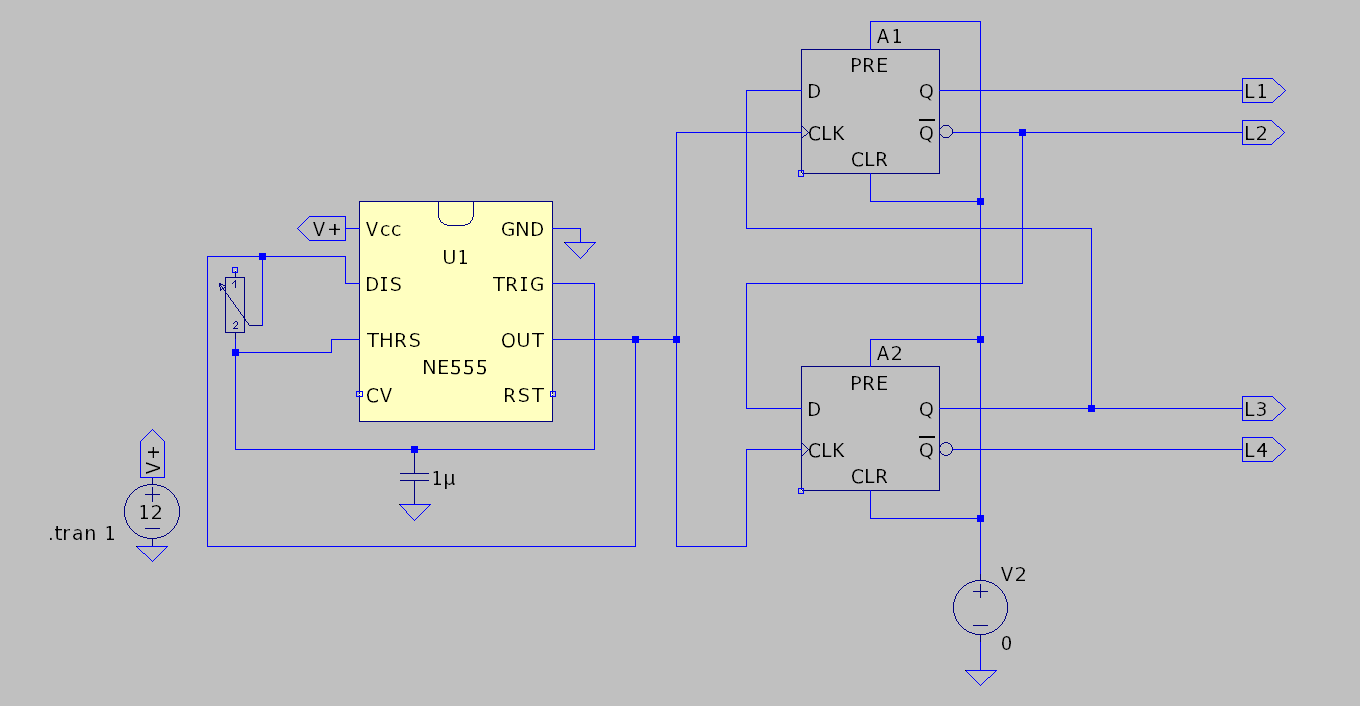
If you want to keep a 50% duty cycle over a range of frequencies the easy way is to run the oscillator at twice the frequency and drive a flipflop IC with the pulse train. Not only does this assure a constant 50% duty cycle, it also provides a complement signal as well.
I would call it an astable with a divide by two circuit. It was quite common for providing a clock signal plus a complement clock signal a while back. It is still a good choice for obtaining symetrical square waves.
Specifically, the CD4013 flipflop triggers on the rising edge of the trigger pulse. The only down side is that the 555 does need to run at twice the desired pulse rate.
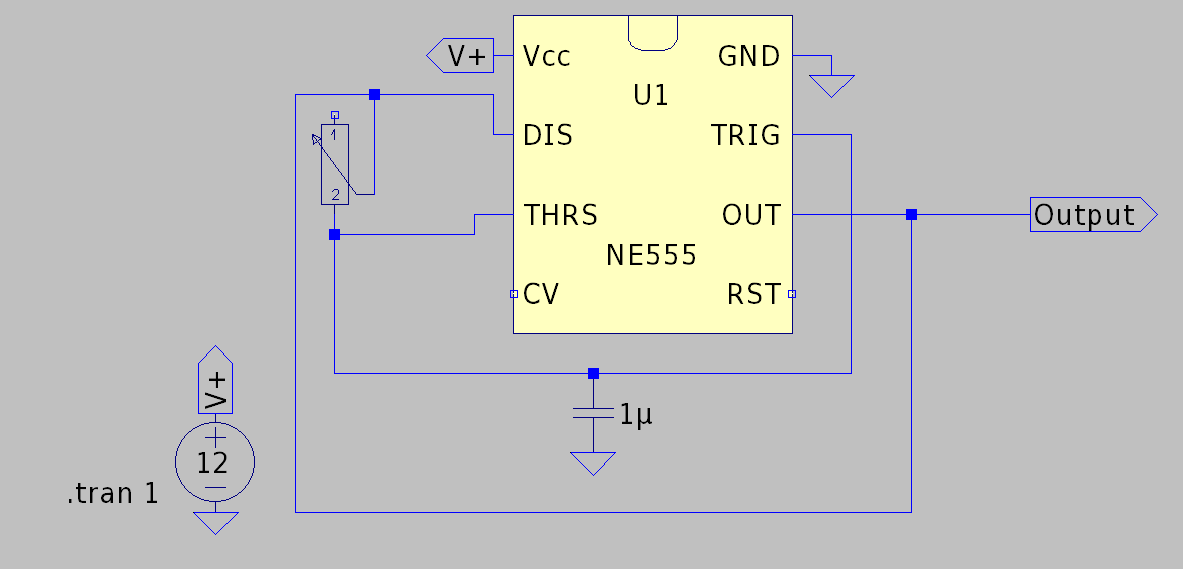
The nice thing about the circuit in post #3 is that you don't need another chip; one 555 does it all. Note that the output duty cycle is not *exactly* 50/50, but it is not for either of the circuits in post #1, either. The output duty cycle will be closer to 50/50 with a CMOS 555 (LMC555) than with a bipolar one (LM555, NE555, MC555, etc.).
The nice thing about the circuit in post #3 is that you don't need another chip; one 555 does it all. Note that the output duty cycle is not *exactly* 50/50, but it is not for either of the circuits in post #1, either. The output duty cycle will be closer to 50/50 with a CMOS 555 (LMC555) than with a bipolar one (LM555, NE555, MC555, etc.).
A second IC, for less than a dollar, and no additional components, and getting EXACTLY a 50% duty cycle over a very wide frequency rang, plus the complement term is a cheap price. Being exactly right for just a bit more, with a large dynamic range, is no a bad deal.
Depends on the Index Of Good-Enough-Ness. If 52/48 or 51/49 are good enough, then tripling the semiconductor cost and real estate are costs with no associated benefits. If you want to drive an LED, losing the 555's 200 mA output stage is a net loss of function. Also, an undiscussed feature of the hysteretic 555 circuit is that the discharge pin is unused. With one pull up resistor it becomes a complimentary output.
There is no mention of an issue or problem with output symmetry in the TS question, so I see the 50/50/flipflop talk as a straw man diversion.
Speaking of the original question ...
1. No, there is no need for a dual pot.
2. In both circuits, diode D1 makes the circuit output asymmetrical (not 50/50 duty cycle). The asymmetry increases when the circuit is run on lower and lower voltages.
3. If you want the duty cycle to stay fixed at (near) 50/50 while varying the frequency, then the circuit in post #3 is better than either one in post #1.
The TS mentioned that the simulator produced a constant 50% duty cycle at all settings. There is no mention of driving an LED with the output..
And while "close enough" may be good enough, a response to provide exactly the sought-after function was reasonable. An example is driving a synchronous detector, where the 50% duty cycle is certainly required for best performance.
No. It is because the diode has a voltage drop across it, so the high state output voltage on pin 3, which is the source for charging up the capacitor, is reduced by 0.7 V.
For a perfect 50/50 output, the charge and discharge voltages must be equidistant from the power mid-point. With Vcc = 15 V, the midpoint is 7.5 V. A typical 555 low output voltage is around 0.5 V, but the high output is only 13.5 V, not 14.5 V for symmetry. So the output is not symmetrical to start, and the output wave will not be 50/50. Reducing the high output voltage by another 0.7 V makes the asymmetry even worse. This is why the circuit in post #3 is the best this technique can do. Note that we're talking about a duty cycle change of a couple of percent, not a big deal most of the time.
Nothing, ever, will be as popular as the 555. It is 47 years old, and was the first IC ever to sell 100,000, 1 million, and 1 billion pieces (per year). In 2003 it sold 1 billion pieces world wide. Hans Camenzind was paid $1200 to develop it. The chip was his idea.
Side note - for those of you who think Class D (switching) audio power amplifiers are all the hot thing,,,, Hans designed one in 1962. Smart guy.
I recall seeing a switching amplifier article in "Radio Electronics" magazine some time around that era. What I recall is that version was fairly complex and used several expensive transistors. Or it may have been closer to 1965 or so. A good design published will often encourage others to experiment.
AND as for the 555, with that kind of head start others wind up being "Me Too" at best. The 555 offers a whole lot of advantages over the CD4047, which was an earlier CMOS IC that had some similar capabilities. The 555 offered a set of abilities that was different from anything else available at the time. It was exactly the right product at exactly the right time.
How close will this get to 50% duty up to 1Mhz if its
1. driving a high impedance load (gate driver or some other stuff)
2. its a cmos 555
3. driven below its max supply voltage
On many instances a circuit will work perfectly in simulation, but in the physical implementation the results are not quite so perfect. Then adjusting real world values to get back to what is wanted becomes a bit tedious.That is why I suggested using the 4013 flipflop.If a bit more drive is needed then it can run on a higher voltage, within limits. And if a lot more current sinking is required then add a 4049 or a 4050, with all six sections in parallel. Running on 12 volts that can sink a whole lot of current. Yes, still another device, but no other parts extra. And unless one is creating some consumer thing the extra package is a very small expense.
More packages but much simpler to get the exact results with no tweaking at all.
They can sink a fair amount of current, especially when run at a higher voltage, 12 or 15 volts. That allows the internal transistors to saturate more than at 5 volts. And the FF shown is not a 4013. Set and reset would need to be pulled LOW on a CMOS CD4013./ MC14013.

 Facebook
 Google
 GitHub
 Linkedin