[S.T. - 8] Application circuits for BJT's

WBahn

Joined Mar 31, 2012
32,878
What diode? There is no diode in the schematic you posted (unless it is in the ASC file that you posted and I'm not in the habit of downloading files that require special software to open -- post a screen capture, appropriate scaled, of the schematic you are talking about).

Have you bothered to read about various ways to implement a NAND gate?

Here's an idea: You want to learn (big assumption on my part) about why a diode might be used in a NAND gate. So Google: NAND diode. See what happens.
 

Thread Starter

PsySc0rpi0n

Joined Mar 4, 2014
1,786
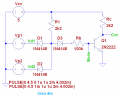
I was talking about the circuit that works as a NAND gate and not the output stage! Screen is attached!
I'm talking about D3. It's importance in the circuit! I know it has something to do with the Base-Emitter junction voltage but I would like to understand the reason!
 

Attachments

WBahn

Joined Mar 31, 2012
32,878
Have you looked at any of the webpages that come up when you Google: NAND diode?

Have you analyzed the circuit?

You don't have to do a detailed analysis. You have four possible input conditions. What are the node voltages, just assuming an ideal transistor and diode models using a constant diode voltage drop of whatever you want, say 0.7V?

What would happen if resistors were used instead of diodes?
 

Thread Starter

PsySc0rpi0n

Joined Mar 4, 2014
1,786
Have you looked at any of the webpages that come up when you Google: NAND diode?

Have you analyzed the circuit?

You don't have to do a detailed analysis. You have four possible input conditions. What are the node voltages, just assuming an ideal transistor and diode models using a constant diode voltage drop of whatever you want, say 0.7V?

What would happen if resistors were used instead of diodes?
Is that kind of analysis that I'm not very comfortable with. That's why I'm asking help! I can't figure out (understand) how to interpret voltage changes in that node between D1 and D3.
 

WBahn

Joined Mar 31, 2012
32,878
Is that kind of analysis that I'm not very comfortable with. That's why I'm asking help! I can't figure out (understand) how to interpret voltage changes in that node between D1 and D3.
It's one thing to not be comfortable with something -- that's why you are taking the course -- but it's quite another to not even make an attempt and expect strangers to just spoon feed you. We are seeing basically zero effort on your part. You won't even TRY to offer an explanation for how the circuit should behave.

In this case, forget about D3 and everything to the right of it. Erase it for now. If both input voltage are low, what voltage do you expect to see, roughly, at the anode of the two diodes (the node where they used to connect to D3)?
 

Thread Starter

PsySc0rpi0n

Joined Mar 4, 2014
1,786
Be sure to properly credit the note to Jony130, since this information in no way came about as a result of YOUR efforts.
Well, I can do that but when I help someone over the internet I'm not expecting that credits for that help that are given to me in any possible way, but if Jony130 want, I'll do it for sure!

Anyway, I still need help to answer to the question of the importance of that diode in the circuit! Any tips would be appreciated to finish this report that needs to be handed to teacher later today!
 

WBahn

Joined Mar 31, 2012
32,878
Well, I can do that but when I help someone over the internet I'm not expecting that credits for that help that are given to me in any possible way, but if Jony130 want, I'll do it for sure!
You totally miss the point.

Anyway, I still need help to answer to the question of the importance of that diode in the circuit! Any tips would be appreciated to finish this report that needs to be handed to teacher later today!
Still waiting for you to show at least some attempt.

But since that isn't likely and since this is coming due real soon, just give my your teacher's contact information and I'll be sure to turn your work in for you so that you don't have to worry about a thing.
 

ericgibbs

Joined Jan 29, 2010
21,448
I was talking about the circuit that works as a NAND gate and not the output stage! Screen is attached!
I'm talking about D3. It's importance in the circuit! I know it has something to do with the Base-Emitter junction voltage but I would like to understand the reason!
Hint:
Assume that the transistors Vbe On is say 0.7V and the diodes also have a Vfwd of 0.7V.
Is it possible that when the input diodes are connected to a logic '0' [ which may not be at 0V, say +100mV] would the transistor be conducting or not.?

E
 

Thread Starter

PsySc0rpi0n

Joined Mar 4, 2014
1,786
It's one thing to not be comfortable with something -- that's why you are taking the course -- but it's quite another to not even make an attempt and expect strangers to just spoon feed you. We are seeing basically zero effort on your part. You won't even TRY to offer an explanation for how the circuit should behave.

In this case, forget about D3 and everything to the right of it. Erase it for now. If both input voltage are low, what voltage do you expect to see, roughly, at the anode of the two diodes (the node where they used to connect to D3)?
You totally miss the point.


Still waiting for you to show at least some attempt.

But since that isn't likely and since this is coming due real soon, just give my your teacher's contact information and I'll be sure to turn your work in for you so that you don't have to worry about a thing.
Hey, take an easy, please. I didn't saw your previous post. I don't want you to do anything for me. And yes, I have attempted to see how the circuit behaves in that node. Just didn't posted my attempt here in the forum, ok??
If you want to help, I'll accept your help but I don't have to accept that kind of altercation towards me! I'm at work right now, so as you and everyone else has things to do in the meantime and can't answer my posts in the second after I have replied, so do I because maybe, just maybe I'm busy at work and can't answer in the second following your replies.

Hint:
Assume that the transistors Vbe On is say 0.7V and the diodes also have a Vfwd of 0.7V.
Is it possible that when the input diodes are connected to a logic '0' [ which may not be at 0V, say +100mV] would the transistor be conducting or not.?

E
WBahn, see how Mr. EricGibbs is really helpful without being harsh? I'll reply to him as soon as I can!
 

WBahn

Joined Mar 31, 2012
32,878
Anyone can claim to have done all kinds of work that they can't be bothered to show anyone. You have given no reason to believe that you have done anything of the sort because you refuse to show anything of the sort.

And EricGibbs is actually asking you to go further with the analysis than I asked you to in Posts #23 and #24. Feel free to surprise me and actually show some effort.
 

ScottWang

Joined Aug 23, 2012
7,501
This homework forum was created to help the student whom will help himself, not just get the answer directly from other members, so what the WBahn said is to executing the purpose and spiritual of this forum, there is no personal emotion and he really help many students, he just want you to learning something from your homework, so the first thing is that you should post your attempt, you also could check other student's homework to see how do they do.

The circuit has something error in your post #22.
 

Thread Starter

PsySc0rpi0n

Joined Mar 4, 2014
1,786
I have already saiud that I don't want answers. But some of you looks like can't read some of my words. Anyway, I'll try to answer to what are the voltages at that node for all 4 possibilities in diodes 1 and 2. I just want to state that no one needs to be severe as you have being. Mr. EricGibbs is doing his best and his not being that way. That's the difference!
Anyway I'm going to try to figure out the voltage at that node, let's say node X, for the 4 possibilities, but for that I need to understand what is the influence of Vcc in that node and all my questions are a lot to be asked here but I'll try.

Ok, A and B are grounded (situation 1)

In this situation, both D1 and D2 are forward biased, right? Because if they have 0V at their cathode there will be some voltage which is more positive at their anodes coming from the Vcc across the 2k2Ω resistor.
If this is correct, I should know the voltage at node X, but I don't know. But I can "shoot" a value... Will it be 1.4V that is the voltage drop across both D1 and D2 diodes from anodes to cathodes???

I'll wait for your resplies!
 

ericgibbs

Joined Jan 29, 2010
21,448
In this situation, both D1 and D2 are forward biased, right? Because if they have 0V at their cathode there will be some voltage which is more positive at their anodes coming from the Vcc across the 2k2Ω resistor.
Yes the the two input diodes connected to the 2k2 are forward biased due to the 2K2, but consider if the third diode was not present, would not the transistor be also forward biased.?
EDIT:
Providing that both diode cathodes are at 0V


If this is correct, I should know the voltage at node X, but I don't know. But I can "shoot" a value... Will it be 1.4V that is the voltage drop across both D1 and D2 diodes from anodes to cathodes???
Which node are you naming 'X', ?
 

Thread Starter

PsySc0rpi0n

Joined Mar 4, 2014
1,786
Yes the the two input diodes connected to the 2k2 are forward biased due to the 2K2, but consider if the third diode was not present, would not the transistor be also forward biased.?
EDIT:
Providing that both diode cathodes are at 0V
Before I answer, please let me know if I'm correct when I say that the voltage at node X is 1.4V.

Even without knowing the exact voltage at node X, I think that if the voltage at that node is greater than Vbe and Ib is greater than 0A, then the transistor will be conducting.

Which node are you naming 'X', ?
The node that is common to all 3 diodes at their anode!
 

ericgibbs

Joined Jan 29, 2010
21,448
OK.
If either of the two input diodes are connected to 0V, how can VX be at 1.4V, if the Vfwd of a diode is only 0.7V.??
Are the two input diodes in parallel or series.???
 

Thread Starter

PsySc0rpi0n

Joined Mar 4, 2014
1,786
OK.
If either of the two input diodes are connected to 0V, how can VX be at 1.4V, if the Vfwd of a diode is only 0.7V.??
Are the two input diodes in parallel or series.???
The diodes are in parallel. I say 1.4V because there will be a more positive voltage at node X coming from 2k2 Ω resistor, so if I place the red probe of a multimeter at node X and the black probe at any of the cathodes, I'll have ... [ups, maybe I have 0.7V at node X instead of 1.4V]. Ok, 0.7V at node X when both inputs are at 0V

So as voltage at node X is equal to Vbe, probably the transistor is cut off (but wouldn't it be also cut off with D3)!????
 

Thread Starter

PsySc0rpi0n

Joined Mar 4, 2014
1,786
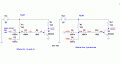
Look at this image and tell me what you think the voltages are for the two circuits.
The questions are on the image.
Ok, a friend of mine gave me some "live" help wich is better than replying in foruns and wait for the reply...

For Fig #1

When both input diodes are grounded, Vx = 0.7V because if I place a red probe of a multimeter at node X and the black probe at GND, I'll be neasuring voltage drop across diodes.
Vy I think it will be 0V because D3 drops the 0.7V existing in Vx.
Vb I think will be also 0V.

If both diodes are with their cathode to the +Vcc then they will be reverse biased because the voltage is equal at cathode and anode, so they do not conduct. In this case, I think Vx = 0V and D3 will be reverse biased because voltage in anode is equal to cathode which is 0V...
 
Last edited:

WBahn

Joined Mar 31, 2012
32,878
What about when one diode cathode is at 0V and the other is at Vcc?

Taking the case with both diodes at 0V and Vx=0.7V, if the diode D3 was removed, would the transistor be on or off? Do you need it to be on or off in this case? What does that tell you about the role of D3?
 
Top