Ryobi 18V lithium battery: charging without original charger

Attachments

76Y6OTE="MrAl, post: 1598244, member: 241810"]
Show us some pictures maybe one will be the right one for the OP.
[/QUOTE]
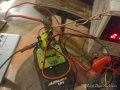
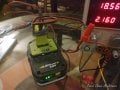
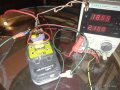
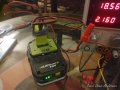
Here is photo proof of the solution I posted yesterday.
I was trying to see if I could charge the Ryobi P102 Lithium battery without the original charger (a working battery). According to some videos I have viewed, all one needs to do is attach charging current, 20 or so Volt to the + and - terminals of the battery. I let the battery drain to 18V. Then I connected 19.2V from a laptop power supply, positive to battery marked + and negative to battery marked -. But it did not work. So, I searched a little further. The battery post has 3 terminals. 1 on the side marked with + , one on the other side marked -. The third one in front (or you can call it behind) is not marked. Commonsense would say that the charger should have current between the corresponding +/- terminals. NOT SO. In the charger, I connect the probes of the meter to the two side terminals. It shows no current. But if I touch the one in the front to one of the two on the side, I get 3 volt, the front one being positive. So front-left is 3V and front-right is 3V. And this thing charges an 18V battery.

Can any one please explain the above. And how would 3V charge a battery to 20V or so?

Any one knows a way of charging this battery without owning the charger and without having to open the battery to charge it. Thanks.
Lithium ion charging of a pack that has higher voltage than one cell has to be done very carefully. That is because the cells when powering the drill have to be connected in series. If they are kept in series that means they need careful monitoring so that one cell voltage does not go too high. This is very different than charging the old NiCd or NiMH cells which can put up with some overcharging. Li-ion cells are not like that and can get very hot if not charged properly.
With this in mind, it is going to be a risk to build a home built charger unless you are an expert in this area. Cell voltage should be monitored as well as cell temperature.
Maybe you can find a used one on a site that sells stuff. That would probably be the best bet.

Even better, go out and buy a quality drill. I bought a Ryobi several years ago and got two battery packs with it. They both went dead very soon afterward. I had to replace the cells and build my own charger to keep them topped off without damage because the charger that came with it just keep charging and charging. Never buy Ryobi again. I went to a Makita Li-ion type which works well and i had it for a while now too. My dad long time ago had a Makita too and it worked well for a long time too that's what sold me on mine. Came with a fast charger too.

So after all is said and done, it may not be worth it to even bother with a Ryobi just a waste of money.
I agree Ryobi is only an average cordless drill. I have used just about every brand in the past 40 years and the BEST OVERALL BRAND IS RIDGID. I own several brands of corded and cordless drills and impacts but the the drill/impact set I bought in 2011 looks new and is still working. The Ridgid R86035 was the most powerful 1/4 inch impact on the market until only a few years ago. It has 2250 in-lbs of torque and 2600 RPM. In fact it has more torque than it's sister drill, the Ryobi drill discussed in this feed and the corded Dewalt DW245 4500 RPM 300A beast, COMBINED. At 2600 RPM it is still faster than most impacts of the last 11 years. THE MOST POWERFUL brushless 18V cordless impact sold today is the Ridgid Octane 6 speed which has 13,200 in-lbs of torque or 1100 ft-lbs of torque. I can still bust the lugs on a semi all day long and must take care to lower the speed on smaller bolts so as not to break them off.
See photos.
[Craftsman 315photos.j/8" Corded Electric Drill Reversible w/Chuck76: 241810"]
Lithium ion charging of a pack that has higher voltage than one cell has to be done very carefully. That is because the cells when powering the drill have to be connected in series. If they are kept in series that means they need careful monitoring so that one cell voltage does not go too high. This is very different than charging the old NiCd or NiMH cells which can put up with some overcharging. Li-ion cells are not like that and can get very hot if not charged properly.
With this in mind, it is going to be a risk to build a home built charger unless you are an expert in this area. Cell voltage should be monitored as well as cell temperature.
Maybe you can find a used one on a site that sells stuff. That would probably be the best bet.

Even better, go out and buy a quality drill. I bought a Ryobi several years ago and got two battery packs with it. They both went dead very soon afterward. I had to replace the cells and build my own charger to keep them topped off without damage because the charger that came with it just keep charging and charging. Never buy Ryobi again. I went to a Makita Li-ion type which works well and i had it for a while now too. My dad long time ago had a Makita too and it worked well for a long time too that's what sold me on mine. Came with a fast charger too.

So after all is said and done, it may not be worth it to even bother with a Ryobi just a waste of money.
[/QUOTE]
I agree the Ryobi 18 volt 1/2" cordless drill is only average. I own several brands and by far the best overall brand i
is Ridgid.
I'm working/playing around with my P102 and may have found a way to charge them without opening the packs. Still in the working.
jinbound3367696555798707231.jpginbound737790119875347852.jpgg
Yes do explain what is happening please..
The housing contains 5 18650 3.8v-4.2v batteries wired in series. The motherboard is called a charging protective circuit. The purpose of this is as much to insure the sale of new chargers as much as it is for safety. Between the 2 positive leads are 2 MOSFET transistors wired in tandem. Transistors are analogous to a relay switch. Unless a voltage is applied to the Gain the circuit remains open. When a voltage is applied to the Gain on the center contact the charging circuit is closed and current runs from the Source to the Drain charging the batteries. The system has monitoring and control chip to prevent each cell from over charging. The output on these types of batteries is capable of handling very high discharge currents of hundreds of AMPs. Normally a battery will only explode or ignite when the poles are shorted out, however lithium is a highly reactive alkali metal and with enough external heat the battery undergoes chemical reduction that can lead to thermal runaway and the release of gas. Overcharging, over-discharging and over current can also lead to thermal runaway but the control circuitry prevents this. Rarely these batteries can ignite or explode do to imperfections in the construction, which can be catalyzed from shock, or not! Some years ago I was walking down my hall with one of these 18650 cells in my hand when it exploded for no apparent reason.
Trent Anderson
 

Attachments

I apologize for the discontinuous and haphazard order of my responses and photos. I am still learning how to navigate the 'All About CIRCUITS interface. The previous post, #23 explains how this charging circuit works. I did not intend to post duplicate photos and am trying to learn how to edit my posts.
 

MrAl

Joined Jun 17, 2014
13,765
76Y6OTE="MrAl, post: 1598244, member: 241810"]
Show us some pictures maybe one will be the right one for the OP.
Here is photo proof of the solution I posted yesterday.


I agree Ryobi is only an average cordless drill. I have used just about every brand in the past 40 years and the BEST OVERALL BRAND IS RIDGID. I own several brands of corded and cordless drills and impacts but the the drill/impact set I bought in 2011 looks new and is still working. The Ridgid R86035 was the most powerful 1/4 inch impact on the market until only a few years ago. It has 2250 in-lbs of torque and 2600 RPM. In fact it has more torque than it's sister drill, the Ryobi drill discussed in this feed and the corded Dewalt DW245 4500 RPM 300A beast, COMBINED. At 2600 RPM it is still faster than most impacts of the last 11 years. THE MOST POWERFUL brushless 18V cordless impact sold today is the Ridgid Octane 6 speed which has 13,200 in-lbs of torque or 1100 ft-lbs of torque. I can still bust the lugs on a semi all day long and must take care to lower the speed on smaller bolts so as not to break them off.
See photos.
[Craftsman 315photos.j/8" Corded Electric Drill Reversible w/Chuck76: 241810"]
Lithium ion charging of a pack that has higher voltage than one cell has to be done very carefully. That is because the cells when powering the drill have to be connected in series. If they are kept in series that means they need careful monitoring so that one cell voltage does not go too high. This is very different than charging the old NiCd or NiMH cells which can put up with some overcharging. Li-ion cells are not like that and can get very hot if not charged properly.
With this in mind, it is going to be a risk to build a home built charger unless you are an expert in this area. Cell voltage should be monitored as well as cell temperature.
Maybe you can find a used one on a site that sells stuff. That would probably be the best bet.

Even better, go out and buy a quality drill. I bought a Ryobi several years ago and got two battery packs with it. They both went dead very soon afterward. I had to replace the cells and build my own charger to keep them topped off without damage because the charger that came with it just keep charging and charging. Never buy Ryobi again. I went to a Makita Li-ion type which works well and i had it for a while now too. My dad long time ago had a Makita too and it worked well for a long time too that's what sold me on mine. Came with a fast charger too.

So after all is said and done, it may not be worth it to even bother with a Ryobi just a waste of money.
[/QUOTE]
I agree the Ryobi 18 volt 1/2" cordless drill is only average. I own several brands and by far the best overall brand i
is Ridgid.
jView attachment 282119View attachment 282120g

The housing contains 5 18650 3.8v-4.2v batteries wired in series. The motherboard is called a charging protective circuit. The purpose of this is as much to insure the sale of new chargers as much as it is for safety. Between the 2 positive leads are 2 MOSFET transistors wired in tandem. Transistors are analogous to a relay switch. Unless a voltage is applied to the Gain the circuit remains open. When a voltage is applied to the Gain on the center contact the charging circuit is closed and current runs from the Source to the Drain charging the batteries. The system has monitoring and control chip to prevent each cell from over charging. The output on these types of batteries is capable of handling very high discharge currents of hundreds of AMPs. Normally a battery will only explode or ignite when the poles are shorted out, however lithium is a highly reactive alkali metal and with enough external heat the battery undergoes chemical reduction that can lead to thermal runaway and the release of gas. Overcharging, over-discharging and over current can also lead to thermal runaway but the control circuitry prevents this. Rarely these batteries can ignite or explode do to imperfections in the construction, which can be catalyzed from shock, or not! Some years ago I was walking down my hall with one of these 18650 cells in my hand when it exploded for no apparent reason.
Trent Anderson
[/QUOTE]


I purchased a Ryobi (or is it Cryobi ha ha) and i was disappointed to say the least. It attracted me because it came with two battery packs and was priced reasonable. The problem was that BOTH packs went dead on me way too soon (maybe 6 months dont remember now) and so i had to replace the batteries myself in one pack. I also created a new charger using a microcontroller based charger because their charger was crap.
Some time after that pack went (about 5 or 6 years later) i decided to scrap replacing the cells. Instead, i connected leads and a diode inside one pack and connected to a 12 volt 7 ampere hour battery. I got good torque that way and never had to replace the batteries again.
I did find the drill itself to be fairly strong and powerful, but with dead batteries you cant even put a sewing pin into the wall with it let alone several screws. Eventually i went with a 19v Makita which has a fast charger and Li-ion batteries rather than NiCd. I've been using it ever since. The battery pack has a level indictor too you press the button and it gives you the state of charge estimate.

So i'll never by another Ryobi product just anything else like Milwaukie or Porter-Cable or even Makita.
 

MrAl

Joined Jun 17, 2014
13,765
Oh more abbreviations.
Well the only thing i can say then is JBWID;;DKIWNB:kz and that's a true statement. :)

You know in all seriousness, we are becoming a society of confusion. Not only are there abbreviations for everything there is also the naming conventions used by companies for new products and services. There are becoming more and more collisions among these names so that when you look something up you'll get plenty of hits that have absolutely nothing to do with your search term. That's because so many names are being used over and over again for completely different things. There is also the spelling change so that the name sounds like another name but has one or two letters changed for example from a 'c' to a 'k' or from a 'k' to a 'c' and i guess they think they did something really kool.

BTW, thanks for the link.
 

ccap123

Joined Sep 23, 2023
1
So, the only real way to recharge one of those batteries is to pull the case apart and charge each cell individually. Which can be done without taking each one apart.
That third terminal on the battery is for charge protection. It corresponds to two terminals both in the battery and in the charger. They are labeled as "T1" and "T2."

T1 is a Test terminal that is used by the charger to determine if the pack is okay—if the FETs are off then the pack will fail this test and the charger blinks the defective led pattern. The FETs connect the terminal labelled (-) to the bottom of cell 1.

The charger and the pack send a secret code back and forth on T1; without it the pack won't charge, and the charger won't work either.

T2 is a Test terminal with the same external indicator circuit as T1 for the state of the FETs, but it also has an internal indicator path to the PIC controller.

Now it is possible,however, to bypass this in the batteryin order to be able to slow pulse charge it from the (+) and (-) terminals on the battery case.
I would absolutely not recommend that though. Lithium ion batteries can and will explode from over heating due to it being charged for too long at too fast of a pace or just one of those separately
 
Top