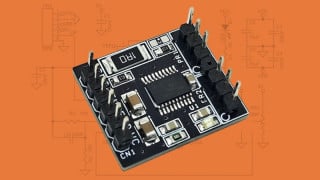
Rotary Switching for 4 Cell 18650 Package

Thread Starter

Deve

Joined Dec 28, 2015
95
Hello everyone! I am trying to make a nice power source for my Arduino projects large and small. The 18650 is a nice way to go about this. The plan is to use a buck converter to reduce to the desired voltage, yet have power that lasts.

I want to 3D Print a box that has a 4 cell 18650 battery holder, a voltage and current meter, a switch for turning the package off/on, and a 0-36 Volt IN and 4 - 36 Volt OUT Buck Converter.

The meter I am looking at is here: https://www.ebay.com/itm/DC-100V-10...ital-Volt-Amp-Meter-Gauge-Tester/282787771075 (the 10 amp version).

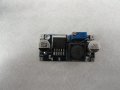
The Buck Converter is here: https://www.ebay.com/itm/10pcs-DC-D...r-Power-Supply-Module1-3V-35V-UP/273088096185

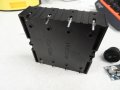
The cell holder is here: https://www.ebay.com/itm/5Pcs-Li-io...er-for-4x3-7V-18650-Battery-M6M1/252732634852

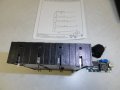
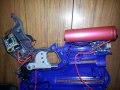
THE ISSUE is, I want a rotary switch mounted on the new case. The idea is to switch in or switch out one battery at a time. The problem is, I am hitting a mental block on how to go about wiring this case, and what kind of rotary switch would do this best. Attached is pictures of the parts involved minus the meter since I haven't ordered it yet. How to wire it?

A side issue is, the above issue is Serial battery configuration. 3.6v, then 7.2, then 10.8, then 14.4. I am also wondering if there is a way through switching to put it in Parallel configuration for when I want the longevity of a 7.2 volt source (x2). (or 3.6v x4) I just can't seem to wrap my head around the wiring diagram for this project. Thank you!Scratch.JPG 18650x4a.JPG BuckConverter.JPG 18650x4b.JPG
 

Alec_t

Joined Sep 17, 2013
15,117
Welcome to AAC!
A problem with using an arbitrary number of cells in series at a time is that they will become discharged at different times and there is a risk that, unless precautions are taken, reverse current could be forced through a discharged cell by the other cells in series with it.
Does each cell have its own charge/discharge control circuit for safety?
Lithium chemistry cells produce spectacular, hazardous, firework displays if not treated properly.
 

dendad

Joined Feb 20, 2016
4,637
Last edited:

dendad

Joined Feb 20, 2016
4,637
Using 18650 cells is a good idea.
An 3.3V Arduino will run ok on one 18650 cell. I am using some Pro Minis in a Laser tag system. And each will have charge controller/battery protector board.
Charger.png
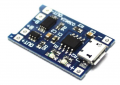
These are very cheap on Ebay. make sure you get those with 6 connections as the 4 connection versions are just charge controllers, not over discharge protectors too.
20171209_091126.jpg
Here you can see the cell and the charge controller. And the Pro Mini with a WT588D sound board on top.
 

Thread Starter

Deve

Joined Dec 28, 2015
95
Ok, so I am trying to understand.. I have several projects I would like to use a battery pack for. Some are 3.3v, some 5v and some 12v. I want to be able to switch batteries in as they are needed. This is more of a test box than anything. It is no different than placing the next battery in an empty holder right? I just don't want to make dummy 18650s and keep swapping those in and out of the holder. So a switch is in order is it not?

Also, please explain what these controller boards do? I have lots of Arduino projects going and all of them use 18650s and none of them use this controller board. Why do I need it? I am trying to understand this. I am not being critical.
 

dendad

Joined Feb 20, 2016
4,637
The battery controller board controls the charging of the 18650 cell. You must use a charge controller of some sort to charge the cells otherwise you risk battery fires of explosion. Also, this version of the board disconnects the load when the cell is discharged to prevent over discharging otherwise you can easily damage the cell and it will no longer take a charge.
How are you charging your 18650 cells now?

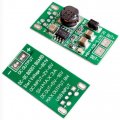
As for various output volts, from Ebay, I have just purchased some off these boost converters. Not bad for under $2 each.
"8W 5V to 12V DC-DC Converter Step Up Module USB Power Supply Boost Module"
BoostConverter.jpg
As of yet, I have not tried them out.
They are preset but changing a resistor will select the voltage out. These will run from the 18650 cell and give you a higher voltage out , output up to 8watts and 20Volts. The voltage setting resistor could be a resistor and a pot in series. The resistor sets the lower volts and the pot varies it up to the max volts.
 

Thread Starter

Deve

Joined Dec 28, 2015
95
I use a very nice BA6 Li-on Charger for my charging. It does the whole balance thing. As I stated in the first post, I also use a Buck Converter that allows me to reduce the voltage using an on-board Pot to whatever I want to (lower than input). I like what you have done there.

The issue I am trying to solve involves 3 neopixel light rings with a total of 47 individual LEDs. This is hooked up to a 5v Nano with a 5 volt input using two 18650s. At max brightness of 255, the LEDs will use as high as 3 amps of current. This is too high for the more delicate Nano's regulator. The 18650's will serve the whole amp requirement, but the Nano supposedly cant handle that. (Lowering the numbers to half (127) is not an option because it is a programming tool and I do not want the kids to do what I would have done as a teen and max everything out to see what would happen!

I thought by making a box that I could check the actual current being used, I could do further testing with stepdown converters to see if I can only serve the Nano with what it is capable of handling. I do NOT know what I am doing, so I am in the midst of trying a bunch of different things and am hoping I can get a clue by asking you guys! How would you solve this? [besides lowering the number of LEDs). Is there such a thing as voltage AND current stepdown? I want the current limited to 1 amp.

One of the restrictions is I can't use a big ole current limiting resistor because the casing is 3D printed PLA and the heat would be a bad thing. I am okay with the lights being half intensity. I just want to create a current limiting circuit to do that in hardware so the kids are none the wiser. I just have no idea how to go about this.
 

dendad

Joined Feb 20, 2016
4,637
As you know, with the NeoPixels, you can limit the current by putting a top limit on the brightness in your code on the Arduino. They will usually be plenty bright enough at lower current settings. But I take it from your comment you don't want to go that way.
So you will be stuck with the current requirement.
You can limit the current to 1 Amp but then the volts will drop from 5V when the current limit is hit. That is how it works. If you keep the volts at 5V, then the current will go up to the 3Amp limit. If you limit to 1 Amp, then the volts will drop to the value that supplies 1 Amp.
A "Polyswitch" (brand name) https://en.wikipedia.org/wiki/Resettable_fuse could be put in line to limit the current. I will take some time to operate and will cut in when it heats up. Then reset when cool again.
Or a transistor circuit to limit the current could be used. And just going tor a regulator that has a 1Amp (or adjustable) current limit is another option.
Here is a link that is talking about current limit at the moment....
https://forum.allaboutcircuits.com/...ion-with-current-limiter.146440/#post-1246015

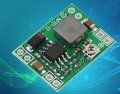
I use these regs. They are tiny and are rated at 3Amps.
reg.jpg
Another Ebay special ;)
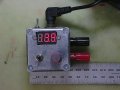
This is what I has a student build. It is very compact and has 2 voltage ranges. I think it was 1.2V to 10V, then 5V to 15V. 2 ranges was used as that suited the pot I had. A cheap volt meter was added and it ran on a 19V laptop supply.
We removed the trimmer and added a pot in its place. 100K gives about 10V.
IMAG0486.JPG.jpg
 
Last edited:
Top