Rocket Launcher (from FET question edited)

Thread Starter

B-JoJo-S

Joined Jan 3, 2026
210
I want a sensing circuit that draws no current but gives an indication when the system sees a voltage. Here's what I need help understanding. Looking at many (MOS)FET's I see "Logic Level" which I interpret to mean 5V on the gate controls the FET. I don't want that. I plan to sense when 12V is present. It shouldn't have to handle much current, maybe an amp or two. Don't ask for specifics as I have yet to make these decisions. I saw someone building a rocket launcher and they used a FET to detect when the igniter was properly hooked up. I don't want the FET to launch the rocket I just want to sense when the igniter is properly connected to the circuit. I can't find that thread or remember who posted it. If I recall, that person built a launch timer to go with his system. I don't want all those bells and whistles. I just want to have a green light tell me the igniter is properly connected. That way when I press the fire button I know the igniter is ready. If the green light goes out and the rocket doesn't launch I know either my clips have come off of the igniter or if it burned but failed to launch the rocket.

I need help choosing a FET that when a voltage is present on the gate the source and drain are turned on.

Enhancement / depletion / P-FET, N-FET, it's a whole new world to me. I know it's been around a long time but I've been reluctant to pursue FET's. I'd even like some advice on a good FET that can handle up to 10 amps. Not that I'll need that much but since I don't yet have a plan having the headroom wouldn't be a bad idea.

I want the FET because it won't prematurely detonate the igniter. A relay coil could draw enough current to launch the moment the leads are connected. So relays are out. Maybe an IGBT ? ? ?
 

Irving

Joined Jan 30, 2016
4,996
You're overthinking this. Go back to basics - there are many ways to sense a voltage whilst drawing a minuscule current, a FET is just one, however its not the best solution if you want to sense a specific voltage. I'm not sure why you need the FET to carry any current if it's in a sensing role.

Assuming your igniter circuit is just the basic two wires out to the igniter and the firing point is just a12v battery and a switch then there are many options. The igniter is just a hot-wire element, a light bulb without the glass. A small current, a few mA or so will not ignite it, that takes typically an amp or so, as stated on one model rocketry website "Most launch systems use a light bulb in series with the igniter to show that there is continuity through the igniter. A normal motor igniter takes a fairly high current to fire so the small current for continuity indication will not fire them." In other words, even a 5mA LED would serve the purpose of showing continuity. An LED is preferable to a light bulb as, with the correctly calculated series resistor, takes a known precise current, no more, no less whereas a bulb takes a larger current when cold reducing as it lights up. Nothing more is needed.
 

MisterBill2

Joined Jan 23, 2018
27,173
Sensing continuity with a mosfet should not be a problem. I am guessing that the igniter resistance plus the connectionresistance is less than a HUNDRED OHMS. So a bias to one side of the igniter thru a 5000 ohm resistor from a 12 volt source should be safe. Using a SMALL light bulb to sense is pprobably OK, unless the bulb ever accidentally gets broken and fails shorted. An LED with a series current limiting resistor would be safer, but it is polarity sensitive. That might be an issue eventually..Since an LED is fairly voltage sensitive, it might also serve to sense if the igniter connections were short circuited. THAT could be a handy function.
 

Irving

Joined Jan 30, 2016
4,996
An LED with a series current limiting resistor would be safer, but it is polarity sensitive.
So is the MOSFET option, it adds no extra functionality AND could be susceptible to EMI/ESD - the gate would be connected to what is in effect a long wire antenna!

Since an LED is fairly voltage sensitive, it might also serve to sense if the igniter connections were short circuited. THAT could be a handy function.
The igniter resistance is tiny, typically <5ohm, you wouldn't see any difference. The total igniter circuit would typically be <10ohm
 

Thread Starter

B-JoJo-S

Joined Jan 3, 2026
210
You both bring up interesting points.

As for a FET, I kind of have my heart set on that approach. However, as MisterBill2 said, if the clips are shorted I could get a green light but when pressing the button I could short out my system. In order to use an LED with series resistor - the launch switch would need to bypass (short across) the LED (or even the bulb). Should the clips come together for some reason I'd have a dead short. A small SLA battery or even a series of Li-Ion batteries won't like the dead short. So that's something more for me to consider.
 

Thread Starter

B-JoJo-S

Joined Jan 3, 2026
210
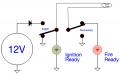
OK, so - - - -
Screenshot 2026-04-25 at 8.02.28 AM.png
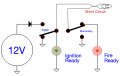
But how to prevent this from smoking the system?
Screenshot 2026-04-25 at 8.01.57 AM.png
The diode is to prevent hooking things up backwards.

EDIT: The LED's are 12V ready (has its own built in resistor AND rectifier)
 

Thread Starter

B-JoJo-S

Joined Jan 3, 2026
210
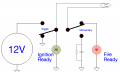
For short circuit protection - what if I use a large value cap, say 0.01 F (10,000 µF)? Wouldn't it absorb the short then quickly stop the flow of current? Then there's a bleeder resistor that can bleed down the cap to get ready for the next launch.
Screenshot 2026-04-25 at 8.47.11 AM.png
 
Last edited:

Irving

Joined Jan 30, 2016
4,996
You both bring up interesting points.

As for a FET, I kind of have my heart set on that approach. However, as MisterBill2 said, if the clips are shorted I could get a green light but when pressing the button I could short out my system. In order to use an LED with series resistor - the launch switch would need to bypass (short across) the LED (or even the bulb). Should the clips come together for some reason I'd have a dead short. A small SLA battery or even a series of Li-Ion batteries won't like the dead short. So that's something more for me to consider.
You're asking a different question. The resistance of an igniter is typically 0.1 - 5ohm, at the end of a long pair of wires, say 24awg @ 100', around 2.6ohm each leg. Depending on the igniter it will be hard to detect a short at that distance with much certainty. Better to simply avoid the possibility of a short with insulated croc clips. In any case, it won't be a dead short from the batteries perspective; there's 200ft, 5'2 ohms of cable resistance, so no more than 2.3A will flow - that will take some charge out of the batteries but won't damage them.

To deal with a real short of the igniter, you need to measure the resistance of the igniter locally at the rocket end, or at least very close to it. Since the resistance is low you need a reasonable current to measure it. Consider a 1ohm igniter. 5mA through it will generate 5mV across the igniter filament. While measuring a 5mV potential difference is possible, its non-trivial. The usual solution to this is similar to fuse testing, use a larger current but pulsed for a very short time. For example, the heating effect of a 1A pulse lasting 5mS once a second is the same as a continuous current of 5mA, except now we get a 1v pulse across the igniter, and that can be easily measured. To be honest, this is a level of complexity that isn't practical or necessary.
 

Reloadron

Joined Jan 15, 2015
7,855
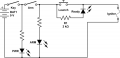
This is a very basic rocket launcher circuit. My read is an igniter is about 1.5 to maybe 2.0 ohms. Likely less.

Rocket Igniter.png

The battery can be 12 volts. The idea is when testing the igniter for continuity we limit the current using R1 and if the igniter is a go the Ready LED will glow. Pressing the launch button will bypass the current limiting, the igniter will fire and that's it. These things can be as simple or complex as you wish, including adding a uC (micro-Controller) like an Arduino or similar and a test sequence along with auto launch. Yes, a logic level MOSFET just requires a low gate voltage. For that matter you could use a complete wireless approach and launch using your smart phone. Just a matter of how simple or complex you want things? The idea here is to limit the current through the igniter while testing continuity. Describe in detail what you want/expect and we will come up with a solution.

<EDIT> If you would like a MOSFET tossed in the mix, that can be easily done. My advice is sit down with a pencil and paper and note exactly what you would like. </EDIT>

Ron
 
Last edited:
Thhere is an entieely different scheme for igniting the rocket engines, and it is a bit more forgiving of line resistance, aswell as less likely to go off accidentally . That system is the EXPLODING BRIDGE WIRE ignitor. The concept is to charge a high value low ESR capacitor to several hundred volts and then dump the charge across the wire, which evaporates a bit of the wire,producing a small cloud of copper vapor. THAT will usually set thigs off very well.
 

Reloadron

Joined Jan 15, 2015
7,855
Thhere is an entieely different scheme for igniting the rocket engines, and it is a bit more forgiving of line resistance, aswell as less likely to go off accidentally . That system is the EXPLODING BRIDGE WIRE ignitor. The concept is to charge a high value low ESR capacitor to several hundred volts and then dump the charge across the wire, which evaporates a bit of the wire,producing a small cloud of copper vapor. THAT will usually set thigs off very well.
Just maybe a little overkill for a model rocket launch. :)

The precise timing of exploding wire detonators compared with other types of detonators has led to their common use in nuclear weapons
Then too, if it was good enough for Fat Boy (Manhattan Project) it should be good enough to ignite a model rocket engine, assuming it doesn't blow the rocket up. :)

Ron
 
When my son was into model rocketry, I used the same circuit that Ron showed in his post, with a small refinement: In series with the “ready” LED, I added an optocoupler’s LED. The transistor side of the coupler pulled up, when lit up, a 555’s reset line. The 555 was in astable mode and fed a small speaker, which would emit a high-pitched sound to warn bystanders. The reason was that in bright sunlight the LED was difficult to see, but the sound would provide an unambiguous warning.
 
If you know the *current* needed to assure ignition, a switchable constant current circuit near the battery can both indicate a good/bad ignition loop and fire the rocket. What is the recommended current through an ignitor?

ak
 

Thread Starter

B-JoJo-S

Joined Jan 3, 2026
210
Found this so far - but it doesn't make clear to me the current requirements. As I recall many years ago when I was flying with my children four AA batteries in a hand held launch controller with a push button and two wires with clips on the ends were all that was needed to launch. It was so long ago that I don't remember having difficulty with drained batteries.

My current plan is to use 8 D-cell batteries in series. They're cheap enough to replace when dead. As opposed to 12V SLA battery which requires periodic charging whether used or not. And when they go bad because a child completely neglected to maintain the battery the cost of replacement is higher. If I were to go with Li-Ion batteries then the cost goes up with the need for a proper charger. And given the chance for mishandling by a child, damage could result in injury in the form of severe burns. D-cell seems stable enough. And when they need to be replaced it's only a few bucks. An 8-pack costs less than $16.00. Lowe's has an 8 pack for 18.98. And they should last a long time. Easily outlast one flying season, of course depending on how many launches.

EDIT: Found this:
https://www.rocketryforum.com/threads/minimum-amperage-for-ignition.99063/
 

Reloadron

Joined Jan 15, 2015
7,855
What is the recommended current through an ignitor?
Well this makes for a wide window. Typical igniters are just a small piece of nichrome wire having a resistance ranging between 0.5 to 3.0 ohms. The required current for good ignition is about 2 to 3 amps when applying 12 volts. Imagine an old incandescent light bulb less the glass envelope going poof. The idea being to apply enough voltage so the current spikes. You don't want an igniter slowly warming up for ignition, you want ignition to be instant less any delay. Within a few milli-seconds we want game over and rocket on its way.

I used the same circuit that Ron showed in his post, with a small refinement: In series with the “ready” LED, I added an optocoupler’s LED. The transistor side of the coupler pulled up, when lit up, a 555’s reset line. The 555 was in astable mode and fed a small speaker, which would emit a high-pitched sound to warn bystanders. The reason was that in bright sunlight the LED was difficult to see, but the sound would provide an unambiguous warning.
Nice addition! These things can be as simple or as complex and elaborate as we like. The addition of an audible is a nice touch.

Ron
 
The safety benefit with the EBW igniter scheme is that until the capacitor is charged, hitting the fire button does nothing.

and the interesting thing about those ignitors is that they are simple to re-use: Just poke the used igniter into a fresh engine, and then CAREFULLY poke in a match head . I developed that process for the scouts, on a rocket launching event. A scout would not put the igniter in properly and it would fail to light the engine. BUT the material that lit the engine was burned off. So part way thru tyhe event, no more igniters, and a bunch of unhappy kids. So I quicly invented the reuse scheme. Fairly simple and really cheap. AND not that difficult.
 
Top