RLC at resonance

Thread Starter

JoyAm

Joined Aug 21, 2014
126
Hello, I tried to solve a simple "problem" with an series rlc circuit at resonance, what i wanted to find was
1) if voltage magnification will occur
2)VL , VC , VR , I0
3)The circuits power at resonance
I attach two print screens of the circuit( given Vs, L,C,R) and my solution attempt.
Is the way i try to solve it right ?
http://prntscr.com/4jmlsg
http://prntscr.com/4jmm8j
 

MikeML

Joined Oct 2, 2009
5,444
The circuit has such a low Q that the Voltage Magnification at V(a) is barely perceptible.

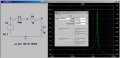
Here is the complete solution. You can check to see if your work matches this:

70.jpg
 

Thread Starter

JoyAm

Joined Aug 21, 2014
126
Thank you for your immediate answers Mike and Joe.
What i really need to know is
1) how will i know if a voltage magnification will occur ( what i can think of is to check the voltage on either capacitor or inductor (assuming I=Vs/R) and then check if its bigger than the one in the resistor, which will be the same with the source Vs , is that right ?)
2) the power of the whole circuit will be Vs^2*R because the sum of the capacitor and inductor is zero ?
Thanks in advance :)
 

MikeML

Joined Oct 2, 2009
5,444
Thank you for your immediate answers Mike and Joe.
What i really need to know is
1) how will i know if a voltage magnification will occur ( what i can think of is to check the voltage on either capacitor or inductor (assuming I=Vs/R) and then check if its bigger than the one in the resistor, which will be the same with the source Vs , is that right ?)
2) the power of the whole circuit will be Vs^2*R because the sum of the capacitor and inductor is zero ?
Thanks in advance :)
I have never heard the term "voltage magnification" until your post. The concept is tied up to the Q of a resonant circuit, so read up on Q.
I already showed you the power into the circuit (the expression V(1)*-I(V1) shown in the bottom plot pane). Since L and C are ideal, lossless components, then it follows that at resonance, the power in the resistor is the same as the input power.
 

Thread Starter

JoyAm

Joined Aug 21, 2014
126
I have never heard the term "voltage magnification" until your post. The concept is tied up to the Q of a resonant circuit, so read up on Q.
I already showed you the power into the circuit (the expression V(1)*-I(V1) shown in the bottom plot pane). Since L and C are ideal, lossless components, then it follows that at resonance, the power in the resistor is the same as the input power.
1)Maybe i am using the wrong term then. What i mean is that at resonance we have VL=-Vc and Vs=VR
That makes the VL and VC able to much higher than Vs and when that happens we call it voltage magnification ( if there is another term that describes this phenomenon please let me know).
2)So the power of the circuit at resonance is equal with the power in the resistor, right ?
 

Thread Starter

JoyAm

Joined Aug 21, 2014
126
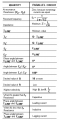
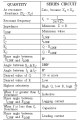
At best, Vc and Vl will be the Q x E line. Look at that cheat sheet for series resonant circuits at fr.
So we come to the conclusion that in this circuit(with these values of Vs,R,L,C) even when it is at resonance, no voltage magnification occurs, am i right ?
Also about your cheat sheet, i think that you use the value of Vs=10volt in your calculations, but when we are given the peak to peak voltage, dont we have to divide it by 2 to get the V0?
 

JoeJester

Joined Apr 26, 2005
4,390
When I used 10 volts pk to pk all other values were peak to peak.

If I were going to use rms, I would have done more than divide by 2.

If you were going to take the readings using an oscilloscope, they would be pk to pk.
 

MikeML

Joined Oct 2, 2009
5,444
Here is a plot of the "magnification" that occurs in V(a) as a function of frequency with R1=1000. Note it increases only ~ 1%:

205b.jpg

Here is a plot with R1=10, a much higher Q:

205c.jpg
 

Thread Starter

JoyAm

Joined Aug 21, 2014
126
Here is a plot of the "magnification" that occurs in V(a) as a function of frequency with R1=1000. Note it increases only ~ 1%:

View attachment 72679

Here is a plot with R1=10, a much higher Q:

View attachment 72680
Well that what solved all my misunderstandings ( i was blind to it all the time although your were trying to make me see it )
So to sum up, if Q>1 that means we will have a voltage magnification :)
Thanks both of you once more
 
Top