RIAA Equalization pre-amp for phono input

sasaudio

Joined Oct 18, 2009
34
Indeed it does. It tells me you have no freaking idea about the device in question.
Sadly, again, I see you could not refute nor explain even a single point with any education.
Don't you have some basic high school electronics with which to reply with?
If you would have had even some electronics education, you would have understood why
my reply #72 covered your question(s).

Here are a couple of more basic and engineering text suggestions, with which I helped some
engineering students over the decades.

Semiconductor and Tube electronics
Network Analysis
RCA Radiotron Designers Handbook, over 1500 pages of audio frequency, radio frequency and
other topics. The principles discussed cover both tubes and solid state, only the terms are different.

Cheers

pos
 

sasaudio

Joined Oct 18, 2009
34
Hi,

I did not see this post at first, that's very good that you posted something more concrete.

Electrolytics do have problems as you note, but they are not usually used alone. Maybe in older designs they were, but today they are almost always used with a smaller value ceramic in parallel. That's been known for a long time now, even back in the days of base line Transistor Transistor Logic (TTL) circuits.
If you know of a reason why this might not work for audio it would be good to mention here and interesting to read.
I assume you are talking about power supply bypassing.
I understand where you are coming from Al. Thanks for your civilized post. Much appreciated.
For the general public I will try to be as simple as possible. Chime in Al if you can simplify or
make things clearer.

A capacitor is simply two conductors with insulation between. The insulation can be a vacuum,
air, liquid, or solid. Capacitance is generally measured in micro micro farads (pf) or micro farads
(uf or ufd).

The insulation tends to have electrons, on the conductor's surface, stick to the insulation,
and slowly release from the insulation when the voltage between the conductors change.
Dielectric Absorption (DA) is the insulation's Inability to release electrons instantaneously
when necessary.

Ceramic capacitor's are typically used to cover radio frequencies (RF) due to their small ufd
and physical size. Logic circuits have high frequency components present, and an electrolytic
capacitor is basically an inductor at RF, so the need for a ceramic, mica etc. Even ceramic
capacitors have a limiting high frequency of usefulness.

DA of ceramic caps vary depending upon its design, some from several tenths of a percent to
5% or much higher. At least a factor higher than a polypropylene capacitor. Small ceramic
and poly caps are of virtually no help in analog circuits as the frequencies covered are generally
much lower and requires much higher values.

Electrolytic capacitors are known to mask inner detail and negatively influence the harmonic
structure. As such, when decoupling capacitors are replaced with just poly capacitors, true inner
detail emerges for greater naturalness, spaciousness, realism. Try to keep the cap tolerances
tight as it is easy to alter the perceived frequency response.
It might take some experimentation as the system is more sensitive to changes, parts quality etc.

I hope this helps.

cheers

pos
 

Thread Starter

wayneh

Joined Sep 9, 2010
18,119
Sadly, again, I see you could not refute nor explain even a single point with any education.
Don't you have some basic high school electronics with which to reply with?
Can you read English? I asked you a very specific question regarding how you know about the circuitry details in the Pyle 444 and its power supply. I got no answer but a screed in reply. It may all have been right, but failed to answer the direct question. That's what BS artists and politicians do, and so you didn't do yourself any favor.
 

crutschow

Joined Mar 14, 2008
38,543
Electrolytic capacitors are known to mask inner detail and negatively influence the harmonic
structure. As such, when decoupling capacitors are replaced with just poly capacitors, true inner
detail emerges for greater naturalness, spaciousness, realism. Try to keep the cap tolerances
tight as it is easy to alter the perceived frequency response.
An electrolytic capacitor may possibly affect the signal if used as coupling capacitors in the signal chain, but they have no effect on the signal when used as decoupling capacitors in the power rail.
Where did you come up with that piece of misinformation?

And words like "true inner detail emerges for greater naturalness, spaciousness, realism" belong in an advertising brochure, not a serious technical discussion.
It just sounds like you are blowing smoke.

Also a tight tolerance for a decoupling capacitor is not needed as those capacitors are generally specified much larger than the minimum needed for decoupling.
 

MrAl

Joined Jun 17, 2014
13,720
I understand where you are coming from Al. Thanks for your civilized post. Much appreciated.
For the general public I will try to be as simple as possible. Chime in Al if you can simplify or
make things clearer.

A capacitor is simply two conductors with insulation between. The insulation can be a vacuum,
air, liquid, or solid. Capacitance is generally measured in micro micro farads (pf) or micro farads
(uf or ufd).

The insulation tends to have electrons, on the conductor's surface, stick to the insulation,
and slowly release from the insulation when the voltage between the conductors change.
Dielectric Absorption (DA) is the insulation's Inability to release electrons instantaneously
when necessary.

Ceramic capacitor's are typically used to cover radio frequencies (RF) due to their small ufd
and physical size. Logic circuits have high frequency components present, and an electrolytic
capacitor is basically an inductor at RF, so the need for a ceramic, mica etc. Even ceramic
capacitors have a limiting high frequency of usefulness.

DA of ceramic caps vary depending upon its design, some from several tenths of a percent to
5% or much higher. At least a factor higher than a polypropylene capacitor. Small ceramic
and poly caps are of virtually no help in analog circuits as the frequencies covered are generally
much lower and requires much higher values.

Electrolytic capacitors are known to mask inner detail and negatively influence the harmonic
structure. As such, when decoupling capacitors are replaced with just poly capacitors, true inner
detail emerges for greater naturalness, spaciousness, realism. Try to keep the cap tolerances
tight as it is easy to alter the perceived frequency response.
It might take some experimentation as the system is more sensitive to changes, parts quality etc.

I hope this helps.

cheers

pos
Hi,

Yes, and interesting. There is just one question then.
It seems that you want to use poly caps alone, so how do you get to the value required for power supply bypassing with poly caps alone? Are you talking about paralleling a bunch of them?
We could be talking systems that are several hundred watts, or even just 100 watts. For example, in an automobile audio system where we want excellent bass response.
As you probably know, bass response becomes critical at frequencies like 20Hz, which is even more difficult to filter (DC) than at line frequencies like 60Hz.

I worked on a design with others and we had to use poly caps for sample and hold circuits which of course required very low leakage. I was surprised how light weight they were and actually felt like they were fake or something :)
 

sasaudio

Joined Oct 18, 2009
34
Can you read English? I asked you a very specific question regarding how you know about the circuitry details in the Pyle 444 and its power supply. I got no answer but a screed in reply. It may all have been right, but failed to answer the direct question. That's what BS artists and politicians do, and so you didn't do yourself any favor.
And I answered your question, but you don't comprehend.

Let's try this. Because all circuits need capacitors and the physical size of the component
dictates electrolytic caps.

Do you understand this???

Cheers
pos
 

sasaudio

Joined Oct 18, 2009
34
An electrolytic capacitor may possibly affect the signal if used as coupling capacitors in the signal chain, but they have no effect on the signal when used as decoupling capacitors in the power rail.
Where did you come up with that piece of misinformation?

And words like "true inner detail emerges for greater naturalness, spaciousness, realism" belong in an advertising brochure, not a serious technical discussion.
It just sounds like you are blowing smoke.

Also a tight tolerance for a decoupling capacitor is not needed as those capacitors are generally specified much larger than the minimum needed for decoupling.
Sigh. For viewers, understanding a very basic Thevenin Equivalent Circuit (TEC) gives understanding
as to why a decoupling capacitor is in the direct signal path, and Does negatively affect the
musical quality in multiple ways, more than the coupling capacitor or DC coupling.
The TEC is found in any electronics/electrical engineering textbook.

But let's go with just a typical simple circuit. Attached file.

Figure 1 is a typical analog circuit for solid state or tube. L can also be a resistor. Figure 2
is simplified and shows just the AC musical signal path, DC path left out.

Notice the red line showing the audio signal current paths from the output musical signal A.
We have two signal current paths from signal output A to ground.

1. from the output A through C1, and Rg1 to ground
2. through RL and C decoupling power supply capacitor to ground.
2b. As such musical signal current flows through both C1/Rg1 to ground and RL/C to ground.
C is reactive, meaning its AC musical signal resistance varies with frequency, along with DA of 7%,
internal inductance and internal resistance, and Phase shift is also affected.

Actually they both are in parallel. It is just that one is tapping the output from C1, not C.
However, RC affects the musical quality at A much more than C1 because C is an electrolytic
capacitor with all the problems associated with it, while C1 is a higher quality, much fewer
problems, poly cap. C dictates the musical signal quality.

If C1 were gone, with just DC coupling, then we have a non linear frequency response due to
C's reactance being frequency sensitive. Thus RL + C total AC resistance rises as the
frequency decreases. Surprise, the bass is exaggerated.

Hope this helps Al.

pos
 

Attachments

Last edited:

sasaudio

Joined Oct 18, 2009
34
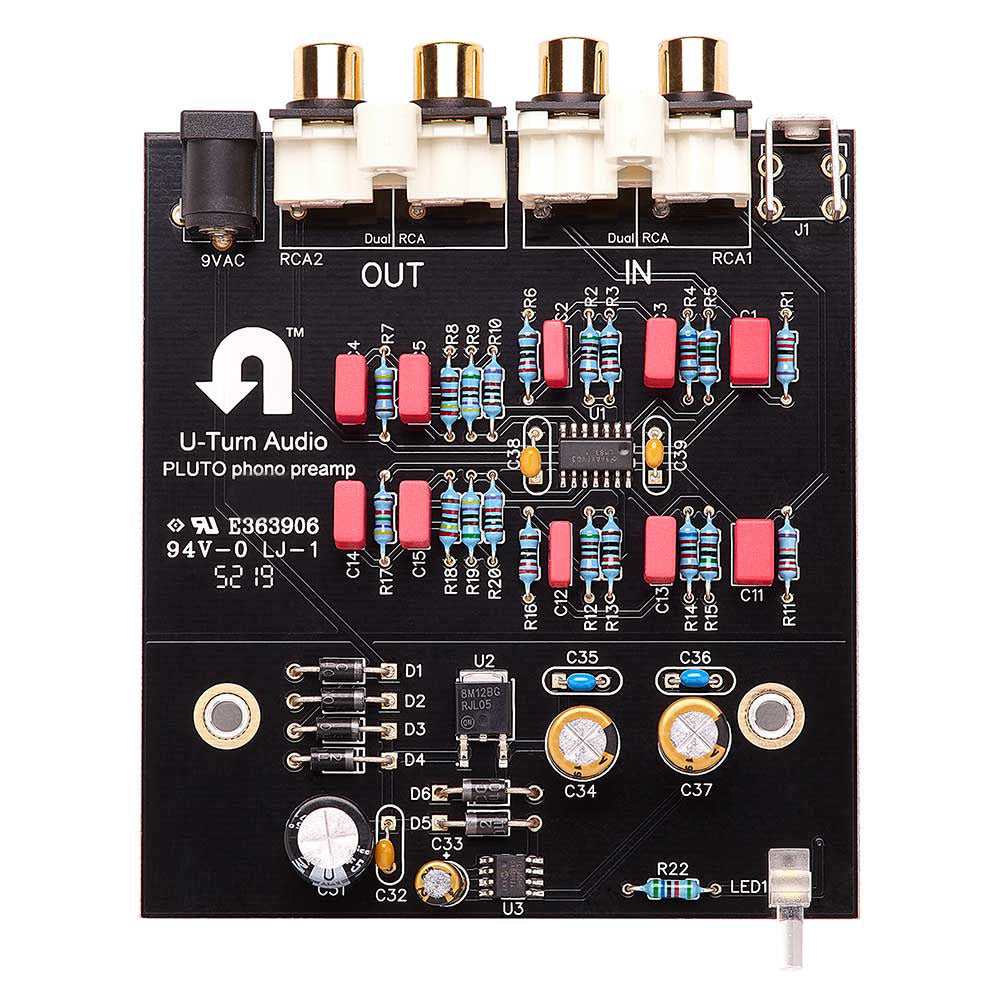
This is not my device, just a picture I could find. I see a few electrolytic caps on the power supply but none on the signal side.
A circuit won't work without power supply filtering, decoupling capacitors. It appears C38-39 are ceramic/tantalum
capacitors to prevent RF oscillations.
They simply placed the decoupling caps away from the signal path. If I remember correctly, the hum/noise is only
-70db down, which is not good.

cheers
pos
 
Last edited:

crutschow

Joined Mar 14, 2008
38,543
This is sad. Do you realize the harm you are creating to the community by hyping your
knowledge through exaggeration and deception; when you understand virtually no
electronic/electrical engineering, even the very basics?
I am a degreed electrical engineer with 40 plus years of professional analog design in military and space electronics, so don't insult me my telling me I don't know the basics.
What circuit design work have you done?

What's really sad is, you are the one spouting BS about audio circuits with your pseudo-scientific ramblings that the "golden ear" audiophiles often use, and insisting it is factual information.

The decoupling capacitors in your posted circuit have no effect on the audio, if they are properly sized, even if the caps are less than ideal.
If you did some calculations for an actual circuit, you would see that instead of using generalities that mean little.
 

MrAl

Joined Jun 17, 2014
13,720
An electrolytic capacitor may possibly affect the signal if used as coupling capacitors in the signal chain, but they have no effect on the signal when used as decoupling capacitors in the power rail.
Where did you come up with that piece of misinformation?

And words like "true inner detail emerges for greater naturalness, spaciousness, realism" belong in an advertising brochure, not a serious technical discussion.
It just sounds like you are blowing smoke.

Also a tight tolerance for a decoupling capacitor is not needed as those capacitors are generally specified much larger than the minimum needed for decoupling.
Hi there Cruts,

I am not sure if this is the same thing you wanted to talk about, but power supply filter caps are critical for good bass response, and at high frequencies we know from switching power supply designs they have to be low ESR too.
This leads to an indirect effect on the audio quality and can be very striking which is easily noticeable. For the bass frequencies, large capacitor values are required in order to keep the voltage high enough to prevent dips in the signal peaks. If the peaks get cut, the bass response suffers and can sound very raspy like a bad speaker cone. For higher frequencies, the current has to be maintained and has to be available in an instant in order to reproduce the waves with precision. High ESR can never provide this and we know that from working with switching power supply input caps and output caps.

I suppose that poly caps could be better, but it seems like it would take a lot of a lot of parallel caps to get to the values we would want in a really good high power audio amplfier, even one that works in the automobile at 12vdc. The power surges have to be available close to the source, and that can only mean good quality capacitors to supply that demand.

This would not have anything to do with coupling capacitors, which couple AC signals from one DC level to another in order to not affect the bias set points of either stage. I'm not sure if he meant the same thing though.
 

crutschow

Joined Mar 14, 2008
38,543
I am not sure if this is the same thing you wanted to talk about, but power supply filter caps are critical for good bass response, and at high frequencies we know from switching power supply designs they have to be low ESR too.
This leads to an indirect effect on the audio quality and can be very striking which is easily noticeable.
Of course the caps need to be large enough to handle the low frequency decoupling, and there should be some low ESR non-polarized caps in parallel to help with high frequency decoupling.
But things like ESR or DA have negligible effect on the ability of the electrolytic capacitor to perform their decoupling function without adverse affect on the amp's audio output, contrary to what sasaudio is saying.

Low ESR caps are needed for switching power supplies, but that's a red-herring, different kettle of fish for this discussion, as they have large high frequency currents in them which audio amp filter capacitors do not have.
SMPS caps primarily need low ESR to prevent overheating of the caps due to the ripple current, not to improve the character of the output voltage.
 
Last edited:

crutschow

Joined Mar 14, 2008
38,543
I can only conclude that any real Electronics/Electrical Engineer would have understood what
I presented in this string, directly from Electronic/Electrical Engineering textbooks.
No, some of the crap "facts" you stated were not.
I understand Thevenin and Norton equivalent circuits and know how to apply them.
I also understand that capacitors can affect sound quality, just not to the extreme degree that you think it does.

But I'm through with this little discussion and your personal insults.
 

Thread Starter

wayneh

Joined Sep 9, 2010
18,119
Ok, so that clears up a few questions. Why didn’t you say worked in the industry? It doesn’t explain why you’d know much about the Pyle product but at least makes it believable that you could.

Or that your preamp costs well north of $1000? A product like that might get some favorable reviews but is way off in the weeds for most folks.

Or that your website appears to be offline? Maybe the niche market was too small to continue supporting?
 

MrAl

Joined Jun 17, 2014
13,720
Of course the caps need to be large enough to handle the low frequency decoupling, and there should be some low ESR non-polarized caps in parallel to help with high frequency decoupling.
But things like ESR or DA have negligible effect on the ability of the electrolytic capacitor to perform their decoupling function without adverse affect on the amp's audio output, contrary to what sasaudio is saying.

Low ESR caps are needed for switching power supplies, but that's a red-herring, different kettle of fish for this discussion, as they have large high frequency currents in them which audio amp filter capacitors do not have.
SMPS caps primarily need low ESR to prevent overheating of the caps due to the ripple current, not to improve the character of the output voltage.
Hello again,

Wow, sorry, but maybe we are not understanding each other if you can say that ESR has NO effect (or negligible effect) on the output of an audio or switching power supply. It may narrow down to what you mean by "large" caps.
When we talk about a large cap, we usually refer to the value of the cap in farads. You can have a cap that is 1 full farad and still get a distorted output if the ESR is too high. Heck, make that 10 farads, same thing. The problem is that with a larger ESR the filtering action is sort of delayed, and that is where the problem comes in. In audio even 10kHz could be affected, but even bass frequencies could be affected due to the higher series resistance.
Before MOSFETs, many switching power supplies were actually 10kHz and 20kHz, and ESR was always an issue. With the input cap, we need the energy to be available as close to the switching transistor as possible in order to be able to supply that to the output. The input cap takes care of that. It acts as an energy reservoir that the transistor can use to transfer to the output. If that reservoir has a significant ESR, it's going to limit the energy transfer and the speed of the energy transfer.

We could get sarcastic and think about what would happen with a 0.1 Ohm ESR, a 0.5 Ohm, 1 Ohm, 2 Ohm, etc., ESR. How about a 100 Ohm ESR. Lucky we always see lower than that except with those dang fake caps :)

It's ok though if you don't really want to worry about the ESR in an audio amp, I have no problem with that. At least we covered the difference between a coupling cap and a power supply bypass cap, which should be more than clear to the thread now.
 

crutschow

Joined Mar 14, 2008
38,543
we are not understanding each other if you can say that ESR has NO effect (or negligible effect) on the output of an audio or switching power supply. It may narrow down to what you mean by "large" caps.
Okay. It may not be NO problem, but perhaps negligible.
From what I've read, the ESR of a typical 1mF electrolytic cap is no more that a couple tenths of an ohm, and for a high-power, properly designed amp I would presume you would have more than one of those in parallel, so I don't see the ESR as a significant issue in an audio amp.
 

sasaudio

Joined Oct 18, 2009
34
Let me try another explanation to help the folks/viewers understand what is
really occurring. I will try to keep this as simple as possible. We will also
keep the audio frequencies involved within negligible phase shift.

Attached is a basic circuit Figure 1 and Thevenin Equivalent Circuit Figure 2.

Current is musical signal voltage divided by resistance. I=E/R is the basic equation.
If there is no musical signal current flow through a capacitor, there is no
degradation caused by the capacitor.

Point "A" in Fig. 1 is the output signal voltage of either solid state or tube device.
(I will leave out the solid state collector/drain and tube plate resistance for simplicity.)

In this case we have two paths from "A" musical signal voltage source to ground;
1. (red lines) consisting of C1 in series with Rg1 to ground, and
2. C in series with RL to ground.

(C1 and C in both legs which are reactive, basically meaning they have AC resistance.)

For simplicity,
C1 and Rg1 have extremely high AC resistance (reactance) and resistance.
"A" signal voltage divided by C1 reactance and Rg1 resistance gives us extremely low
musical signal current flow. (I = "A" signal voltage divided by C1 + Rg1)

C and RL have much much less reactance and resistance than C1 Rg1, thus much much larger
musical signal current. (I = "A" signal voltage divided by C + RL)

Again, C RL musical signal current flow is much much greater than the musical signal flow than C1 Rg1.

Hence, C RL deviations, problems DA etc, influences musical signal quality at "A" much much greater
than C1 Rg1. "A" is the musical signal source that feeds the following component stage. If "A" is
degraded, the following stage musical signal is degraded.

With that said, C capacitor Dielectric Absorption (7%), is hundreds of times greater than that of a
polypropylene capacitor C1 0,02%. That is hundreds of times greater problems than C1's problems.

One cannot claim C1 capacitor influences the sound while C capacitor does not? That would break
the basic laws of science.

Let's make this clear. C capacitor clearly dominates the musical quality at "A", musical signal that feeds
the next analog stage.
Tantalum and ceramic capacitors are just as bad as electrolytic capacitors.

Picking Capacitors by Walter Jung and Richard Marsh is a good source of measurments and information.
It is a 2 part article.

Cheers
pos
 

Attachments

Last edited:

sasaudio

Joined Oct 18, 2009
34
Hello again,

Wow, sorry, but maybe we are not understanding each other if you can say that ESR has NO effect (or negligible effect) on the output of an audio or switching power supply. It may narrow down to what you mean by "large" caps.
When we talk about a large cap, we usually refer to the value of the cap in farads. You can have a cap that is 1 full farad and still get a distorted output if the ESR is too high. Heck, make that 10 farads, same thing. The problem is that with a larger ESR the filtering action is sort of delayed, and that is where the problem comes in. In audio even 10kHz could be affected, but even bass frequencies could be affected due to the higher series resistance.
Before MOSFETs, many switching power supplies were actually 10kHz and 20kHz, and ESR was always an issue. With the input cap, we need the energy to be available as close to the switching transistor as possible in order to be able to supply that to the output. The input cap takes care of that. It acts as an energy reservoir that the transistor can use to transfer to the output. If that reservoir has a significant ESR, it's going to limit the energy transfer and the speed of the energy transfer.

We could get sarcastic and think about what would happen with a 0.1 Ohm ESR, a 0.5 Ohm, 1 Ohm, 2 Ohm, etc., ESR. How about a 100 Ohm ESR. Lucky we always see lower than that except with those dang fake caps :)

It's ok though if you don't really want to worry about the ESR in an audio amp, I have no problem with that. At least we covered the difference between a coupling cap and a power supply bypass cap, which should be more than clear to the thread now.
Bypassing the power supply electrolytic capacitor with a small poly capacitor will not solve the sonic problems
of a truly high fidelity audio amplifier, especially as the frequency drops through the audio range to low frequencies.
That is just one of the reasons why a solid state amplifier will never be perceptually perfectly accurate, no matter
what others assume.

cheers
pos
 
Last edited:

MrAl

Joined Jun 17, 2014
13,720
Okay. It may not be NO problem, but perhaps negligible.
From what I've read, the ESR of a typical 1mF electrolytic cap is no more that a couple tenths of an ohm, and for a high-power, properly designed amp I would presume you would have more than one of those in parallel, so I don't see the ESR as a significant issue in an audio amp.
Hi,

That's great, no problem, and I am not trying to be funny here but what you are saying is that the ESR is no more than 'k' Ohms (make 'k' whatever) but then that ESR is not an issue. If ESR was not an issue, then why did you have to mention it at all? To redirect this so it does not sound personal, why do 'we' even have to talk about it at all? What does anyone have to talk about it at all?
If we say that ESR should be no more than 1 Ohm, 0.1 Ohm, 0.010 Ohms, that means we must have had to consider the ESR.

Still, I see what you are saying here, that since most caps used in audio will satisfy the requirement, we shouldn't have to talk about it. That's the only place where we differ on this. You are speaking more generally while I am speaking with a more detailed viewpoint.

If we switched from talking about caps to talking about inductors, we could say that an inductor that was already chosen for a design should have a low enough ESR, but for me the clarification about the ESR is always a good thing to talk about. If for example someone new to this came into the picture, they would have to be explicitly told about the ESR.

So we don't really disagree, we just have different viewpoints on what should be talked about. It's not a big deal really :)
 
Top