Can you describe your impression of what the reverse process might be. The reason I mention this is that the process might be its own reverse.
That is: Constant Input voltage gives PWM which then gives constant output voltage.
A basic topology is the buck converter which transforms a higher voltage to a lower voltage.
The reverse is possible with a boost converter which transform a lower voltage to a higher voltage
The short and correct answer is"YES".
Now for any more details to be available a much greater explanation in more detail is required. The details will include frequency range, power levels, accuracy and linearity requirements. Any cost or complexity limitations will also need to be stated.
I was thinking of a sequence lets say '1101'.A dc converter can take that sequence and convert it into a analog voltage.I was wondering if the reverse was true.
I was thinking of a sequence lets say '1101'.A dc converter can take that sequence and convert it into a analog voltage.I was wondering if the reverse was true.
I was thinking of a sequence lets say '1101'.A dc converter can take that sequence and convert it into a analog voltage.I was wondering if the reverse was true.
I think so. You take a constant reference voltage that represents the desired value of the PWM and a sawtooth waveform. These to analog signals are the inputs to a comparator which will output the PWM equivalent of the constant voltage input
Couple things in your question: "A DC converter" takes a DC voltage and converts it into a sine wave. Most commonly it's called an inverter where powered by a 12VDC source it outputs 120VAC. From where are you getting a "duty cycle"? And what are you calling an "analog voltage"?
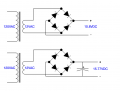
The opposite of an inverter is a rectifier circuit. You can take a 120VAC transformer with an output of 12VAC (RMS) and convert that into 16.97VDC by means of a full wave rectifier bridge and capacitive filter. Why 16.97VDC? Because 12VAC RMS is the useful voltage of an AC sine wave, roughly 71% of the wave form. When you rectify it and filter it you get the Peak voltage of the sine wave. Without the filtration you'll get 12VDC (minus the forward voltage of the bridge rectifier).
Note the upper illustration has no filter capacitor. Hence, its voltage is 12VDC minus the two conducting diodes (assuming peak sine wave) resulting in 10.8VDC. But note that this is a pulsating DC voltage. The lower illustration has a filter cap and the voltage is higher. 12VAC RMS x 1.414 = 16,968VDC. 16.968VDC minus 1.2Vf (forward Voltage) = 15.768VDC (Also of note: Two of the four diodes are conducting at any time). Each diode introduces about 0.6 forward voltage drop meaning it takes that much voltage to push the diode into conduction. You lose that 0.6Vf. Since two of them are in conduction you get about 1.2Vf drop.
There are digital to analog converters, as well as analog to digital converters, BUT it is not likely that the same circuit could work in both directions. And if such a reversible function circuit were created it would be rather complex.

 Facebook
 Google
 GitHub
 Linkedin