Resistors for Led in Series

Thread Starter

rusk1y

Joined Jan 9, 2013
45
Hi, i am new to this forum and circuitry but have been reading a lot about LED's and resistors and need a little help. I am building a aquarium canopy with high power LED's for live plants.

The Given:
Power source = 19VDC , 4740mA
LED's
White Min(3.4V) Typical(3.8) @ 700mA
Blue Min(3.4V) Typical(3.8) @ 700mA SAME as whites
Red Min(2.1V) Typical(2.4) @ 700mA

What i'm doing:
running a total of 20 white, 5 blue, 8 or 9 red. Each color will be it's own series and white will run 4 strings (in series). Trying to run whites at 3.6v so...
R= (19v-(3.6 x 5))/.7 = (19-18)/.7 = 1.43 Ohms, next highest 1.5Ohms.
Would it be better to run it at 1.8Ohm?
I tried that setup with 1.8ohm 1watt, and it seems to be under the .7A LED rating and the resistor stays warm to touch. (Is it supposed to be warm at all? it will never be cold live?)

Since the blue LED's were same ratings as the whites, i am doing same thing. 5 in series, but when i try the same resistor (1.8ohm 1watt), they are not warm to the touch but actually get kinda hot, cant hold it longer than 10 seconds.

The reds i tried 8 in series on it's own resistor. The resistor is 2.2ohm 1watt and seems to be same warmth as the white one. I believe when i measured these they were under .7A as well.

My question is, why were the blue LED's measured at .8 Amps if they are the same rating as the whites and same resistor used?
Am i doing this right? Any help or suggestions would make my day! :)
 

abhaymv

Joined Aug 6, 2011
105
Hi,
Using a series resistor to drive a high power LED is a bad idea.
You should use a constant current source that gives 700mA output for each string. This is because LED's are very sensitive to the voltage used to power them (ie, the current changes a lot with a small change in voltage). So you shouldn't use a constant voltage source, but a constant current source. Then you won't have to worry about series resistances and your LEDs have a happier life.

For details, see the book "Power supplies for LED drivers" By Steve Winder
 

Digitrax

Joined Aug 22, 2012
1
Hi, i am new to this forum and circuitry but have been reading a lot about LED's and resistors and need a little help. I am building a aquarium canopy with high power LED's for live plants.

The Given:
Power source = 19VDC , 4740mA
LED's
White Min(3.4V) Typical(3.8) @ 700mA
Blue Min(3.4V) Typical(3.8) @ 700mA SAME as whites
Red Min(2.1V) Typical(2.4) @ 700mA

What i'm doing:
running a total of 20 white, 5 blue, 8 or 9 red. Each color will be it's own series and white will run 4 strings (in series). Trying to run whites at 3.6v so...
R= (19v-(3.6 x 5))/.7 = (19-18)/.7 = 1.43 Ohms, next highest 1.5Ohms.
Would it be better to run it at 1.8Ohm?
You'll dissipate less wattage (= less brightness, but less wattage across r = less heat)
I tried that setup with 1.8ohm 1watt, and it seems to be under the .7A LED rating and the resistor stays warm to touch. (Is it supposed to be warm at all? it will never be cold live?)
1.8Ω @ 700mA is >88% of your resistor's capacity - best to use a 1.5W or better resistor. Failing that, two 3.9Ω 1W in parallel will handle 2W (@ 1.95Ω) or you could series two 0.82Ω @ 1W each and even at 1.64Ω, they should run cooler - (make sure you leave some airflow around the resistors if possible; if PCB, solder them ¼" off the board).
Since the blue LED's were same ratings as the whites, i am doing same thing. 5 in series, but when i try the same resistor (1.8ohm 1watt), they are not warm to the touch but actually get kinda hot, cant hold it longer than 10 seconds.

The reds i tried 8 in series on it's own resistor. The resistor is 2.2ohm 1watt and seems to be same warmth as the white one. I believe when i measured these they were under .7A as well.

My question is, why were the blue LED's measured at .8 Amps if they are the same rating as the whites and same resistor used?
Am i doing this right? Any help or suggestions would make my day! :)
The blue LEDs probably display less Vfwd than the reds, despite their rating. (i.e. there's a reason these ratings have a range and even the "typical" isn't always typical.)
 

mcgyvr

Joined Oct 15, 2009
5,394
Using resistors is just very inefficient and prone to problems as slight changes in voltage can drastically effect the current.
I'd highly recommend constant current LED drivers..

Here is how "I" would do it.. and I'm gonna assume you might want to dim them too..
So lets see you have the following LED's
20 x 3.4V @700mA whites
5 x 3.4V @700mA blues
9 x 2.1V @700mA reds
Giving a total of 34 LED's..

Id run something like 3 series strings of 11, 14, and 9
String 1 (11 whites) 11 x 3.4 = 37.4 VDC
String 2 (9 reds + 5 blues) 9 x 2.1 + 5 x 3.4 = 35.9VDC
String 3 (9 whites) 9 x 3.4 = 30.6V

So we know we need a driver with a dc output voltage range greater than 37.4VDC
Now I go to meanwells site and I'll just pick one that would work..
The LPF-25D-42 (rated 23 to 42V DC output voltage and 600ma) 3 of those drivers would work just fine. Then get 3 x 100k potentiometers for dimming or just leave the dimming circuit open for full current all the time.

Thats how I would do it..

Don't forget you need some "good" heatsinks to keep those LED's cool.. I'd shoot for no more than 60 deg C temps measured on the metal clad PCB's.. That should ensure the junction temp stays low enough for long life
 

Thread Starter

rusk1y

Joined Jan 9, 2013
45
Id run something like 3 series strings of 11, 14, and 9
String 1 (11 whites) 11 x 3.4 = 37.4 VDC
String 2 (9 reds + 5 blues) 9 x 2.1 + 5 x 3.4 = 35.9VDC
String 3 (9 whites) 9 x 3.4 = 30.6V
Isn't it bad to run two different LED's that require different voltage. Your saying to wire the blue with the red in one series string. Isn't that bad? they will even out the voltage and reds might be getting too much, while blue might be getting too little.

Also, i'm just wondering. I tested the current on one series of 5 white LED's and it was around 650mA using a 1.8ohm resistor 1watt, but when i did the same thing with the blue led's that require same Vf as white, using same resistor, they read about 850mA. My goal is to keep it under 700. What am i doing wrong? what can i do to accomplish below 700?
 

Thread Starter

rusk1y

Joined Jan 9, 2013
45
Hi,
Using a series resistor to drive a high power LED is a bad idea.
You should use a constant current source that gives 700mA output for each string. This is because LED's are very sensitive to the voltage used to power them (ie, the current changes a lot with a small change in voltage). So you shouldn't use a constant voltage source, but a constant current source. Then you won't have to worry about series resistances and your LEDs have a happier life.

For details, see the book "Power supplies for LED drivers" By Steve Winder
My 19vdc power supply is from a old laptop. I measured the voltage, it is stable at 18.9. Never hit 19 even. your saying it's not safe to assume the current will be stable as well?
 

mcgyvr

Joined Oct 15, 2009
5,394
Isn't it bad to run two different LED's that require different voltage. Your saying to wire the blue with the red in one series string. Isn't that bad? they will even out the voltage and reds might be getting too much, while blue might be getting too little.
Nope not at all.. Not how LED's work.. They are constant current devices not constant voltage devices..

In the most basic way...
Think of an LED's forward voltage rating as what it "absorbs" or eats from the power supply. Leaving whats left to do the work.
 

Thread Starter

rusk1y

Joined Jan 9, 2013
45
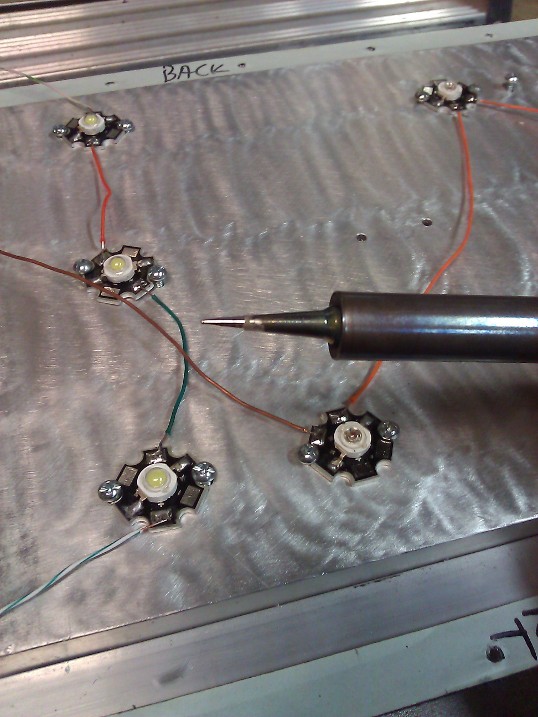
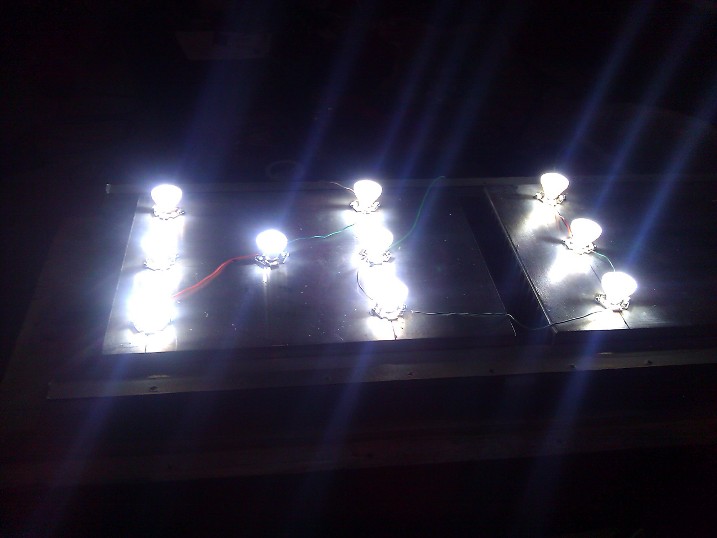
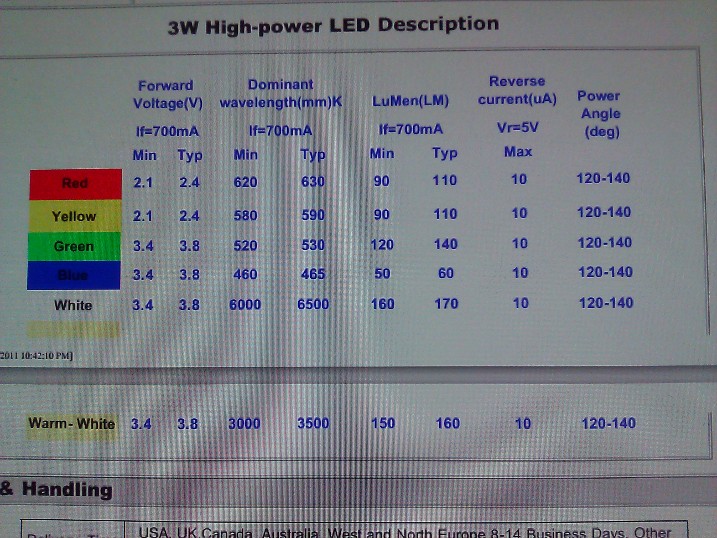
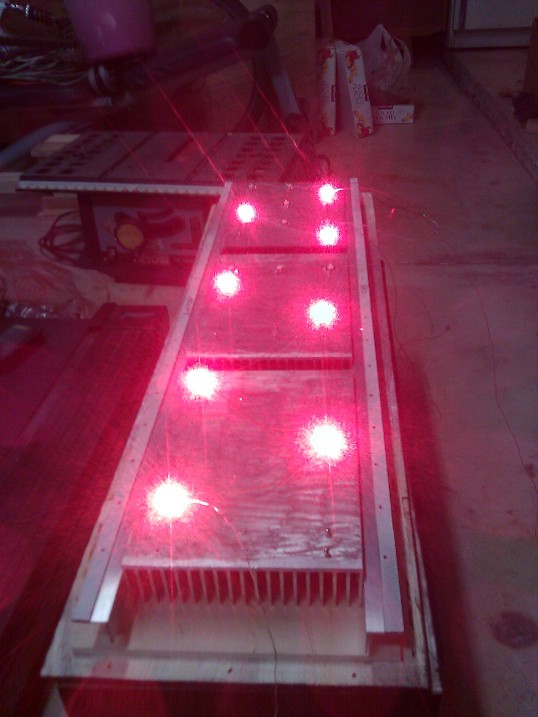
Here's some pictures to give you an understanding of what i'm trying to do.


The above is the power supply rating.
 

Thread Starter

rusk1y

Joined Jan 9, 2013
45
Nope not at all.. Not how LED's work.. They are constant current devices not constant voltage devices..

In the most basic way...
Think of an LED's forward voltage rating as what it "absorbs" or eats from the power supply. Leaving whats left to do the work.
Either way, i was hoping i can have them on their own string so that i can have a on/off switch to control the red, the blue, and white, and fans individually.

Can you guys teach me a little more about using Resistors in Series / Parallel?
That looks like it can help in my case.
 

Thread Starter

rusk1y

Joined Jan 9, 2013
45
Any wow... holy guacamole!
The prices for the LED drivers are steep!
http://www.pegasuslighting.com/led-driver-12w-700ma-hardwire.html
I was thinking of using a couple of those, but that is way too much for me. I will stick with resistors at the moment. Just help me choose one that can keep current around 600mA for each series of 5 LED's. I dont mind doing resistors in series or in parallel, throw some suggestions at me.
 

mcgyvr

Joined Oct 15, 2009
5,394
Here is an example of how to do this. I'm gonna just make up some numbers because I can.
Hint... OHMS LAW is all you need..
(google "ohms law wheel" to see all the iterations of the formula)
We calculate the value of the resistor first..
Power supply = 24VDC
LED max forward voltage 3.2V
Current 600mA (.6A)
Now 24/3.2 = 7.5 (can't have half and LED and 8 would/could be too much as we are left with 0 Volts and we can't do work with that really.
So we can have 7 LEDs in series so now we have
24 - (3.2*7) = 1.6V left
1.6V/.6A = 2.66667 Ohms resistor needed (2.7 is a standard one)

Now to find wattage
.6^2 * 2.7 = .972 W (x 2 for safety) = 2W resistor

So you put 7 LEDs in series with a 2.7 Ohm 2W resistor..

Now we can back check using ohms law still just because.
E/R=I
1.6/2.7 = .59 Amps = good

BUT (and this is the big BUT and the problem with LED's, constant voltage and resistors) what if our LEDs are really running in the 3V forward voltage range and they more than likely will or not..you don't know till its running and even then can/will change during operation/heating
24-(7*3) = 3V
3/2.7 = 1.11 Amps.. Oops.
I hope you see the BIG..BIG problem. As the forward voltage of an LED changes with temperature its very easy to have the perfect amount of current or enough to quickly destroy the LED's..

A constant current driver is constantly adjusting for changes in voltage to ensure the current remains the same..
 

Metalmann

Joined Dec 8, 2012
703
Any wow... holy guacamole!
The prices for the LED drivers are steep!
http://www.pegasuslighting.com/led-driver-12w-700ma-hardwire.html
I was thinking of using a couple of those, but that is way too much for me. I will stick with resistors at the moment. Just help me choose one that can keep current around 600mA for each series of 5 LED's. I dont mind doing resistors in series or in parallel, throw some suggestions at me.


Drivers on Ebay are a lot cheaper....;)
 

mcgyvr

Joined Oct 15, 2009
5,394
Drivers on Ebay are a lot cheaper....;)
And of far less quality.. You get what you pay for...

Last week on another board I go to, a teacher bought a LED fixture from China using one of the "cheaper" drivers and had it over a fish tank in her classroom.. Xmas eve night it caught fire causing half a MILLION dollars in damage to the school.. :(
 

Thread Starter

rusk1y

Joined Jan 9, 2013
45
And of far less quality.. You get what you pay for...

Last week on another board I go to, a teacher bought a LED fixture from China using one of the "cheaper" drivers and had it over a fish tank in her classroom.. Xmas eve night it caught fire causing half a MILLION dollars in damage to the school.. :(
Lol your scaring me!
Well maybe it was a faulty driver... if it's constantly changing voltage to keep the current the same, maybe something flickered and instead of shorting out it let the current through 100%?
 

Thread Starter

rusk1y

Joined Jan 9, 2013
45
And of far less quality.. You get what you pay for...

Last week on another board I go to, a teacher bought a LED fixture from China using one of the "cheaper" drivers and had it over a fish tank in her classroom.. Xmas eve night it caught fire causing half a MILLION dollars in damage to the school.. :(
And why didn't they put out the fire with the water in the fish tank? :)
 

Thread Starter

rusk1y

Joined Jan 9, 2013
45
And of far less quality.. You get what you pay for...

Last week on another board I go to, a teacher bought a LED fixture from China using one of the "cheaper" drivers and had it over a fish tank in her classroom.. Xmas eve night it caught fire causing half a MILLION dollars in damage to the school.. :(
I do plan on leaving my lights on in a controlled staged environment to make sure they are safe enough before putting them over the tank. Test them out in the garage on concrete or something for a week or so.
 

Thread Starter

rusk1y

Joined Jan 9, 2013
45
Here is an example of how to do this. I'm gonna just make up some numbers because I can.
Hint... OHMS LAW is all you need..
(google "ohms law wheel" to see all the iterations of the formula)
We calculate the value of the resistor first..
Power supply = 24VDC
LED max forward voltage 3.2V
Current 600mA (.6A)
Now 24/3.2 = 7.5 (can't have half and LED and 8 would/could be too much as we are left with 0 Volts and we can't do work with that really.
So we can have 7 LEDs in series so now we have
24 - (3.2*7) = 1.6V left
1.6V/.6A = 2.66667 Ohms resistor needed (2.7 is a standard one)

Now to find wattage
.6^2 * 2.7 = .972 W (x 2 for safety) = 2W resistor

So you put 7 LEDs in series with a 2.7 Ohm 2W resistor..

Now we can back check using ohms law still just because.
E/R=I
1.6/2.7 = .59 Amps = good

BUT (and this is the big BUT and the problem with LED's, constant voltage and resistors) what if our LEDs are really running in the 3V forward voltage range and they more than likely will or not..you don't know till its running and even then can/will change during operation/heating
24-(7*3) = 3V
3/2.7 = 1.11 Amps.. Oops.
I hope you see the BIG..BIG problem. As the forward voltage of an LED changes with temperature its very easy to have the perfect amount of current or enough to quickly destroy the LED's..

A constant current driver is constantly adjusting for changes in voltage to ensure the current remains the same..
I know all about ohm's law... i've used that formula in my brain so many times i get it... it's simple. The only thing i dont get is how you know that you will get exactly that amount of voltage drop using the particular resistor versus how you know you will be getting the particular current or anything "close enough". After plugging in the resistor and testing it out, the results are always off by some percent. What i want to know if which resistors i can use or use in series/parallel to make the LED work at like 60-65% of it's max capacity current wise, and to keep voltage levels down too. say about 3.3-3.4V / LED.
 

mcgyvr

Joined Oct 15, 2009
5,394
I know all about ohm's law... i've used that formula in my brain so many times i get it... it's simple. The only thing i dont get is how you know that you will get exactly that amount of voltage drop using the particular resistor versus how you know you will be getting the particular current or anything "close enough". After plugging in the resistor and testing it out, the results are always off by some percent. What i want to know if which resistors i can use or use in series/parallel to make the LED work at like 60-65% of it's max capacity current wise, and to keep voltage levels down too. say about 3.3-3.4V / LED.
If you knew ohms law (well and how an LED works) you wouldn't be asking those questions.. Stop think about the forward voltage as the voltage an LED needs to produce a desired brightness.. This isn't a fan where you supply it with 12V and it spins so fast or supply it with less voltage and it spins slower.. LED"s (diodes) don't work like that.

An LED's forward voltage is just what it is you need to deal with it.. Higher junction temps = higher forward voltage. For example an LED when cool might have a forward voltage of 3V..As it heats up its forward voltage will rise (datasheet typically has the information about what the Vf will be at what junction temp). As the forward voltage rises or lowers and you are using a fixed resistor/fixed voltage source the current will be changing (and many times quite a bit).. Hence AGAIN the problem with LED's and fixed value resistors/constant voltage power supplies. Again why you want to use a constant current supply NOT constant voltage. A LED's brightness is related to the amount of current flowing through it not its forward voltage..

There is one goofball (Tako or something) on here that is using LED's with constant (well adjustable voltage supplies) voltage supplies.. BUT the reason its working for him is that he can adjust the output voltage to ensure the current remains where it should be.. With a 100% fixed voltage supply like you have you DON'T have that luxury. And your LED fixture is bound to fail.. And when it fails it could be as simple as a burned out LED or it could result in a fire.

And about the school fire.. The sprinkler system did put out the fire.. The problem was that in that process that room and 7 others were FLOODED. The majority of damage was flood damage..not actual fire damage.

oh and if you really want to continue using a fixed voltage source I've already shown how you figure out the resistor you need.. But I also showed how thats a problem.. read it again till you understand.
 
Last edited:

Audioguru

Joined Dec 20, 2007
11,248
Are you going to operate the LEDs at their absolute maximum allowed current? Then you must cool them expensively.

Did you see that the LEDs have a RANGE of forward voltage? Some white or blue ones might be 3.4V and others might be 3.8V.

Maybe your power supply is exactly 19.0V.
Maybe all 5 LEDs are 3.4V. Then with a 1.8 ohm resistor the current is 1.11A!
Maybe all 5 LEDs are 3.8V. Then they will not light!

Use less LEDs in series (then the resistors get VERY hot). Or use a current-regulator circuit.
 

abhaymv

Joined Aug 6, 2011
105
My 19vdc power supply is from a old laptop. I measured the voltage, it is stable at 18.9. Never hit 19 even. your saying it's not safe to assume the current will be stable as well?
My point have been made by other members, but still, I wish to emphasize it. It took me a while to understand.
-Having a constant voltage source will not ensure the current being constant.
-You cannot regulate voltage and current at the same time, so its either a constant voltage source (like what you have) or a constant current source in any circuit.
-You need a constant current source for LEDs! They will take whatever voltage that is required to maintain the constant current.

If you want details, see this thread. I had the exact same problem in my project.
http://forum.allaboutcircuits.com/showthread.php?t=78061
 
Top