Resistors and Voltage Regulator

Thread Starter

dingo

Joined Mar 11, 2011
60
Hello everyone.
In my Tina7 simulation schematic, I was able to reduce a 12v battery to about 3.7v using some xxx ohms resistor. Is this a good idea? I want to have a constant flow of around that smaller volt. Or do i need a voltage regulator that will regulates from 12v to 5v, then use resistors to around 3.7v?

What do experienced member here think?
 

lkgan

Joined Dec 18, 2009
117
You mean either using a voltage divider or voltage regulator to obtain the desire 3.7V? Well, it depends on your application and your load impedance. If you would need a very stable voltage, I would recommend you to use voltage regulator. A voltage divider output varies if maximum power transfer do not occur between your source and load.
 

Jaguarjoe

Joined Apr 7, 2010
767
LM317 adjustable voltage regulators can used to get a constant 3.7v. You didn't mention how much current is required, the 317 can put out 3 amps in the bigger package. In the TO-92 pkg it is good for 100ma (they're cheap too). Be sure to check the power dissipaqtion to determine if a heatsink is required.

A resistive voltage divider is ok if the load doesn't change at all and the input voltage to the divider is constant.
 

Thread Starter

dingo

Joined Mar 11, 2011
60
thanks for both of your kind replies.

My batter for my camera is currently at 7.2v at 1150mAh. I'm very new to hands on things. I've just been doing things digitally and I know the real world is a whole lot different because there are many variables that effects your electronics.

I've been looking at the RadioShack website and did like the 317. :) Thanks Jaguarjoe.

So in a dummy explanation, can I connect them all in this fashion?

12v battery connects to LM317. 317 connects to some resistors. Resistors connect to a diode. Diode connect to camera. Camera connect to GND.

Is this okay?
 

lkgan

Joined Dec 18, 2009
117
It would be clearer if you draw out the schematic. Beware that if your resistor is in series with your camera, there's a voltage drop at the resistor and you might not get 3.17V for your camera.
 

Jaguarjoe

Joined Apr 7, 2010
767
Here is the datasheet. Can you find your circuit?

http://www.national.com/ds/LM/LM117.pdf

You shouldn't need a diode in series with the 317 going to the camera.

Radio Shack is very convienient but also very expensive. You can get cheaper parts here:

All Electronics
BGmicro
Electronics Goldmine
Electronix Express
Hosfelt
MP Jones

Full line suppliers that will have just about anything you could think of:

Digikey
Newark
Mouser
Allied Radio

A $2.49 LM317T at Radio Shack is $0.70 at All Electronics. They have a smaller version in a TO-92 package for $0.65. It would probably work well for you:

http://www.allelectronics.com/index.php?page=search&search_query=lm317&x=22&y=6
 
Last edited:

Audioguru

Joined Dec 20, 2007
11,248
A "7.2V" rechargeable battery might be two lithium cells in series that charge at 8.4V or it might be six Ni-Cad or Ni-MH cells in series that charge at 8.4V.
The charger must limit the current to the spec's of the battery and sense full-charge then shut off.

It will get very complicated if the camera is turned on while its battery is charging.
 

Audioguru

Joined Dec 20, 2007
11,248
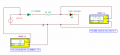
You are measuring the voltage across the 1.74V red LED. The 1N4005 diode reduces the 12V to 11.3V and the 100 ohm resistor limits the current in the LED to 96mA which will quickly burn it out. The power dissipated in the resistor is 0.9W.

A resistor is not a voltage regulator.
 

Thread Starter

dingo

Joined Mar 11, 2011
60
Hello there Audioguru,

Thank you for your great advices. I learned alot just from those few sentences.
So I have 2 questions that has been bugging my for a while.
1. What is the proper way to reduce a 12v to a 3.7v?
2. What is the difference between a volt and a current and how are they related?


thanks
 

Audioguru

Joined Dec 20, 2007
11,248
You said the charger for your camera is rated at 7.2V, not 3.7V. So why do you need a 3.7V voltage regulator?

We don't know if the charging circuit for your camera is in the camera or is in the charger. We also don't know where is the diode that keeps the battery from being discharged by the charger.

An LM317 is a voltage regulator that can have its regulated output voltage set to 3.7V or set to 4.4V so that a series output diode can be used to deliver 3.7V without discharging the battery in the camera.

You need to go to a high school physics class to learn about the simple electricity terms of volts and amperes. Or look in Google.
 

Audioguru

Joined Dec 20, 2007
11,248
Your camera might be designed to only run from its battery. its charger migh have the charging circuit in it that has a low current for charging the camera's battery but its current might not be high enough to run the camera.

Which voltage? 3.7V or 7.2V? With a diode or without a diode?
 

Thread Starter

dingo

Joined Mar 11, 2011
60
Hello Audioguru,

7.2 or 3.7. It doesn't really matter to me. I mistake both of them. I'm interested in the setup. I think that If I can minimize the volt then I should be able to do the same to make it smaller to 3.7 if I needed to.

How would you set this up?
 

Audioguru

Joined Dec 20, 2007
11,248
Your camera runs on a certain voltage. If the voltage is too low then the camera will not run or it runs poorly.
If the voltage is too high then the camera and its charging circuit and its battery might be destroyed.

An adjustable LM317 voltage regulator can be set to any regulated voltage you want. But you don't know how much voltage.
 

Thread Starter

dingo

Joined Mar 11, 2011
60
Hello Audioguru,

I would like to thank you for taking your time to discuss this with me.

In regards to the voltage, I have a multimeter. Can't I just simply check the voltage on the battery? Or look up the technical spec for the battery and see what it's volt is?

Will I have to measure the how much current is going out as well?
 

Audioguru

Joined Dec 20, 2007
11,248
You said 7.2V/1150mAh so maybe it is written on the battery?
A battery can supply a very high current for a moment for the camera to turn on and "open". We don't know how much current so we don't know how much current an external power supply should have. It might be for a duration that is too short for a multimeter to measure.

If you connect a regulated 7.2V power supply with enough current as is needed (2A? 3A?) then the camera should work.
 
Top