Require small 3 pin connector

Thread Starter

AlbertHall

Joined Jun 4, 2014
12,619
I need a small 3 pin connector which can be safely hot plugged.
I thought of a 2.5mm stereo connector but the pins get shorted when plugging or unplugging, and it is easy to disconnect accidentally - just pull the wire.
Also possible USB connector. The problem here is the small ones have pins which I may not be able to make a PCB for them. I can do minimum 0.3mm width tracks and isolation.
Any ideas?
 

Hymie

Joined Mar 30, 2018
1,347
Have you considered a micro USB socket, although making the solder connections and ensuring no shorts could prove difficult – I’ve constructed a number of home-brew projects powered by USB, using these adapter boards (with postage they work out at less than 40₵ each).

https://www.ebay.co.uk/itm/191674193772
 

panic mode

Joined Oct 10, 2011
4,864
not sure i understand the requirements. 2,5mm stereo connector as well as USB connectors are easy to disconnect accidentally - just pull the wire. how often this is supposed to be mated? obviously amphenol/cannon have bayonet option but are too large. perhaps connectors with threaded retention would work? like on industrial sensors... T4111001041-000 or similar (those are more common M8).
View attachment 332498
but one can go smaller with M5...
like https://www.mouser.ca/datasheet/2/18/1/Amphenol_M5_XXBMMM_SL7FXX_B_-2885911.pdf
https://www.mouser.ca/datasheet/2/18/1/Amphenol_M5_XXPFFP_SF7001_A_-2885915.pdf
 
Last edited:

Ya’akov

Joined Jan 27, 2019
10,226
Echoing @Jon Chandler’s concern, using a common, well defined connector for things it is not designed to do is generally inviting trouble. However if you are going to do it you can at least avoid trouble by carefully choosing the pins you use.

Avoiding the VBUS pins is the first thing. The problem is easily used connectors will include only those pins (since they will be intended to power and no data or other signals).

What are the signals on the three lines? I assume one is 0V, are the other two power?
 

Ya’akov

Joined Jan 27, 2019
10,226
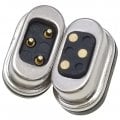
By the way, one alternative might be the ubiquitous magnetic connectors now very commonly available.

They come in a variety of types and it is unlikely that you’d encounter another device using a particular one (that uses more than two pins). For example, this three pin variety:

IMG_3393.jpegIMG_3395.jpeg
 

Ya’akov

Joined Jan 27, 2019
10,226
Power, Ground, and signal (sensor data).
The only "someone" who might plug in the wrong lead is me!
Consider this, the Type-C connector can be plugged in either of two ways. How will you handle that? You will have to have the signals arranged so they work no matter the orientation.

You will also find that the available cables vary considerably in which pins they connect.
 

Thread Starter

AlbertHall

Joined Jun 4, 2014
12,619
Consider this, the Type-C connector can be plugged in either of two ways. How will you handle that? You will have to have the signals arranged so they work no matter the orientation.

You will also find that the available cables vary considerably in which pins they connect.
Yes, I will be doing some continuity measurements.
 

Hymie

Joined Mar 30, 2018
1,347
If you are going to use a USB socket for connection, I would recommend that you add epoxy resin/glue as an additional means of securement, besides the solder.

I have found that with repeated connection/disconnect, the soldering fixing of USB sockets is likely to fail – just make sure when applying the glue that you do don’t impact the plug connection.
 

Thread Starter

AlbertHall

Joined Jun 4, 2014
12,619
If you are going to use a USB socket for connection, I would recommend that you add epoxy resin/glue as an additional means of securement, besides the solder.

I have found that with repeated connection/disconnect, the soldering fixing of USB sockets is likely to fail – just make sure when applying the glue that you do don’t impact the plug connection.
The connector I plan to use has four through-hole pins for fixing to the board so that should be OK - SMT for the electrical connections.
 

Ya’akov

Joined Jan 27, 2019
10,226
that should not be a problem. just parallel circuits of A and B side. example mentioned in #5 only uses pins 5,9 and 12.
https://www.allaboutcircuits.com/te...pe-c-which-pins-power-delivery-data-transfer/
But using the PD/VBUS pins is the most dangerous arrangement. Making the mistake off plugging in a bogus charger with a Type-C connector on it could lead to... an adverse outcome.

@AlbertHall maybe you could actually use Type-C and PD. There are pins that can be used for arbitrary signaling and you can get PD protocol chips ultra cheap.
 

MisterBill2

Joined Jan 23, 2018
27,180
Although it has nine pins and you only need three pins, the old computer "D" style connectors are often available on used and scrapped items. They offer the benefit of a solid connection, backshell options for wire strain relief, optional screw locking, and common availability. In addition they are often available with cables attached.
Of course, in some areas no obsolete or discarded hardware is available.
A second common alternative is the five-pin (DIN) circular connectors such as have been used for both keyboard and audio connections for many years. They are an easy to handle size and big enough to be easy to install without needing a magnifier. And they do not match any of the current products so accidents are much less likely.
 

panic mode

Joined Oct 10, 2011
4,864
But using the PD/VBUS pins is the most dangerous arrangement. Making the mistake off plugging in a bogus charger with a Type-C connector on it could lead to... an adverse outcome.
could be... if polarity and voltages do not match... the way i read it this is not a USB application so there is no need for PD protocol chips. since this is just a sensor, it should be easy to protect. but since the specs and actual arrangement are not known i am not going to try guessing.
 
Top