Facebook
 Google
 GitHub
 Linkedin
Hello all,
I have received for free one of these soldering stations that is sold under the names of Fixpoint AP2, Velleman VTSS4N, ProK Power Solder 2/3/4 (here is a review by a Dutch guy) as it was defective and it had the following problem: when rotating the potentiometer, it would essentially not heat up the iron or the tip unless the potentiometer was set to a position of maximum power/heat. I could also hear sparks (as from an inductive/capacitive current) for a very narrow range of potentiometer positions/angles (transition between no power consumption to significant or maximum power consumption). Since I had already had experience with this soldering station before (I bought one for myself somewhere in 2013-2015), I suspected the culprit was the heating element, since this was the problem I had had with the soldering station I bought, and the problem had been solved by replacing the heating element (in 2023).
I bought a replacement heating element and installed it (the older heating element had a resistance of about 1.6 kOhm and was somewhat falling apart, while the new one had a resistance of about 1.2 kOhm). The problem didn't get solved. I therefore opened the soldering station and started doing some basic tests (mostly measuring resistance values of components, to check for open and short circuits). I realized something weird about the potentiometer terminals: the resistance wouldn't change for pretty much the whole rotating range of the potentiometer (about 326 kOhm), and it would then suddenly drop to essentially zero (less than 5 Ohm) for a very narrow range (maybe the last 15-20 degrees). Note that the potentiometer is in parallel with another potentiometer (which explains the 326 kOhm value) and that two of its pins are shorted (which is okay).
I then desoldered the potentiometer (ironically, with a soldering station of the same model, that I found and bought after getting the defective one; I cannot use the one I bought in 2013-2015 since it is far away, i.e., in my home country). The potentiometer was indeed faulty, and electrically had a behavior very much like an open circuit for almost the whole rotating range and a few Ohms for the narrow range. It was also the source of the sparks, so I soldered two wires to the PCB and to the potentiometer and recorded such sparks while rotating it (video link; yes, "do not try this at home"... also, the potentiometer stopped working completely not long after recording this video). I opened the potentiometer, and what I remember seeing was that, for that narrow range, the resistive material was not on the PCB material/substrate anymore but on the tiny "hooks" of the slider, as if the slider had scrubbed it off.
This led me to think that maybe the new potentiometer could fail in the same way. I therefore spent some time reverse engineering the circuit (PCB photo below) and simulate it using circuitjs (here, or upload the attached file to the circuitjs website). The TRIAC is MAC97A6, so I adjusted the parameters of the TRIAC more or less according to its datasheet and the DIAC to have a breakover voltage of 30-40V and to have a representative power consumption by the load for different positions of the potentiometer (minimum around 7W, middle around 20W, maximum around 46W). According to the simulation results, the potentiometer seems to dissipate excessive power, exactly within a quite narrow range (the range in which the sparks/worn out resistive material would occur). For example, when the potentiometer is set to 22.3 kOhm, average power dissipation is 72 mW; assuming the nominal power for the whole resistive material is 250 mW, then proportionally when set to 22.3 kOhm (22.3/500=0.0446 or about 4.5%), the potentiometer should only be dissipating about 4.5% of 250mW, i.e., about 11 mW. That means it's dissipating 6.5 times what it should be dissipating!
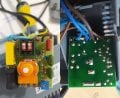
I also have another problem: there is coil whine (from the black inductor, I assume, from the current through it being switched at 2*50=100 Hz — I live in Europe) for almost the whole range of the potentiometer except close to the very end (I think that, because the chopped voltage is very close to the mains sine wave, the result is that the current doesn't increase sharply and therefore noise is much lower).
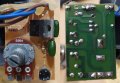
I also have a photo of the PCB of the soldering station (model ZD-98) I used to replace the faulty potentiometer. The design is very similar, it is just missing the EMI/RFI filter (transformer, X2 capacitor, inductor) and the RC snubber of the TRIAC.
The reasons I posted this:
1) how could the circuit be improved to prevent the potentiometer from overheating/wearing out prematurely?
2) how could I alleviate or completely suppress the coil whine, while keeping the filtering of the inductor (I could just short it by soldering a wire to its terminals, sure, but then the filtering it provides is gone)?
Thank you in advance
I have received for free one of these soldering stations that is sold under the names of Fixpoint AP2, Velleman VTSS4N, ProK Power Solder 2/3/4 (here is a review by a Dutch guy) as it was defective and it had the following problem: when rotating the potentiometer, it would essentially not heat up the iron or the tip unless the potentiometer was set to a position of maximum power/heat. I could also hear sparks (as from an inductive/capacitive current) for a very narrow range of potentiometer positions/angles (transition between no power consumption to significant or maximum power consumption). Since I had already had experience with this soldering station before (I bought one for myself somewhere in 2013-2015), I suspected the culprit was the heating element, since this was the problem I had had with the soldering station I bought, and the problem had been solved by replacing the heating element (in 2023).
I bought a replacement heating element and installed it (the older heating element had a resistance of about 1.6 kOhm and was somewhat falling apart, while the new one had a resistance of about 1.2 kOhm). The problem didn't get solved. I therefore opened the soldering station and started doing some basic tests (mostly measuring resistance values of components, to check for open and short circuits). I realized something weird about the potentiometer terminals: the resistance wouldn't change for pretty much the whole rotating range of the potentiometer (about 326 kOhm), and it would then suddenly drop to essentially zero (less than 5 Ohm) for a very narrow range (maybe the last 15-20 degrees). Note that the potentiometer is in parallel with another potentiometer (which explains the 326 kOhm value) and that two of its pins are shorted (which is okay).
I then desoldered the potentiometer (ironically, with a soldering station of the same model, that I found and bought after getting the defective one; I cannot use the one I bought in 2013-2015 since it is far away, i.e., in my home country). The potentiometer was indeed faulty, and electrically had a behavior very much like an open circuit for almost the whole rotating range and a few Ohms for the narrow range. It was also the source of the sparks, so I soldered two wires to the PCB and to the potentiometer and recorded such sparks while rotating it (video link; yes, "do not try this at home"... also, the potentiometer stopped working completely not long after recording this video). I opened the potentiometer, and what I remember seeing was that, for that narrow range, the resistive material was not on the PCB material/substrate anymore but on the tiny "hooks" of the slider, as if the slider had scrubbed it off.
This led me to think that maybe the new potentiometer could fail in the same way. I therefore spent some time reverse engineering the circuit (PCB photo below) and simulate it using circuitjs (here, or upload the attached file to the circuitjs website). The TRIAC is MAC97A6, so I adjusted the parameters of the TRIAC more or less according to its datasheet and the DIAC to have a breakover voltage of 30-40V and to have a representative power consumption by the load for different positions of the potentiometer (minimum around 7W, middle around 20W, maximum around 46W). According to the simulation results, the potentiometer seems to dissipate excessive power, exactly within a quite narrow range (the range in which the sparks/worn out resistive material would occur). For example, when the potentiometer is set to 22.3 kOhm, average power dissipation is 72 mW; assuming the nominal power for the whole resistive material is 250 mW, then proportionally when set to 22.3 kOhm (22.3/500=0.0446 or about 4.5%), the potentiometer should only be dissipating about 4.5% of 250mW, i.e., about 11 mW. That means it's dissipating 6.5 times what it should be dissipating!
I also have another problem: there is coil whine (from the black inductor, I assume, from the current through it being switched at 2*50=100 Hz — I live in Europe) for almost the whole range of the potentiometer except close to the very end (I think that, because the chopped voltage is very close to the mains sine wave, the result is that the current doesn't increase sharply and therefore noise is much lower).
I also have a photo of the PCB of the soldering station (model ZD-98) I used to replace the faulty potentiometer. The design is very similar, it is just missing the EMI/RFI filter (transformer, X2 capacitor, inductor) and the RC snubber of the TRIAC.
The reasons I posted this:
1) how could the circuit be improved to prevent the potentiometer from overheating/wearing out prematurely?
2) how could I alleviate or completely suppress the coil whine, while keeping the filtering of the inductor (I could just short it by soldering a wire to its terminals, sure, but then the filtering it provides is gone)?
Thank you in advance
Attachments
-
1.5 KB Views: 21
Last edited: