Relays needed to make my central hearing and hot water "smart"

Thread Starter

elsmandino

Joined Mar 3, 2022
11
Hi there.

I am in the process of using a Shelly 2PM (Gen 4) Relay to make my heating/water system, smart. I am then going to use Home Assistant to control it.

I need two relays for the project:

* A mechanical SPDT NO relay, 230v 10A
* A mechanical SPST relay, 230v 10A

Can anyone offer me any advice on what and where to buy (I am in the UK) as these are trickier to find that I had first thought.

Do I need to buy a separate relays and relay holders or can the wires be connected directly to the relays?
 

B-JoJo-S

Joined Jan 3, 2026
300
What is the control voltage? The relay coil? It looks like you're looking for relays that can switch 230VAC with a relay rated to handle up to 10 amps. Are you looking for an SPST NO or NC relay? The SPDT has both NO & NC.

Do you know you can use two SPDT relays? You'll just have one unused pin.
 

Thread Starter

elsmandino

Joined Mar 3, 2022
11
Thanks for this - oddly, it might actually end up cheaper to use two SPDT relays as they seem to be slightly cheaper.

Just to clarify what I am up to:

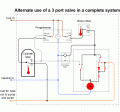
I currently have this system in my house:

Y Plan central heating system

I have bought one of these ( Shelly 2PM Gen4 - Shelly Europe ) to replace my current water and heating controller.

The heating side is quite straightforward as all it needs is a SPST connection, so I can wire this directly into one of the channels of the Shelly.

The hot water is slightly more tricky as the wiring requires a SPDT switch. As the Shelly only has a SPST, I need to wire a SPDT relay to the hot water wiring and then in turn connect that relay with the Shelly's other channel.

The reason I need an additional SPST relay?

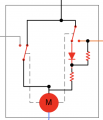
This Y Plan type of heating has a drawback whereby the actuator gets stuck on when you are using the heating only but then turn the heating off - the actuator is designed for this but I have read that by adding a relay like in the attachment, you can significantly extend the life of the actuator.

Hopefully, if I can find the correct relays, it should be quite a simple rewiring job.
 

Attachments

B-JoJo-S

Joined Jan 3, 2026
300
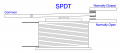
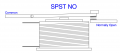
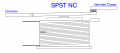
I hate to ask this question - it's not intended to make you feel foolish or uneducated - but do you know the difference between an SPST relay and an SPDT relay? I've prepared some pictures. I think you might be thinking more of a DPDT relay, which I can quickly bang out a picture if needed.
Screenshot 2026-06-03 at 6.41.05 AM.png

Screenshot 2026-06-03 at 6.41.19 AM.png
Screenshot 2026-06-03 at 6.41.53 AM.png
It's important to understand what you need. From your drawing it looks like the control voltage is likely 230VAC. Does your water heater draw 10 amps? (2300W)
 

Thread Starter

elsmandino

Joined Mar 3, 2022
11
Thanks so much for this - please don't worry about making me feel foolish or uneducated (those, who know me, would definitely say I am both ). :)

I am here to absorb all I possibly can and really appreciate the help.

My system is protected by a 3Amp fuse, so I was going with 10A relays to give me a bit of headroom.

Looking at your drawings, I think I definitely need a SPDT for the hot water part of the wiring as it relies on either one or the other part of the circuit being connected at any one time.

With regard to the relay for connecting the hot water to the actuator - I think I need (at a minimum) a SPST NO relay. This should guarantee that when the room thermostat is not calling for heat, the grey wire is not connected and three-port valve returns to its default state (hot water only).

I think the Y-Plan circuitry is very clever but it does give me a bit of headache, each time I look at it.
 

B-JoJo-S

Joined Jan 3, 2026
300
My system is protected by a 3Amp fuse, so I was going with 10A relays to give me a bit of headroom.
Good plan. If anticipating a 3 amp load then the MINIMUM rating for the contacts should be 130% of the load. 150% is better. With some caveat's going with a 10A contact is fine in this case. In some cases you don't want to go overboard. Has an effect on the bottom line AND too large a contact means there's never enough of an arc to clean the contacts. Forget about that - it's just minutia at this point.
I think the Y-Plan circuitry is very clever but it does give me a bit of headache, each time I look at it.
I've never seen this before and it will take me some time to wrap my head around it.

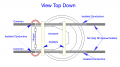
FYI I've banged out an overhead view of a DPDT relay. From the drawing below you can see that in this case there are two contact circuits, each consisting of C, NO & NC (the NO is hidden behind the NC contact, though not exactly labeled). The actuating armature is isolated from the two circuits via an insulator bar. The isolated conductors are flexible braided wire (red) meant to allow the armature free movement. I didn't draw in the spring that holds the armature away from the coil so you have to use a little imagination. The circular parts of the illustration is the coil below the armature.
Screenshot 2026-06-03 at 7.35.34 AM.png
I enjoy drawing mechanical drawings. I've used some differentiating fills to show the difference between conductors that are stationary and those that move.
 

ThePanMan

Joined Mar 13, 2020
918
I think they're shown in the motor NOT running position. When power comes on the diode is bypassed. When the motor comes up to speed the centrifugal switches (if that's what they are) switch over and power goes to the motor through two resistors, though I don't know why. At the same time power is routed out to the boiler. I don't even have any idea what the diode does for the circuit. Perhaps at shut-down any BEMF may be stopped by the freewheeling diode. The SPST Mains Relay; What is that doing? Supposed to be doing? If the motor is running then power is passing through two resistors, through the relay and going to the Cylinder Stat (stat port) and to the water heater (HW Off port). It kind of looks like a goldbrick circuit.
 

ThePanMan

Joined Mar 13, 2020
918
Is the motor a Circulating pump? What's the "Call for heat out to pump and boiler" do? OK, it turns the boiler on and turns on a pump. Is this the pump shown in the box?

[edit] If you're in the UK - I didn't know they had a neutral wire on their electrical circuits. UK, as far as I know is a 240VAC service with L1 & L2. No Neutral. In the US the service is split phase 240VAC split to 120 - 0 - 120VAC with L1, N & L2.
 

Thread Starter

elsmandino

Joined Mar 3, 2022
11
It is really difficult to work out how it all works until you see it in action. The actuator sits on top of a three way valve. The valve's default position sends hot water through my hot tank, the middle position sends water through both my tank and radiators and the third position sends water through my radiators only.

When either is activated, both my boiler and pump are called into action.

I currently have a timer next to the actuator that dictates when hot water and heating run. I want to swap out the timer and put a two channel shelly in its place.

In the Y Plan central heating system wiring diagram, as the Shelly only has a SPST relay built into it, I need a SPDT relay to connect ports 1 and 3 of the "Programmer". The second relay is to fit in as indicated as per my attachment above.
 

MaxHeadRoom

Joined Jul 18, 2013
30,654
[edit] If you're in the UK - I didn't know they had a neutral wire on their electrical circuits. UK, as far as I know is a 240VAC service with L1 & L2.
Domestic supply is fed from one phase of a 3ph transformer, the star point is the grounded neutral.
At least it was when I originally worked and lived there.
 
Last edited:
Top