Relay contacts welding - inductive motor load - RC snubber question

MisterBill2

Joined Jan 23, 2018
27,687
Consider that relay contacts do not "weld closed" during the relay OPENING action. AND, a snubber or other protective scheme works to reduce sparking damage when a relay OPENS.
I researched the relay data sheet and I see an AC rating for the contacts of 3 amps. BUT, looking at the rest of the relay contact ratings, my evaluation is that those ratings are rather hard to believe.
Consider that the motor is always starting under load, both lifting and lowering the blind.
 

Thread Starter

peugot

Joined Sep 15, 2025
9
ChuckMcM, I've built a zero-crossing circuit using an optocoupler h11aa1 and it does work, but only with a hardcoded delay of ~5ms after the detection! It then works very consistent as well, no arcing at all!

What causes it to work with only this delay? On the scope I can see that the optocoupler triggers basically instantly on the 0-volt signal, and the relay gets immediately turned on/off then (if it needed to be).

I have a feeling that this offset delay could be dependent on the motor load, which then makes it still unusable when a different motor is used.
 

MisterBill2

Joined Jan 23, 2018
27,687
ChuckMcM, I've built a zero-crossing circuit using an optocoupler h11aa1 and it does work, but only with a hardcoded delay of ~5ms after the detection! It then works very consistent as well, no arcing at all!

What causes it to work with only this delay? On the scope I can see that the optocoupler triggers basically instantly on the 0-volt signal, and the relay gets immediately turned on/off then (if it needed to be).

I have a feeling that this offset delay could be dependent on the motor load, which then makes it still unusable when a different motor is used.
Certainly an adequately rated zero crossing switch would be a very good choice for this application. AND, it is not until post #13 that we see an actual application circuit. That circuit tells me that the motor is actually a reversible "permanent Split Capacitor" type of motor. THAT type of motor should never be "instantly " reversed!!
In addition, as already stated clearly, that form-factor of relay is not at all suited for motor control operation.AND, one thing that I neglected to mention is that those diodes across the relay coil SLOW THE RELEASE of the relay, allowing lots of time for arcing to heat the contacts.
 
Last edited:

panic mode

Joined Oct 10, 2011
5,041
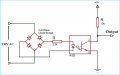
i do not like the circuit with optocoupler in that link. resistor value is way too low for 230VAC. as a result input current is excessive (nearly 100mA) and beyond safe limit for 4N25 (Absolute maximum is 60mA)
1759160000894.png

i would rather use AC style opto like SFH6206, get rid of full bridge rectifier and increase resistor value from 2.2k to 22k so that input current is in the ballpark of 10mA and well within product ratings.


EDIT -----------

always check power as well...!

this 22k resistor should be 5W (or at the very least 3W).

if you want to reduce heat dissipation size it according to product specs. for example SFH6206has CTR of 63-200%.
Ic current is limited to 5V/10k = 0.5mA, and 0.5mA/0.63 of that is 0.8mA.
suppose we choose 2.3mA as safe value that makes math easier. 230V/0.0023A = 100k

230V*230V/100k = 0.53W so 100k 1W resistor will do.
 
Last edited:

MisterBill2

Joined Jan 23, 2018
27,687
WHERE did the 120 volts AC come from controlling an opto device???
The post from the TS shows a signal feeding an FET to drive the relay.
AND, rather than adding that diode that slows the relay release and allows a greater arcing time, why not simply use a higher voltage rated MOSFET??? For that fairly low current relay coil driving application, how much more does a 200 volt mosfet cost than the 30 volt mosfet device???
 

panic mode

Joined Oct 10, 2011
5,041
What causes it to work with only this delay?
it depends what your circuit and software look like. relays are electromechanical devices and need some 10-12ms or so to turn on, and some 15-18ms to turn off (example values). if the mains is 60Hz then period is

T=1/60 Hz= 16.7ms.
so it may be that what you observe is close enough to the next zero crossing
5ms (delay) + 10..12ms (relay) = 15..17ms
 

MisterBill2

Joined Jan 23, 2018
27,687
RFlay contacts DO HAVE a number of current ratings, and always, the "carry" current rating is the highest rating. THAT is the one that always gets published, while the make and break ratings AT A SPECIFIED LINE VOLTAGE are only published by the more honest relay sources.
One more picky point is that most shaded-pole motors are not conveniently reversible. It is most likely a permanent split capacitor motor.
 

Thread Starter

peugot

Joined Sep 15, 2025
9
Thanks for all the replies again!

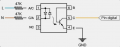
Note that I followed this circuit, and already noticed the low resistance values some people used. I use 47k ohm 3W resistors (and a pullup on the output pin). For safety reasons I also added a fuse on the AC lines: 1759212895428.png

I did not think about the delay time in the relay itself! This makes me wonder though how suited this Zero-Cross detector option really is, because I can imagine that there will be differences between each relay for the turn on/off time... (or let's say between relay production batches)?
 

MisterBill2

Joined Jan 23, 2018
27,687
HOW do those circuits in posts #24 and #28 relate to controlling the motor power???
A standard "relay bridge" circuit with adequately rated relays will work very well. AND it will provide a bit of dynamic braking. Two suitable solid state relays can also be used. AND all of the SSR devices that I have used included internal isolation, and used low voltage DC inputs, usually five volts.
 

panic mode

Joined Oct 10, 2011
5,041
... I can imagine that there will be differences between each relay for the turn on/off time... (or let's say between relay production batches)?

relays use mechanical movement of the armature to alter state of the contacts. for one product values will be reasonably consistent. but relays are slow devices, i would not use them for anything that requires response time shorter than 5x to 10x relay response. the only exception are safety relays because they are monitored by safety controller so timing is known precisely. also they have different construction for cheap relays to ensure that all contacts are moving at the same time - even if one contact welds and prevents change of state, that would affect all contacts (this is one of prerequisites for safety monitoring).
 

MisterBill2

Joined Jan 23, 2018
27,687
In the line of SSR devices, the "OPTO 22" brand stands out. The ones for AC power control plug-in boards , with the 5 volts DC control input, would seem to be a good choice for PCB installation on the existing assembly.
AND, once again, consider that contact welding generally happens during the contact closing time and not the releasing time. and the contacts weld because there is not enough mass to absorb the heat and keep the temperature below the melting point of the contact material. That is the basic physics of welding.
 
Top