Facebook
 Google
 GitHub
 Linkedin

Howdy,
I'm building a little gizmo to turn a tiny DC motor off and on with a microcontroller. The motor is just a "signal" to a person, and goes on for about 500msec then is off for a few seconds, then comes on again. PWM is not used/needed, just off/on for a short period of time.
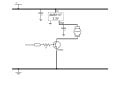
Here is the circuit:

Motor - 3V 70mA, used as a vibrator in cell phones
2N3904
AMS1117 3.3V regulator
I added the regulator to the circuit so that the motor always sees 3.3V, no matter what Vcc I choose at some time in the future.
With a voltage divider I'd have to change the value of the resistors.
Questions:
1. Is it bad practice to use a regulator as part of a switch like this?
2. Do you have a different suggestion that allows the motor to always see 3.3V but allow the overall circuit to see more volts?
Thanks again.
I'm building a little gizmo to turn a tiny DC motor off and on with a microcontroller. The motor is just a "signal" to a person, and goes on for about 500msec then is off for a few seconds, then comes on again. PWM is not used/needed, just off/on for a short period of time.
Here is the circuit:
Motor - 3V 70mA, used as a vibrator in cell phones
2N3904
AMS1117 3.3V regulator
I added the regulator to the circuit so that the motor always sees 3.3V, no matter what Vcc I choose at some time in the future.
With a voltage divider I'd have to change the value of the resistors.
Questions:
1. Is it bad practice to use a regulator as part of a switch like this?
2. Do you have a different suggestion that allows the motor to always see 3.3V but allow the overall circuit to see more volts?
Thanks again.
Attachments
-
 24.3 KB Views: 65