Reconfigurable windings in PMSM

Thread Starter

toby1234321

Joined Jun 23, 2022
9
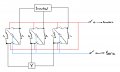
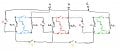
I want to make a switch box for a PMSM to able to reconfigure between series-parallel and star-delta of the stator windings. Still haven't decided if I want to be able to do all four configurations from the same device or two separate. I have made some suggestions for possible circuits, but I am not an expert so would love to get some feedback.

I am also struggling to decide what kind of "switches" will be most efficient. I want the device to be as small and efficient as possible, as the motor is used for a flying drone. I have looked into back-to-back MOSFETs and triacs, which one do you recommend? Or other suggestions?

Controlling the switching circuit is also another challenge. Will is be possible to drive the control circuit and switches in the "switch-box" from the power supply to the motor? (Which is a 44 V battery)

Would appreciate all kind of help, circuit diagrams, suggestions for switches and control strategy! I did some simulations and the motor draws at most 150 A in the delta-parallel connection.
Thanks!
 

Attachments

nsaspook

Joined Aug 27, 2009
16,328
How often to you need to reconfigure? If you only need manual configuration once in a session then why not use a jumper plug(s)?
 

Thread Starter

toby1234321

Joined Jun 23, 2022
9
Need to be able to reconfigure several times during operation. The reconfiguration needs to be automatic as well. An algorithm for switching operating points is going to be made, but haven't come that far yet:)
 

MaxHeadRoom

Joined Jul 18, 2013
30,663
I can see Star/Delta, but why series parallel for two voltages?
I presume this is a PM field, motor?
How are you controlling the RPM??
 

LowQCab

Joined Nov 6, 2012
5,101
The most important question is why do You want to do this ?
What problem are You trying to solve ?

Hobby-ESCs exist that can extract every bit of performance out of a BLDC 3-Phase-Motor,
including Braking, Reversing and Ramp/Up/Ramp/Down functions, all with a ridiculously small Foot-print.
And, they're virtually bullet-proof, and operate at over ~120-DC-Volts,
( there may be some higher-Voltage versions that I'm not aware of ).

https://powerdrives.net
.
.
.
 

Thread Starter

toby1234321

Joined Jun 23, 2022
9

Thread Starter

toby1234321

Joined Jun 23, 2022
9
The most important question is why do You want to do this ?
What problem are You trying to solve ?

Hobby-ESCs exist that can extract every bit of performance out of a BLDC 3-Phase-Motor,
including Braking, Reversing and Ramp/Up/Ramp/Down functions, all with a ridiculously small Foot-print.
And, they're virtually bullet-proof, and operate at over ~120-DC-Volts,
( there may be some higher-Voltage versions that I'm not aware of ).

https://powerdrives.net
.
.
.
As of now the motor has to be able to operate in both high speed and low speed mode. During done take-off both RPM and torque demand is high. However the motor mostly operate in "cruising" mode where RPM is about one third. The efficiency in low-speed mode is low due to fixed configuration of the stator windings. Thats why I am looking for a way to reconfigure the windings, such that the motor can be optimized for low speed in series connection. Then the parallel connection reduces the voltage constant to about half and the motor can operate at high speed with high efficiency.
 

LowQCab

Joined Nov 6, 2012
5,101
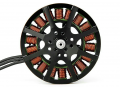
"T-Motor" has what You are looking for ..........
You appear to be making this way more complex than it needs to be, for little or no gain.

Is ~60-Pounds of Maximum-Static-Thrust, and a 1-Hour Loiter-Time, good enough for your needs ?
( this is with 6-Motors )
All it takes is Cubic-Money.

( these are not the most efficient Motors that T-Motor makes,
I decided on a compromise between Performance and Efficiency )
.
T-Motor Antigravity 6007 KV160 FLAT .png
.
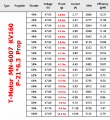
Performance Chart .png
.
T-Motor Anti-Gravity MN6007 KV-160
with P-21*6.3, Carbon-Fiber, 2-Blade-Prop

Motor Dimensions, 2.63" Diameter X 1" Thick
Weight, ~3 Pounds for 6 Motors and 6 Props

Maximum Power for 180 seconds 864 Watts each
( Chosen Props will only Load the Motors to 720 Watts Max )

Maximum Current for 180 seconds 18 Amps
( Chosen Props will only Load the Motors to 15 Amps Max )

Voltage 12S Battery ~50V )
Battery Internal Resistance 0.227 Ohms
----------------------------------------------------------------------------------

Estimated Ready to Fly Weight Calculations .......

6- Motors with Props ___________ 3 pounds

4- Batteries___________________ 7 pounds

Frame and Electronics _________ ~6 pounds

Total Quad Weight ____________~16 pounds

Maximum Thrust = ~60 lbs
Max Vertical Acceleration = 4+ G's

Flight Time
T-Motor, MN6007 KV-160

6- Motors at Hoover Power = 40%, 2.1A X 6 = 12.6 Amps Total
6- Motors at Hoover Power = 40%, 2.8lbs X 6 = 16.8 Pounds of Lift

4-3S Batteries @ 12 Ah / 12.1A = ~1.0 Hour, Loiter Time,

Continuous Crazy Acrobatics =
15A X 6 = 90 Average Amps X 50% time = 45 Amps,
12 Ah / 45 Amps = 15 minutes of Run Time.
.
.
.
 
Top