recommended pull-up resistor for external inputs

Thread Starter

bug13

Joined Feb 13, 2012
2,002
Hi guys

Is there some app note somewhere for calculating pull-up resistor values for external inputs. say for example the external switch is 20 meters in a commercial environment (in a 3V3 or 5V system)

I am also interested in the recommended pull-up resistor value for use in industrial environment.

Thanks guys!
 

cmartinez

Joined Jan 17, 2007
8,760
Hi guys

Is there some app note somewhere for calculating pull-up resistor values for external inputs. say for example the external switch is 20 meters in a commercial environment (in a 3V3 or 5V system)

I am also interested in the recommended pull-up resistor value for use in industrial environment.

Thanks guys!
We need a little more info. Is the external switch mechanical, or solid state? Is it wet or dry contacts?
In any case, you'll most probably need resistors at both sides of the cable you'll be using.

Also, it'll be helpful if you take a look at this link:

https://www.digikey.com/en/articles/techzone/2012/apr/protecting-inputs-in-digital-electronics
 

MrChips

Joined Oct 2, 2009
34,809
Yes, there is an app note somewhere but it is probably easier to explain it.
You need to calculate the range of resistance, i.e. the minimum and maximum resistance required.

The max resistance = (Vdd - Vhigh) / Ihigh
where,
Vdd = supply voltage
Vhigh is in input logic-high threshold voltage
Ihigh is the input logic-high leakage current

The min resistance = (Vdd - Vlow) / Ilow
where,
Vdd = supply voltage
Vlow is in input logic-low threshold voltage
Ilow is the driver max output sink current
 

MrChips

Joined Oct 2, 2009
34,809
For long distances in industrial environments it becomes more critical because you are up against cable resistance and EMI. When switch contacts are involved, you need higher currents, 20mA being a common value.

Hence 20mA in 5V environment would call for 5V/20mA = 250Ω
200Ω or 220Ω pullup would be used.

For 3V environment, this is reduced to 100Ω to 150Ω.
 

MrSoftware

Joined Oct 29, 2013
2,273
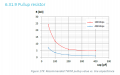
Different devices call for different pull-up values, and even then the values may vary by conditions. For example, I'm working on some I2C stuff today and here is a pull-up resistor chart from one of the devices. Here you can see the pull-up value varies not only by the line capacitance, but also by the data rate. This is just an example of why more details are needed before choosing a pull-up value.

upload_2018-11-13_15-22-45.png
 

dl324

Joined Mar 30, 2015
18,326
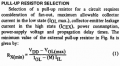
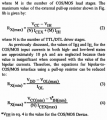
From RCA app note ICAN6602:
upload_2018-11-13_12-24-0.png
upload_2018-11-13_12-24-17.png

EDIT: Realized I didn't include the referenced figures:
upload_2018-11-13_12-35-23.png

It's for interfacing between CMOS and TTL, but the reasoning is similar.
 
Last edited:

Thread Starter

bug13

Joined Feb 13, 2012
2,002
For long distances in industrial environments it becomes more critical because you are up against cable resistance and EMI. When switch contacts are involved, you need higher currents, 20mA being a common value.

Hence 20mA in 5V environment would call for 5V/20mA = 250Ω
200Ω or 220Ω pullup would be used.

For 3V environment, this is reduced to 100Ω to 150Ω.
What is a common current(mA) value used in a commercial environment.
 
Last edited:

MrChips

Joined Oct 2, 2009
34,809
Dry contact switches require a minimum current called "wetting current" sometimes spelled "whetting current".
Again, 4-20mA is common across residential/commercial/industrial applications.
 
Top