Facebook
 Google
 GitHub
 Linkedin

The TI TPS26631 datasheet states: “CIN is a local bypass capacitor used to suppress input noise. TI recommends a minimum value of 1 µF for C(IN) to limit the rate of change during the peak test”
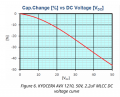
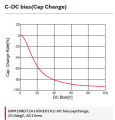
So I went to the Murata website to look for one and found the GRM188D72A105KE01# In its datasheet, there is this diagram showing that at 48V (my voltage) the capacitance drops by 84 per cent, falling from 1uF to approximately 0.161uF
What I’m asking is:
- when a manufacturer recommends a capacitor with a capacitance of x Farad, do they mean that I have to find one which has that capacitance at my operating voltage? ..so in this case I cannot use GRM188D72A105KE01#
- or do they mean that it’s enough just to choose one with that capacitance and that’s that, regardless of the derating curve I’ve attached? ..so in this case I can use GRM188D72A105KE01#
Do you think the 865081740001 would be the best option for me, then? we-online.com/en/components/products/WCAP-ASLI#865081740001
So I went to the Murata website to look for one and found the GRM188D72A105KE01# In its datasheet, there is this diagram showing that at 48V (my voltage) the capacitance drops by 84 per cent, falling from 1uF to approximately 0.161uF
What I’m asking is:
- when a manufacturer recommends a capacitor with a capacitance of x Farad, do they mean that I have to find one which has that capacitance at my operating voltage? ..so in this case I cannot use GRM188D72A105KE01#
- or do they mean that it’s enough just to choose one with that capacitance and that’s that, regardless of the derating curve I’ve attached? ..so in this case I can use GRM188D72A105KE01#
Do you think the 865081740001 would be the best option for me, then? we-online.com/en/components/products/WCAP-ASLI#865081740001
Last edited: