Facebook
 Google
 GitHub
 Linkedin

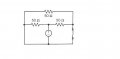
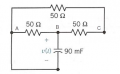
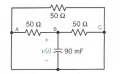
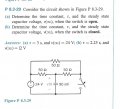
See figure attached for problem statement as well as my attempt.
I've never really done a question of this type before so I don't really know the procedure.
First I drew the circuit with the switch open, and the capictor as it's steady state equivalent(Open Circuit).
The whole circuit becomes an open circuit so no current is flowing. This mean's that V(infinity) = 24V.
I'm also asked for the time constant in this circuit. The only formula I know for solving the time constant in an RC circuit is,
\(\tau = C \cdot R_{t}\)
So I attempted to find the equivalent resistance and multiply it by the capacitance of the capacitor.
The answer they list for the time constant in part a is 3s. What am I doing wrong?
For the second part, I redrew the circuit with the switch closed and the capictor as it's steady state equivalent (open circuit).
I had lots of trouble finding v(infinity) for some reason, I just couldn't see what exactly was going on.
The only logical way I could reason to the correct answer was that we have a voltage source that splits into two branches. Now the total voltage in each parallel branch should be the same, so I have to split the 24 V between two 50ohm resistors, so they'll each get 12V.
Then I simply applied a KVL in the loop with v(infinity) and the first 50 ohm resistor.
Is there another more formal way of seeing that this v(infinity) is indeed 12V?
Also, I'm having trouble finding the time constant in this problem as well. Certainly if I'm making mistakes in trying to find it in the first half of the problem, I'm problem making the exact same mistake in this part of the problem as well.
Can someone clarify how v(infinity) is 12V in part B and how to correctly find the time constant in both part A and B?
Thanks again!
I've never really done a question of this type before so I don't really know the procedure.
First I drew the circuit with the switch open, and the capictor as it's steady state equivalent(Open Circuit).
The whole circuit becomes an open circuit so no current is flowing. This mean's that V(infinity) = 24V.
I'm also asked for the time constant in this circuit. The only formula I know for solving the time constant in an RC circuit is,
\(\tau = C \cdot R_{t}\)
So I attempted to find the equivalent resistance and multiply it by the capacitance of the capacitor.
The answer they list for the time constant in part a is 3s. What am I doing wrong?
For the second part, I redrew the circuit with the switch closed and the capictor as it's steady state equivalent (open circuit).
I had lots of trouble finding v(infinity) for some reason, I just couldn't see what exactly was going on.
The only logical way I could reason to the correct answer was that we have a voltage source that splits into two branches. Now the total voltage in each parallel branch should be the same, so I have to split the 24 V between two 50ohm resistors, so they'll each get 12V.
Then I simply applied a KVL in the loop with v(infinity) and the first 50 ohm resistor.
Is there another more formal way of seeing that this v(infinity) is indeed 12V?
Also, I'm having trouble finding the time constant in this problem as well. Certainly if I'm making mistakes in trying to find it in the first half of the problem, I'm problem making the exact same mistake in this part of the problem as well.
Can someone clarify how v(infinity) is 12V in part B and how to correctly find the time constant in both part A and B?
Thanks again!
Attachments
-
 53.7 KB Views: 33
 -
 181.8 KB Views: 24