Rc Circuit problem

DickCappels

Joined Aug 21, 2008
10,661
Kirchoff's law does not apply to a static circuit like this because current does not flow.

U3 = U1 because there is no current through R to cause a voltage drop.

If U3 were AC you would see a voltage drop across R but Kirchoff's law would give the wrong answer because of the phase difference between U and the voltage drop across R.
 

MrAl

Joined Jun 17, 2014
13,702
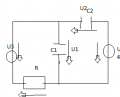
I saw in a book that U1 = U3 I mean if we apply kirchhoff rule we get U1=U3 +Ur ? or maybe its different because its a capacitor ? thanks
Hi,

It depends on how you look at this circuit, the time at which you are looking at those capacitor voltages.

If you look at a short time after the voltage sources have been switched on, the voltage would be:
U1=U2+Ur

and that is the most general. But after a long time the Ur tends to zero so you might still write it as:
U1=U2+Ur

but since Ur becomes SO close to zero that you might just call it U1=U2.

It is common to take a long time to mean 5 or 6 time constants. The time constant is equal to R*C, and after a time T=5*R*C the voltage across the resistor becomes insignificant for many circuits (about 0.007 volts per volt of source voltage, and after a time T=6*R*C it is down to about 0.0025 v/v and just keeps getting smaller).
 
Last edited:

MrAl

Joined Jun 17, 2014
13,702
Hi,

Well the main idea is that voltages in a series circuit add up to zero. So if you follow that loop you are looking at around in a loop you get zero volts as total. That just means whatever is being supplied is also being dropped by other elements.

The caps will have a certain voltage at a certain time because they are charging or discharging, but once the charging or discharging stops they will have a constant voltage, and that one cap will charge up to nearly the entire source voltage so there will no longer be a drop across that resistor. With 0v there we only have the source U and the cap U and the cap U equals the source U.

The equation for charging of a cap is:
Vc=Vs*(1-e^(-t/RC))
where RC is R*C, t is time, Vs is the source voltage, Vc is cap voltage, e is the constant 2.71828...
This means the cap charges over time, little by little, but eventually it reaches the full source voltage so we end up with:
Vc=Vs

This is after a long time has passed. In theory it never charges up fully, but it gets so close that we call it fully charged at some point after a long time has passed.

If you still dont understand, try to be more specific about what it is you dont understand.
 

WBahn

Joined Mar 31, 2012
32,823
Kirchoff's law does not apply to a static circuit like this because current does not flow.

U3 = U1 because there is no current through R to cause a voltage drop.

If U3 were AC you would see a voltage drop across R but Kirchoff's law would give the wrong answer because of the phase difference between U and the voltage drop across R.
Kirchhoff's Laws most definitely DO apply to this circuit (whether it be transient, steady state, or AC).

If I take the arrows in the diagram to be representing the voltage difference across the elements with the arrow head pointing toward the less positive side (though it really doesn't matter as long as it's done consistently), then applying KVL around the left loop we have:

U3 - U1 - Ur = 0 // Taking Ur to be the voltage drop across the resistor.

So we have

U1 = U3 - Ur

The minus sign is due to U3 and Ur having opposite reference polarities in the diagram.

In DC steady state, there is no current flowing due to the capacitors and so Ur = 0, resulting in U1 being equal to U3.

But the relation holds regardless of what U1, U3, and Ur turn out to be.
 
Top