RC circuit capacitor charging

Thread Starter

HarrisonG

Joined Aug 1, 2016
73
Hi, one thing is confusing me and that is the capacitor in not so common cases of RC circuits. One case in specific--> You have 3 resistors in series. For the sake of simplification they are all equal in size and the voltage is 9v. In this way every resistor drops 3v (you have 9volts at the top, 6volts after the first one and 3 after the second resistor). And you have a capacitor in between the first and the last resistor. I don't know to what voltage the cap will charge and in what way it will charge.
 

ericgibbs

Joined Jan 29, 2010
21,439
hi H,
I am assuming this not Homework.
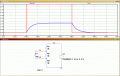
Look at this LTS simulation of your circuit.
What do you think is the equation is for the Capacitor charge/discharge voltage.?
E
 

Attachments

dl324

Joined Mar 30, 2015
18,326
Is this homework?
You have 3 resistors in series. For the sake of simplification they are all equal in size and the voltage is 9v. In this way every resistor drops 3v (you have 9volts at the top, 6volts after the first one and 3 after the second resistor). And you have a capacitor in between the first and the last resistor.
When discussing circuits, you should use schematics and give component values and designators.
 

Janis59

Joined Aug 21, 2017
1,894
But what was a question????
If anything is switched IN SERIES You must ignore it, thus the max voltage on cap will be equal to battery voltage, as soon as the current via it had been decayed.
Yet if Your question is about narrow time span shorter than at least few tau (t=RC), when charging-up is take the place, then apply an diff-circuit`s formula:
see popularly at www.dummies.com/education/science/science-electronics/analyze-a-series-rc-circuit-using-a-differential-equation/
and bit more accurate at https://en.wikipedia.org/wiki/RC_circuit
 

MrChips

Joined Oct 2, 2009
34,807
The two outer resistors are in series and can be combined into one resistor.
Now you have a simple voltage divider consisting of two resistors.
Calculate the voltage across one resistor as if there were no capacitor. This will give you the steady-state voltage across the capacitor after a long time, longer than ten times the time-constant.
 
Top