rc charging circuit

Thread Starter

gorgondrak

Joined Nov 17, 2014
61
Take an rc charging circuit like this.

http://www.allaboutcircuits.com/vol_1/chpt_16/2.html

My question is, is this series resistor considered a loop resistance of 5kohms on both wires connecting the positive and negative side, or is it just 1 10kohm resistor connected to the positive side? If it is not a loop resistance wouldn't that mean the negative side was charging faster than the positive?
 

blocco a spirale

Joined Jun 18, 2008
1,546
You could see it as 2x 5k or 10x 1k or 10,000 x1 Ohm resistors etc. in series.
In a series circuit you can swap all the components around and the effect is the same. It is not possible to charge one side of a capacitor faster than the other.
 

Papabravo

Joined Feb 24, 2006
22,082
No, not unless you include the distributed inductance. You can analyze an infinite ladder of RC elements. What do you think will happen after n sections?
 

MikeML

Joined Oct 2, 2009
5,444
Consider this:

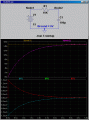
233.gif

This simple circuit has three nodes: Node1, Node2 and Ground so you can ask "what is the voltage at this node?".

It has three circuit elements: a battery V1, a resistor R1 and a capacitor C1 so you can ask "what is the current through this element?"

The upper plot pane shows the voltages at node1 and node2. By convention, the voltage at the "ground" node is considered to be zero, and all other voltages are measured with respect to this special node...

The lower pane shows the (conventional, not electron ) currents through R1, C1 and V1 I(R1) and I(C1) are identical, so the red trace covers the green trace. By convention, the current through V1 is equal (but opposite) to the current through R1 or C1,
 
Last edited:

Thread Starter

gorgondrak

Joined Nov 17, 2014
61
Im thinking the incident wave on the positive side might reflect back to the source as it comes in contact with a larger resistance. A portion will be re-reflected and a portion will propagate through the battery to the negative side. Is that a correct assumption? If so, wouldn't that mean the charging times for each plate would be slightly different for a short time? what would happen if this were an a/c generator, would the wave be able to propagate through the generator to the negative side?
 

Papabravo

Joined Feb 24, 2006
22,082
There is no propagation here. Propagation does not happen in first order systems. With two RC sections you have two capacitors that eventually reach steady state with no DC current flow. With 3, or N, or an infinite number of RC sections it still reaches steady state but just takes correspondingly longer.

If you provide a DC path at the end then the capacitors charge up along the chain and again reach a steady state. Just boring old first order behavior.

Changing to an AC generator just changes the problem to periodic charge and discharge cycles. If the time constants of the RC elements are long with respect to the period of the AC generator all the action will happen close to the generator and almost nothing will happen at the other end. If the situation is reversed then there will be rapid charge and discharge cycles but again no propagation.
 
Last edited:
Top