Radio Receiver problem

MisterBill2

Joined Jan 23, 2018
27,508
Trying to get 7Mhz people communicating but unfortunately getting radio stations :

Not the issue for now..The receiver : antenna to bandpass filter then through Rf amp

Between the filter (for 50 ohm output ) and Rf amp (50 0hm input) is the problem

There's a cable linking the filter to amp input (coupling) capacitor (100nF). My hand has to be touching this cable for there to be sound at the end

Problem is clear??

Please how to fix?

Thanks
If your hand needs to be touching a cable to get a signal in then there is an open connection someplace before that required touch point. It has already been suggested to try the receiver with the antenna connected directly. I think that is the wire that you touch to hear people.
There are several possible problems. The RF amplifier may not be amplifying, and it is probably oscillating and that will prevent any chance of getting a signal through. AND, it is very likely that built the way it is, the amplifier is oscillating, and so the amplifier can not possibly provide a signal.
I know that some folks will tell you that long leads going in every direction will work just as good, but for 7MHZ RF that is NOT TRUE,
 

vu2nan

Joined Sep 11, 2014
357
Hi Zeeus,

1. The pass band of your band-pass filter is to be centred on the portion of the 40m ham band to be received e.g. 7 - 7.1 MHz.

2. The BFO is to also cover the same portion of the band.

3. The low-pass audio filter is to be located between the product detector and the audio amplifier.

4. A lot of RF amplification wouldn't be required should a ½ λ dipole antenna for 40m be available.

With the above points addressed, it would be possible to receive CW and SSB ham radio stations without the out-of-band commercial broadcast stations and the unwanted noise.

Before that, a thorough verification of the wiring would also be in order.

Good luck!

Regards,

Nandu.
 

Thread Starter

Zeeus

Joined Apr 17, 2019
616
If your hand needs to be touching a cable to get a signal in then there is an open connection someplace before that required touch point. It has already been suggested to try the receiver with the antenna connected directly. I think that is the wire that you touch to hear people.
There are several possible problems. The RF amplifier may not be amplifying, and it is probably oscillating and that will prevent any chance of getting a signal through. AND, it is very likely that built the way it is, the amplifier is oscillating, and so the amplifier can not possibly provide a signal.
I know that some folks will tell you that long leads going in every direction will work just as good, but for 7MHZ RF that is NOT TRUE,
Yeah the bandpass was the problem... Connecting antenna directly then there was problem with "touching a cable to get a signal" Thanks
Are you listening for AM signals or SSb??
Not AM...40m...SSb? guess yes but there is no selectivity after mixer. Didn't even use a LPF
 

Thread Starter

Zeeus

Joined Apr 17, 2019
616
Hi Zeeus,

1. The pass band of your band-pass filter is to be centred on the portion of the 40m ham band to be received e.g. 7 - 7.1 MHz.

2. The BFO is to also cover the same portion of the band.

3. The low-pass audio filter is to be located between the product detector and the audio amplifier.

4. A lot of RF amplification wouldn't be required should a ½ λ dipole antenna for 40m be available.

With the above points addressed, it would be possible to receive CW and SSB ham radio stations without the out-of-band commercial broadcast stations and the unwanted noise.

Before that, a thorough verification of the wiring would also be in order.

Good luck!

Regards,

Nandu.
Did a lot of Rf amplification because the "antenna" is just bunch of wires from extension cord tied together : not really long

But thanks, think know how to proceed.. with audio filter after "product detector" then will go from there
 

Dodgydave

Joined Jun 22, 2012
11,395
Yeah the bandpass was the problem... Connecting antenna directly then there was problem with "touching a cable to get a signal" Thanks

Not AM...40m...SSb? guess yes but there is no selectivity after mixer. Didn't even use a LPF
Then you need a 2.5Khz low pass ssb filter to pull in the Lsb sideband, and a Bfo 450 to 470Khz....
 

vu2nan

Joined Sep 11, 2014
357
Then you need a 2.5Khz low pass ssb filter to pull in the Lsb sideband, and a Bfo 450 to 470Khz....
Hi Dodgydave,

In a direct conversion receiver, a low-pass audio filter would be required to sharply cut off any unwanted noise above 2.5 kHz.

The VFO or BFO (whatever one may call it) would be required to tune to the same band of frequencies as that to be received and not 450 to 470 kHz (no intermediate frequency as such).

Nandu
 
Last edited:

Dodgydave

Joined Jun 22, 2012
11,395
Hi Dodgydave,

In a direct conversion receiver, a low-pass audio filter would be required to sharply cut off any unwanted noise above 2.5 kHz.

The VFO or BFO (whatever one may call it) would be required to tune to the same band of frequencies as that to be received and not 450 to 470 kHz (no intermediate frequency as such).

Regards,

Nandu.
You need a Bfo to re insert the carrier for ssb, between 0 to 2.5Khz..
 

vu2nan

Joined Sep 11, 2014
357
Hi Dodgydave,

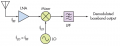
A direct conversion receiver, as simple as this, can receive CW and SSB.

123.png

The lone local oscillator doubles as VFO and BFO!

Nandu
 
Last edited:

MisterBill2

Joined Jan 23, 2018
27,508
I went back and examined the one posted circuit and realized that it is indeed a direct conversion receiver. That changes a whole lot. The TS should have posted the circuit at the beginning, it would have save a whole lot of guessing from folks talking about BFOs and sideband and such. Now it is rather clear that with the wiring as shown it is very likely that the local oscillator frequency is getting into the receiver and how can it hear anything else? AND, for a 7+ mHZ receiver it is very probable that the tuning rate with the variable capacitors shown is far to rapid. So there are two strikes and not even up to bat yet.
 
Top