Radio Dipole Antenna From Pure Copper Rod

Tonyr1084

Joined Sep 24, 2015
9,744
Its not copper tube, but a solid copper rod, which is usually used for earth electrodes
Two issues: First, the last time I bought copper grounding rods they were steel with copper plating. I don't know how thick the plating was - but it wasn't solid copper.
Second, I don't know much about dipole antenna. My concern would be the change to SWR with thermal expansion and contraction. I don't know how much that could change SWR, so this may be a moot point. But it should be a consideration. Tuned in summer and it will change most in winter. Tuned in spring or fall (moderate temperatures) will yield most regular SWR with minimal drift. I think.
 

Thread Starter

meowsoft

Joined Feb 27, 2021
666
Hopefully you didn't pay that price. If not, sell it and pocket the money.
Of course not, I got it for nearly free, from a decommisioning project

Hopefully you didn't pay that price. If not, sell it and pocket the money.
I tell the price just to say, clearly this is not a copper tube but instead a copper rod and also pure copper rod, not the one that is plated
 

MisterBill2

Joined Jan 23, 2018
27,998
OK, I am late into this discussion , which is sort of interesting.
A correctly dimensioned solid copper rod dipole antenna will be a bit more efficient, BUT the improvement will be hard to notice. And the improvement in efficiency will require good equipment to measure. My advice would be to sell the pure copper rod, ot just trade it for good copper wire of an adequate size.
The copper rod may be useful in building higher power transmitters, and it will be good for heat-sinks in building a high power transistor transmitter. AND "Free" is usually a good price for interesting materials.
 

nsaspook

Joined Aug 27, 2009
16,434
OK, I am late into this discussion , which is sort of interesting.
A correctly dimensioned solid copper rod dipole antenna will be a bit more efficient, BUT the improvement will be hard to notice. And the improvement in efficiency will require good equipment to measure. My advice would be to sell the pure copper rod, ot just trade it for good copper wire of an adequate size.
The copper rod may be useful in building higher power transmitters, and it will be good for heat-sinks in building a high power transistor transmitter. AND "Free" is usually a good price for interesting materials.
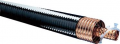
Nobody (never seen it used in the military or in commercial) designs and uses copper ROD (except for maybe an emergency or like the OP, scrap) for RF antennas at any power. We had rows and rows of 10KW HF transmitters at the transmitter site and maybe a dozen antennas of various types. The combiner and primary feeds were all HELIAX dry-air pressurized cable capable of at least 100KW to the remote antenna match. The center conductor for this very expensive cable was a hollow tube because solid didn't change the electrical properties at RF. The only time we would use a cable with a solid inner conductor was for strength on elevated cable runs with copper plated steel as the center conductor.
1740283943211.png

As was said before skin effect negates the solid conductor DC advantage. There is NO electrical (maybe mechanical advantages for small machined RF structures) efficiency advantage of copper rod over copper tubing of the correct size for RF antenna use.
https://tessco-product-images-comme...m/Resources/435733_LCF214-50JA_Spec+Sheet.pdf

Inner Conductor Material Corrugated Copper Tube
Power, kW 226.19 @ 1MHz
 
Last edited:

MisterBill2

Joined Jan 23, 2018
27,998
I did state that the benefit would be very hard to notice or measure. In theory the benefit may exist, but not enough to be worth the effort.
 

Thread Starter

meowsoft

Joined Feb 27, 2021
666
A greater surface area will result in a lower current density, hence a lower resistance loss. Certainly a SMALL DIFFERENCE.. Not made up!!!
At least durability difference will exists, as its will be located outdoor, to a strong enough wind, and harsh winter also sunny day and if my cat play by climb it its will survive, not like wire antenna that will broken if climbed by my cat ;)

Note : my cat is naughty enough to even playing by push my electrical emergency button causing local blackout in my workshop, of course same cat has broken my wire antenna before

My cats like to use my antenna and another stuffs like weather station to become staggering ground to jump and clim to my roof, and I have eight cats, two of them even still a teen cat who push boundaries and learn how to be cat ;)

If its about signal quality aspect, its will be a bit difference I think, but a huge enough impact in durability aspect I think

What do you think about it ?
 
Last edited by a moderator:

nsaspook

Joined Aug 27, 2009
16,434
A greater surface area will result in a lower current density, hence a lower resistance loss. Certainly a SMALL DIFFERENCE.. Not made up!!!
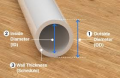
The outside surface area (OUTSIDE DIAMETER (OD)) is the same with a rod or a solid tube of the same OD
1740328746893.png
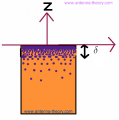
The wall thickness is usually much thicker than the skin effect limited thickness of RF current in a good conductor like copper. The RF current density falls off at an exponential rate per skin effect thickness (measured in fractions of an inch at RF).

https://www.antenna-theory.com/definitions/skin-depth.php
In reality, the current density actually drops off exponentially from the surface, so that if we have a wire that begins at z=0, then current flowing in the y-direction (out of the screen as shown in Figure 2), then the current density (J) will decrease away from the surface exponentially per Equation [2]:
1740329139491.png
 
Top