Perhaps the guidelines for posting in this forum should explicitly discourage text speak. To toffee_pie, English is the forum language and questions should be posted clearly in normal language. Text speak is discouraged (and often disparaged) by many members, so if you respect them, you will get better answers.
For example, "I can have help with this question, please?" is much more likely to get a valuable response.
That is a common problem. Emotions don't travel well over a keyboard. MANY of my attempts at jokes have been ignored. I finally learned to use smileys.
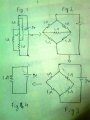
Each of the four figures are equivalent circuits.
At first, I was uncertain of the validity of the assertion that these were really equivalent circuits.
Figure 2 is a simple re-drawing of the first figure. Thus, it was not hard to accept these two as being equivalent.
Figure 3 is equivalent to Figure 2 only when all of the resistors are the same. If one were to replace 1 ohm with R and perform a nodal analysis, one would find that Figure 3 is equivalent to Figure 2 regardless of R. However, if any one resistor is something other than R, then the circuits are no longer equivalent. Setting R = 1 ohm, makes the math easy.
Figure 4 can be found by adding the series and parallel resistors to find "Req". Again, this is only valid when each resistor is the same value. In this case, R = 1 ohm.
I am not sure what you really want to know or if you even really wanted to know anything about these figures. Nonetheless, I enjoyed brushing up on my circuit analysis skills.

 Facebook
 Google
 GitHub
 Linkedin
 287.8 KB Views: 43