Question on Totem-pole Circuit

Thread Starter

pinkyponky

Joined Nov 28, 2019
373
Hello!

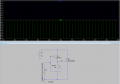
My intention of the circuit is to drive the MOSFET with the totem-pole circuits. But, when I do the simulation, I got the strange voltage at point 'D' (See my circuit). As per my understanding, When the transistor 'Q1' is switched ON, whatever the voltage present at point 'A', that should be also at point 'D'.
In this case, Vc (Q1, point A) is 5V. But, why we can only measure 3V at point 'D', why not 4.3V (5V-0.7V).

Could you help me with this?.

The simulation file is also attached.

Thank you.


1706194092440.png
 

Attachments

sarahMCML

Joined May 11, 2019
695
Hello!

My intention of the circuit is to drive the MOSFET with the totem-pole circuits. But, when I do the simulation, I got the strange voltage at point 'D' (See my circuit). As per my understanding, When the transistor 'Q1' is switched ON, whatever the voltage present at point 'A', that should be also at point 'D'.
In this case, Vc (Q1, point A) is 5V. But, why we can only measure 3V at point 'D', why not 4.3V (5V-0.7V).

Could you help me with this?.

The simulation file is also attached.

Thank you.


View attachment 313528
V2 is driving the base with a 3.3V pulse! I'm surprised that you're even getting 3V out on your display.
 

Thread Starter

pinkyponky

Joined Nov 28, 2019
373
The LTspice default MOSFETs rarely work as you'd hope. Select a 'proper' one by right-clicking the symbol.
Hi Alec!

That is fine, and also I know that I have to chose the real component while using in hardware. But, here, I have tried to understand the functionality of circuit. If you know please help me why I'm not getting 4.3V at the emitter of the Q1 transistor.

Thank you!
 

Thread Starter

pinkyponky

Joined Nov 28, 2019
373
Since Q1 is an NPN transistor its emitter voltage will be about 0.7V less than the base voltage if the emitter current is a few mA, i.e. 3.3V-0.7V=2.6V.
Yeah! I knew this. But, I understand that when the Q1 is switch ON, then the emitter voltage will be = 5V-0.7V = 4.3V. So, is this not correct?
 

Alec_t

Joined Sep 17, 2013
15,104
It's not correct. If Q1 is turned fully on the emitter voltage will be almost 5V (say 4.95V) if the collector supply is 5V. This means the base voltage would need to be about 4.95V+0.7V=5.65V.
 

Thread Starter

pinkyponky

Joined Nov 28, 2019
373
It's not correct. If Q1 is turned fully on the emitter voltage will be almost 5V (say 4.95V) if the collector supply is 5V. This means the base voltage would need to be about 4.95V+0.7V=5.65V.
Hello Alec!
Is it 5.65V?. Are you kidding!..

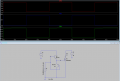
See my simulation results below:

1706281919636.png
 

crutschow

Joined Mar 14, 2008
38,324
the voltage follower also know as Emitter follower and common collector. Right?
Right

M1 in you last schematic will, of course conduct a very high current when ON, since it is connected directly to the power supply.
But it needs more that 3V to fully turn ON.
 

Audioguru again

Joined Oct 21, 2019
6,826
In the last schematic the 3.3V pulse feeding the bases of the transistors produces only 2.6V at the gate of the Mosfet. But the datasheet for the FDH210 Mosfet shows that it barely turns on when the gate is less than 4V. Like most Mosfets, it turns on well with a 10V gate voltage.
 

Thread Starter

pinkyponky

Joined Nov 28, 2019
373
Hello Again!

I have down some more simulations. In which, I have some question so please could you answer to my questions.

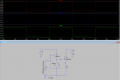
When I change the Load Resistor (R1) between the MOSFET Drain and Source. I can seen different results. Why?

Like; When I keep Resistor 'R1' at Drain, then I can see that voltage at Drain is 50V, and the current though 'R1' is 25A. Yes, I know that it is because of I=V/R.

But, When I keep Resistor 'R1' at Drain, then I can see that voltage at Drain is 50V, and the another voltage at 'R1' is 2.4V, current though 'R1' is 1.2A. Yes, I know that it is because of I=V/R.

I have a question here that, why the voltage at Resistor (R1) is changing when change the position of Resistor (R1)?.

Thank you!

1706286618069.png


1706286652225.png
 

Audioguru again

Joined Oct 21, 2019
6,826
Good, now you are using a newer FDR4420A logic-level Mosfet that turns on well when its gate-source voltage is 4.5V or more.
But with the load at the Source pin as a "source follower" it barely turns on, but it works well when the load is at the Drain pin.
 

BobTPH

Joined Jun 5, 2013
11,465
My intention of the circuit is to drive the MOSFET with the totem-pole circuits
Let’s go back to before the beginning. Why do you want to control a MOSFET wit a totem pole circuit?

And what do you mean by a totem pole circuit? I have only heard that term used for the output stage of TTL logic. Did you perhaps mean a push pull circuit?
 

Alec_t

Joined Sep 17, 2013
15,104
When I change the Load Resistor (R1) between the MOSFET Drain and Source. I can seen different results. Why?
What controls the MOSFET current is Vgs (the voltage between the gate and the source). If R1 is in the source path the current will produce a voltage drop across R1. That reduces Vgs, tending to turn off the MOSFET. If, instead, R1 is in the drain path then Vgs is not reduced.
 

Thread Starter

pinkyponky

Joined Nov 28, 2019
373
What controls the MOSFET current is Vgs (the voltage between the gate and the source). If R1 is in the source path the current will produce a voltage drop across R1. That reduces Vgs, tending to turn off the MOSFET. If, instead, R1 is in the drain path then Vgs is not reduced.
How to calculate the voltage drop across the R1 when the R1 resistor at the source path?.

If we follow V=IR, then, the voltage drop across R1 is 25A*2ohm = 50V. It is not right. So, how we can calculate that?.
 

BobTPH

Joined Jun 5, 2013
11,465
In my circuit I want to drive the MOSFET, so we need to have high voltage at the gate of MOSFET. So, I need to use some gate driver (or) push pull circuits. So that's why using this circuit.


Yes
The voltage at the gate has nothing to do with the need for a push pull driver. What you describe seems to be a level translator

The high voltage (10V typically) can be provided by a pull up resistor, and low by an NPN transistor.

This works absolutely fine for low speed switching. And by low speed, I mean even up to 10KHz.

In that circuit the turn on time will be high because the gate capacitance needs be charged through the resistor. Hence the speed limitation. If it is switching too fast, it spends too much time in between and dissipates a lot of power. The turn off time will be faster because of the higher current sinking capacity of the transistor.

A push pull driver allows high current both on turn on and on turn off, since each is provided through a transistor. So it is appropriate for
much faster switching.

If you are trying to control a MOSFET from a 5V or 3.3V microcontroller, the push pull driver in the micro is often good enough. You just have to use an appropriate logic level MOSFET.

Gate driver ICs also serve another purpose. When using an N-channel MOSFET as a high side switch, you need a voltage higher than the supply voltage it is switching. The ICs create this higher voltage by using a bootstrap capacitor.

So what is your application? What voltages involved, currents? And above all else, what switching speed?
 
Top