Question on an alternator's carbon brushes

Thread Starter

cmartinez

Joined Jan 17, 2007
8,727
I'm currently working on a personal project involving automotive alternators, and one of the things I'm trying to do is see if I can improve a particular brand's carbon brushes durability. Question, assuming that cost is not an issue, is there a better material out there that could be used instead of graphite that would improve their performance? ... @shortbus, maybe this sort of thing is your kind of thing ... if you're feeling generous, is there any insight you might like to share?
1704729123173.jpeg

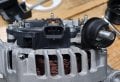
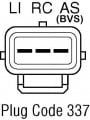
Also, although I think I understand how modern alternators are supposed to work (with their having an integrated regulator, for instance) I'm wondering what the three-pronged connector shown in the picture is for. I'm sure it's a very basic question, I know, and the answer should be fairly easy to understand, but even after googling for an answer I still can't put my finger on it.


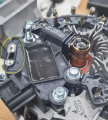
And lastly, just out of curiosity, does anyone know what the part circled in the next pic is for? ... it looks like some sort of sensor, or perhaps it's some sort of fuse?
1704729050499.png
 

MaxHeadRoom

Joined Jul 18, 2013
30,565
The problem with going with brushes that have a higher copper content for slower wear, is that commutator wear is increased.
Obviously an automotive alternator runs continuous and brush copper/carbon content is usually selected for optimum use.
Have you experienced short brush life with the ones you use so far?
What make/model is the ones you are presently using?
If you want in depth answers concerning brushes, Helwig-Carbon are very good.
 

Thread Starter

cmartinez

Joined Jan 17, 2007
8,727
The problem with going with brushes that have a higher copper content for slower wear, is that commutator wear is increased.
Obviously an automotive alternator runs continuous and brush copper/carbon content is usually selected for optimum use.
Have you experienced short brush life with the ones you use so far?
What make/model is the ones you are presently using?
Well, strictly speaking, this alternator does not have a commutator, but rather a contact ring. There are no discontinuities in the copper rings that would accelerate the brushes' wear. But I'm even thinking about changing said copper rings for a better material, maybe some sort of bronze-aluminum... I'm not really sure...

As for its make and model, I'm gonna look it up and get back to you
 

MaxHeadRoom

Joined Jul 18, 2013
30,565
I see that Valeo is a US after-market manuf, of auto parts.
Never ever heard of them.!
They may be able to steer you on to a wiring diagram that could clarify the plug connections.?
Any reason you did not go with the ever popular AC-Delco?
 

Thread Starter

cmartinez

Joined Jan 17, 2007
8,727
I see that Valeo is a US after-market manuf, of auto parts.
Never ever heard of them.!
They may be able to steer you on to a wiring diagram that could clarify the plug connections.?
Any reason you did not go with the ever popular AC-Delco?
That's the brand that I can more easily get a hold of down here where I am.

There are two things I'd like to do now:
  • Find out what each pin of the connectors is supposed to do
  • Find the male and the female connectors that would fit this device so I can intercept their signals and get a real time readout of whatever it is they're doing.

I'd like to make a sort of "T" connector for what I've just described. But it has to be professional-looking and not something that looks improvised.
 

MaxHeadRoom

Joined Jul 18, 2013
30,565
One way may be to get hold of a Ford manual for a truck that uses this model and then it should be possible to see what function the connector does from the wiring schematic..
Do you have any auto wreckers there? We have a couple where you can strip you own parts, which is handy in getting things like the connector etc.
 

MrChips

Joined Oct 2, 2009
34,632
Thanks for the correction ... believe it or not, my knowledge of Technical English has its limits. It's always good to know the correct terminology for things for better communication.
Know the difference between a slip ring and a split ring. That little difference in spelling can make a huge difference.
 

LowQCab

Joined Nov 6, 2012
5,101
How long do you need this Alternator to last ?
The normal Life-Span of Alternator-Brushes / Rings is easily over ~10-years.

I have run an AC-Delco, 100-Amp, Large-Frame-Alternator,
that was already used for some unknown number of years,
for an additional ~20-years, without any failures.

It's hard to imagine why You would need better performance than that.

Are You using the Alternator near it's full capacity for extended periods of time ?
.
.
.
 

Thread Starter

cmartinez

Joined Jan 17, 2007
8,727
How long do you need this Alternator to last ?
The normal Life-Span of Alternator-Brushes / Rings is easily over ~10-years.

I have run an AC-Delco, 100-Amp, Large-Frame-Alternator,
that was already used for some unknown number of years,
for an additional ~20-years, without any failures.

It's hard to imagine why You would need better performance than that.

Are You using the Alternator near it's full capacity for extended periods of time ?
.
.
.
The problem is that the vehicle is with its engine on, and at idle, about 12 hours a day. Plus about 4 to 6 hours of actually moving. That makes this sort of alternator last only about 3 to 6 months before requiring servicing.
 

MisterBill2

Joined Jan 23, 2018
27,215
Well, strictly speaking, this alternator does not have a commutator, but rather a contact ring. There are no discontinuities in the copper rings that would accelerate the brushes' wear. But I'm even thinking about changing said copper rings for a better material, maybe some sort of bronze-aluminum... I'm not really sure...

As for its make and model, I'm gonna look it up and get back to you
Any aluminum will provide much more corrosion possibility, in my experience. and also a greater voltage drop.
What speed do you intend to run the alternator at?
With the slip rings that exposed I see a serious quality issue. I have had an alternator last for about 120,000 miles on at least one Plymouth car . That was not a 100 amp model, probably only a 40 amp version.

If the time between servicing is that short, and the alternator is not being overloaded or over reved, then it certainly is not the correct unit for the application.
 
Last edited:

Thread Starter

cmartinez

Joined Jan 17, 2007
8,727
Any aluminum will provide much more corrosion possibility, in my experience. and also a greater voltage drop.
What speed do you intend to run the alternator at?
The alternator will be running at about 163% of its rated RPM while the engine is idle
 

LowQCab

Joined Nov 6, 2012
5,101
"" The alternator will be running at about 163% of its rated RPM while the engine is idle ""
This statement is somehow incorrect.
Alternators do not have a "Rated-RPM".

A particular model may have a "Maximum-Rpm" rating that can be obtained with
a bit of research, and/or, a large dose of assumptions,
which is the RPM where a Bearing-Failure, and/or, physical explosion may occur.

Otherwise, it may be possible to find a Performance-Curve / Graph that
shows the expected Amperage-Output, relative to RPM-Input.

If a manufacturers Maximum-RPM-rating can not be found, ( which is very likely ),

then the Maximum-RPM displayed on the Performance-Graph might be assumed to be
the maximum permissible, or maximum "safe" RPM.

The best way to extend the mechanical-life of the Alternator is to slow it down with a Pulley change.


Have You tested to see what the maximum-Current requirements of the Machine in question are ?
Is this maximum-Current level demanded at Idle-Speeds also ?
What is the Maximum-Engine-RPM ?
What is the Idle-RPM ?
What is the Engine-Pulley-Diameter ? ( the Pulley that drives the Alternator-Pulley ).
What is the Alternator-Pulley-Diameter ?
Calculate the Alternator-RPM at Engine-Idle-RPMs, and at Maximum-RPMs.
There are online Pulley-Ratio-Calculators that make this easy.

With this information, a competent Alternator-Specialty-Shop can provide You with
a customized solution that will have a very long Life-Expectancy.

If You can easily get stuff from the USA,
I can personally recommend a company called "MechMan" Alternators,
they carry an extensive stock of custom Alternators,
or, they will design a customized Alternator specifically tailored to your exact application.

It may be advantageous to have Custom-Mounting-Bracketry made that will allow
the installation of a more robust Alternator design,
instead of trying to "patch-up" the inadequate Alternator design that You have now.
.
.
.
 
Last edited:

geekoftheweek

Joined Oct 6, 2013
1,429
After a bit of searching I found this page https://www.waiglobal.com/media/wysiwyg/1096-01-wai-us-6g-en-ford-6g-regulators.pdf.
At the bottom of the page it shows the connector 337 along with a legend for the signal names.

Also this page had some good information also https://www.msextra.com/forums/viewtopic.php?t=58358.

This page https://motorcarparts.com/content/uploads/2021/01/Ford-Unit-15427-No-Charge-Issue_1_20_2020.pdf lists
AS =SENSE, RC =GEN-COM, and LI = GEN-MON circuits which will help decode the MegaSquirt information a little better.

Good luck!!

Although Ford alternators aren't as easy to deal with as GMs are if you can find the information they aren't that bad.
 
Top