Question about voltage divider

Thread Starter

John Prowler

Joined Jul 5, 2018
1
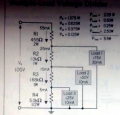
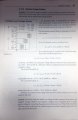
This is a question about building a voltage divider for 3 loads as shown in the image below, the thing that I don't understand is why finding the resistance in R3,R2 and R1 requires subtraction of the voltages in other loads and then dividing by the current, if they all connected to the ground shouldn't they all be equal to the load's voltage minus zero?
Prowler_20180706_005248_corr.jpg

Moderators note : inserted cropped image
 

Attachments

Last edited by a moderator:

MrAl

Joined Jun 17, 2014
13,702
This is a question about building a voltage divider for 3 loads as shown in the image below, the thing that I don't understand is why finding the resistance in R3,R2 and R1 requires subtraction of the voltages in other loads and then dividing by the current, if they all connected to the ground shouldn't they all be equal to the load's voltage minus zero?
Hi,

Basically you have to consider the loads to be in parallel with the voltage divider resistances, then you get realistic tap voltages.
 

crutschow

Joined Mar 14, 2008
38,503
The load currents through the resistive divider affects the divider voltage because of IR drop through the divider resistance, so the load currents must be used to calculate the divider resistances.
For example, the top divider resistor R1, must carry the current for all the loads plus the current through the other divider resistors.
This means the voltage drop across R1 is 55mA * 455Ω = 25.025V.
You do understand Ohm's law, right?

upload_2018-7-6_0-10-34.png
 
Last edited:

shteii01

Joined Feb 19, 2010
4,644
The short answer.

Resistors in series form voltage divider. You know this part.

However. Resistors in parallel, like R4 and Load 3, form current divider. So. (R4||L3)+R3 and L2 form another current divider. And so on.
 

WBahn

Joined Mar 31, 2012
32,823
I think the crux of your misconception is that Ohm's Law relates the resistance to the current through THAT resistor and the voltage across THAT resistor. The node that we happen to choose to call zero voltage (i.e. "ground") is irrelevant to this. The voltage ACROSS a resistor is the voltage difference between one side of the resistor and the other. So for R3, the voltage at the top of the resistance (relative to "ground") is 50 V and the voltage at the bottom of the resistance (again, relative to ground) is 25 V, so the voltage different across R3 is 50 V - 25 V or 25 V. This is the voltage that Ohm's Law, applied to R3, needs to use.
 
Top