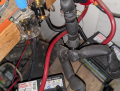
question about FLOW of electricity....

nsaspook

Joined Aug 27, 2009
16,363
yup.. when the Chinese hover boards came to Canada over a decade ago, they were catching fire left right and center. cant imagine the states got any better quality than we did....

and there is enough videos on youtube of people using those chinese lifeo4 batteries in their solar power setup and poof.. fire..... i dont have any fire trauma in my life and i certainly dont need any :)
Those junk Chinese hover boards were not LiFePo4. There are plenty of videos on Youtube showing how hard it is make 'real' LiFePo4 batteries catch fire. As with any product YMMV but LiFePo4 chemistries are much safer than Plain Jane Li Ion chemistry. There is no absolute safety with energy storage systems.
I've seen Flooded lead-acid batteries explode while charging due to excess hydrogen generation being ignited.


https://www.dtgpower.com/post/do-lithium-iron-phosphate-batteries-catch-fire
Do Lithium Iron Phosphate Batteries Catch Fire


Your typical Li ion (Cobalt based) battery drill test. This is why people use 'real' LiFePo4 batteries for energy banks.
 
Last edited:

MrAl

Joined Jun 17, 2014
13,724
hello i have 2 x 12v batterie(SLA) linked in parallel

my question is.. if i charge those two batteries using a 12v wall charger... and i drain said batteries simultaneously... does the dc to ac inverter get any of the electricity from the land power (because all alligator clamps are touching each other on the battery posts) or does the wall charger power actually sink into the batteries before going into the dc to ac inverter ?????

i ask this because i currently reside in a country (Philippines) where the electricity is harmful to computer components.. and im hoping that charging the batteries and having a pure sine wave dc to ac inverter that the 2 batteries somehow... you know.. stabalize or "clean" the electricity.... im just worried about all the clamps touching each other at the battery posts and some of that not so cool power heading straight for the costly dc to ac inverter

PS: im french Canadian sorry if my engrish no good :eek:
I would say that the batteries are going to filter the incoming charge current to some degree, and if there is a DC to AC converter after that and the output AC is regulated, then the output AC should be clean enough, as long as it is a pure sine.
The incoming charge current is probably much lower than the current that would be taken from the batteries during normal use anyway. If the input voltage does vary somewhat due to the input line changing, the batteries will take over the load whenever the input DC drops too low, so it should be good enough.
That's the way capacitors work too, but they charge and discharge faster than batteries in most cases.
 

Thread Starter

corporal_Canada

Joined Oct 17, 2024
138
question though, if i stick to 12V all in parallel, what am i damaging ? the inverter, the batteries or am i just creating an EMF ? because i can just fix that by uncoiling the wires , or am i wrong ?
 

nsaspook

Joined Aug 27, 2009
16,363
question though, if i stick to 12V all in parallel, what am i damaging ? the inverter, the batteries or am i just creating an EMF ? because i can just fix that by uncoiling the wires , or am i wrong ?
You will eventually likely murder (early death vs long life) at least some of the batteries from mismatched charging. The state of charge of individual batteries will diverge quickly. To slow that death you will need to equalize the array so they all again have close to the same SoC. You will need closely matched batteries (battery internal resistance) and equal resistance (cable voltage drops) charging paths to every battery to keep things equal longer at higher currents.
https://www.vertiv.com/48de59/globa...battery.-these-are-only-some-of-the-ways..pdf
3.2. Large battery banks
If a large battery bank is needed, we do not recommend that you construct the battery bank out of numerous series/parallel
12V lead acid batteries. The maximum is at around 3 (or 4) paralleled strings. The reason for this is that with a large battery
bank like this, it becomes tricky to create a balanced battery bank. In a large series/parallel battery bank, an imbalance is
created because of wiring variations and slight differences in battery internal resistance.
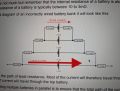
Why is cable resistance important when wiring battery banks? Remember that a cable is a resistor. The longer the cable, the higher the resistance. Also, the cable lugs and the battery connections will add to this resistance. To give an indication of this, the total resistance for a 20cm, 35m2 cable together with cable lugs attached is about 1.5mΩ. You might say that 1.5mΩ is not much but remember that the internal resistance of a battery is also low. Therefore, it does matter a lot! The internal resistance of a battery is typically between 10 to 3mΩ. If you construct an electrical diagram of an incorrectly wired battery bank it will look like this:
1732419176057.png
Current will always choose the path of least resistance. Most of the current will therefore travel through the bottom battery. And only a small amount of current will travel through the top battery. The correct way of connecting multiple batteries in parallel is to ensure that the total path of the current in and out of each battery is equal.
 

Thread Starter

corporal_Canada

Joined Oct 17, 2024
138
I would say that the batteries are going to filter the incoming charge current to some degree, and if there is a DC to AC converter after that and the output AC is regulated, then the output AC should be clean enough, as long as it is a pure sine.
The incoming charge current is probably much lower than the current that would be taken from the batteries during normal use anyway. If the input voltage does vary somewhat due to the input line changing, the batteries will take over the load whenever the input DC drops too low, so it should be good enough.
That's the way capacitors work too, but they charge and discharge faster than batteries in most cases.
it did when the inverter started screaming meaning i was nearing 10v.... during the evening.. this was like 6 months ago... my pc took roughly 100 to 150 watts (tower) and if both batteries are full i should have 1200 watts but back then all my solar panels never put out more than 250watts combined.... so yes on certain occasions i would clamp this chinese "smart" charger onto the batteries (positive on battery 1 and negative on battery 2)
 

MrAl

Joined Jun 17, 2014
13,724
question though, if i stick to 12V all in parallel, what am i damaging ? the inverter, the batteries or am i just creating an EMF ? because i can just fix that by uncoiling the wires , or am i wrong ?
Hi,

I know people put all kinds of batteries in parallel, so I guess they make sure that the voltage is about the same for each one. We can also observe that if one voltage is a little higher than the other, it will quickly charge the other battery while loosing some charge itself, so maybe that is the saving grace in this scenario.

If the series resistance is 0.025 Ohms for each battery, that's 0.05 Ohms total. If the voltage is 0.1 volts difference, that's 2 amps when connected together for the first time. If the ESR is 0.01 Ohms each that 0.02 Ohms total, and with 0.1 volt difference again that's 5 amps when connected together. That 5 amps should quickly charge the lower voltage battery and deplete the higher voltage battery somewhat. That might be what makes this work in real life. There could be a spark though and that could be very dangerous for connecting lead acid batteries together if they have any way of venting. A spark is known to cause explosions when they outgas a little first. Eye protection is an absolute MUST, and you probably have to have a way to get to a shower quickly so you can wash off any acid that lands on you.
It might be a good idea to fan away any gas that may be lingering near the batteries before connecting.

I do not usually connect batteries in parallel, I just get the battery I need for the job, all in one battery.
 

Thread Starter

corporal_Canada

Joined Oct 17, 2024
138
Hi,

I know people put all kinds of batteries in parallel, so I guess they make sure that the voltage is about the same for each one. We can also observe that if one voltage is a little higher than the other, it will quickly charge the other battery while loosing some charge itself, so maybe that is the saving grace in this scenario.

If the series resistance is 0.025 Ohms for each battery, that's 0.05 Ohms total. If the voltage is 0.1 volts difference, that's 2 amps when connected together for the first time. If the ESR is 0.01 Ohms each that 0.02 Ohms total, and with 0.1 volt difference again that's 5 amps when connected together. That 5 amps should quickly charge the lower voltage battery and deplete the higher voltage battery somewhat. That might be what makes this work in real life. There could be a spark though and that could be very dangerous for connecting lead acid batteries together if they have any way of venting. A spark is known to cause explosions when they outgas a little first. Eye protection is an absolute MUST, and you probably have to have a way to get to a shower quickly so you can wash off any acid that lands on you.
It might be a good idea to fan away any gas that may be lingering near the batteries before connecting.

I do not usually connect batteries in parallel, I just get the battery I need for the job, all in one battery.
thank you so much for the advice however i didnt really pay attention too much during the "resistance" portion of DC electricity way back in elementary school.
 

nsaspook

Joined Aug 27, 2009
16,363
Which may well be cells in parallel.
The vast majority of commercial Lead-Acid batteries (other chemistries like lithium with an active BMS are better for paralleling) are larger cells in series to make the total capacity needed. They are likely well matched because they were born, lived and died in the same housing in something like a car battery.

We would series connect cells like this for DC systems of the required voltage.
https://unboundsolar.com/9960020/crown/batteries/crown-2crv1200-agm-2-volt-battery
2Vdc L-16 AGM
1,200ah @ C20 rate
https://unboundsolar.com/1898677/cr...-agm-1200-ah-48-vdc-57-600-wh-24-battery-bank
Crown AGM 1200 Ah 48 VDC 57,600 Wh (24) Battery Bank

https://www.sciencedirect.com/science/article/abs/pii/S0378775316313921
Current distribution within parallel-connected battery cells
 

Thread Starter

corporal_Canada

Joined Oct 17, 2024
138
nobody really addressed my question, unless that ohm star trek chatter up there was the actual answer... if i keep my batteries all at 12v meaning i stay with parallel, what am i damaging ? the appliance ? the batteries ? the inverter ?
 

BobTPH

Joined Jun 5, 2013
11,569
It is OK to parallel 2x12V lead acid batteries and use it as one battery. Just stay away from the limits of charge / discharge currents, and make sure the voltages are the same when connecting them in parallel. Nothing will be damaged.

Expect arguments.
 

MrAl

Joined Jun 17, 2014
13,724
nobody really addressed my question, unless that ohm star trek chatter up there was the actual answer... if i keep my batteries all at 12v meaning i stay with parallel, what am i damaging ? the appliance ? the batteries ? the inverter ?
The only requirement is that if you place two batteries in parallel that you only charge with enough current to charge one battery alone. Thus if the max charge current for one battery is 5 amps and you parallel two batteries, just charge them both at only 5 amps (2.5 amps each in theory). That's so that neither can get too much current if one of them charges up more than the other. We think of them sharing that current as 2.5 amps each, but it's possible that one could take 5 amps while the other takes 0 amps at some point in time.
 

MrAl

Joined Jun 17, 2014
13,724
Which may well be cells in parallel.
I have at least one battery pack I know has more than one 18560 Li-ion cell in parallel. I did not make it though it was made by someone I hope knew how to make them, complete with protection.

Many high power drills have these kinds of battery packs now.

If we want to get down to it, we can even say that even one battery has a diameter where there are almost like a million very narrow cells in parallel.
Protection circuits are supposed to save the day :)

So I guess the rule of the day is to use the battery pack as one single battery when discharging, but take that pack as multiple parallel batteries when charging.
 

nsaspook

Joined Aug 27, 2009
16,363
nobody really addressed my question, unless that ohm star trek chatter up there was the actual answer... if i keep my batteries all at 12v meaning i stay with parallel, what am i damaging ? the appliance ? the batteries ? the inverter ?
I did. https://forum.allaboutcircuits.com/threads/question-about-flow-of-electricity.203735/post-1950061

Without careful design for many parallel LA batteries you will murder (your parallel battery bank will lose capacity) the batteries. RE solar storage applications are sort of different than many battery applications . For solar energy banks you typically have deep, daily discharge and charge cycles that will quickly start individual SoC cell divergence from small wiring connection or cell mismatches.
1732555060706.png
1732555204233.png

For Lead-Acid, this type of activity will quickly unbalance the State of Charge between batteries by over-charging (plate erosion, electrolyte loss) some and under-charging (Sulfation) others unless you equalize (most solar charge controllers designed to charge lead-acid will have this functionality) them frequently to bring the cells inside each battery back into balance with the others.
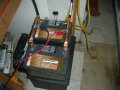
I've done lots of experiments with 12VDC parallel LA battery connections in the past.
4391179972_ea646329d6_c.jpg1732558345706.png
https://forum.allaboutcircuits.com/...ic-controlled-battery-array.32879/post-204585

https://batteryuniversity.com/article/bu-404-what-is-equalizing-charge
https://batteryuniversity.com/article/bu-804b-sulfation-and-how-to-prevent-it

The 'solution' today is to change battery chemistry from Lead-Acid for energy storage.
 
Last edited:

Thread Starter

corporal_Canada

Joined Oct 17, 2024
138
It is OK to parallel 2x12V lead acid batteries and use it as one battery. Just stay away from the limits of charge / discharge currents, and make sure the voltages are the same when connecting them in parallel. Nothing will be damaged.

Expect arguments.
and if i upgrade to 10 batteries ? all in parallel
the cable linking pos to pos and neg to neg to neg is thick.. roughly the thickness of a US dime it says gauge #4
 
Last edited:

MrAl

Joined Jun 17, 2014
13,724
and if i upgrade to 10 batteries ? all in parallel
the cable linking pos to pos and neg to neg to neg is thick.. roughly the thickness of a US dime it says gauge #4
Hi,

Yeah good question :)

With that many maybe some protection circuitry is in order. If one battery shorts out, cut that one out with the protection circuit.
Yes, wiring to LA batteries can be very thick. #4 is what is used in automobiles to run the engine starter. Could be more than 400 amps through those wires. They are also not very long because the length causes a voltage drop, and a voltage drop means less power to the load. #4 AWG wire has a resistance of about 250 microOhms per foot. At 400 amps, that's 0.1 volt per foot, so with a 5 foot wire that's 0.5 volts, which can be significant when you want to deliver a lot of power to the load.
 

nsaspook

Joined Aug 27, 2009
16,363
and if i upgrade to 10 batteries ? all in parallel
the cable linking pos to pos and neg to neg to neg is thick.. roughly the thickness of a US dime it says gauge #4
Larger cable sizes will help to reduce losses but it won't solve the bank unbalance problem. 10 batteries ? all in parallel @12vdc is horrible engineering design and IMO foolish from the standpoint of cost and long term reliability.
This is from a person that wants you to have success in this project instead of making a money pit.

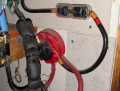
I used 4/0 and 3/0 AWG cable interconnects for my now decommissioned 12VDC system. It helped but I got the very expensive cable for free in a dumpster dive.
4585075550_acdface4eb_c.jpg

1732635386500.png
1732635418191.png
https://www.batterycablesusa.com/0000-gauge-battery-cable-black-4-0-awg
 
Top