Question About Automotive Ground

Programming keys: Did one on a 2000 Solara. Use brake accelerator and master ignition key. Visual UI was security light. I only added keys. Dealer provided key and cut it for me for $18.00.
 

vu2nan

Joined Sep 11, 2014
357
I'm hoping I can get some help with a disagreement concerning "ground" on an automotive forum. My opinion is too many people write off whatever they don't understand is happening with a circuit as a bad ground. In this particular instance the vehicle owner has to turn the interior dome light on to start the vehicle. Most everyone is saying "bad ground," which doesn't make sense to me. If vehicle ground is a "zero voltage reference," then Kirchhoff's Law states the circuit voltage necessary to start the vehicle has to has to be recognized before ground or the zero voltage reference. My opinion is this has to be a short circuit somewhere in the circuit and has nothing to do with ground. Others are adamant that somehow the voltage necessary to start the vehicle is making a "detour" (as they put it) through ground to complete the circuit. It doesn't make sense to me that ground can both be a zero voltage reference and at the same time allow a circuit to find continuity through ground to complete the ignition circuit. This means ground can be both a zero voltage reference and voltage circuit simultaneously. Anyone have any thoughts on this to share? Thank you.
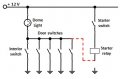
Here's a scenario.

untitled5.JPG

Could be a case of starter relay coil earth jumper, disconnected from a ground terminal block, wrongly plugged on to a door switch terminal block.

Any of those door switches or the interior switch of the dome light could provide the ground path when actuated.
 
Last edited:

MisterBill2

Joined Jan 23, 2018
27,584
Here's a scenario.

View attachment 203818

Could be a case of starter relay coil earth jumper, disconnected from a ground terminal block, wrongly plugged on to a door switch terminal block.

Any of those door switches or the interior switch of the dome light could provide the ground path when actuated.
It is obvious that what you have is a bunch of people with NO information except hearing the complaint. And then spouting off with the hundred year old statement that is occasionally accurate.
What we have here is a situation where it was not until posy #36 that the make, model, and year of the vehicle were mentioned. And still we have no ideas as to what may have been added or changed in the vehicle's 19 year past. If a security/anti-theft system has been added then the operation could be totally correct. And if the present owner is not the only owner things could be "very interesting."
There is a reasonable diagnostic process that is a lot easier if you have a circuit diagram or wiring drawing. Since the ignition switch is probably buried in the steering column, starting the checking at the connector at the bottom is a good place to start.
 

Thread Starter

Back to school

Joined May 22, 2019
106
I appreciate all the responses but my intention with the question was never to solve this specific problem which is why I tried to avoid the specifics here. For me this was about automotive ground. As I originally said, People were passing this off as the ignition circuit finding a "detour" to ground through the dome light and this was caused by a bad ground.

From a website from PE Electrical Engineers this is said:

""A short circuit is simply an unwanted connection between two points in a circuit. This unwanted connection will usually cause the overall circuit to misbehave in some way.""

And another:

""In simple and practical terms, a short circuit is an unwanted or unintentional path that current can take which bypasses the routes you actually want it to take.""

In my opinion, if you want to claim bad ground and then go to "detour" to ground that's a accurate description of what claimed to be a short or "unintentional path."

The problem, in my opinion, with trying to discuss the differences of opinion about what's happening is some take a different opinion as an affront to them and the discussion just degrades from there and nothing meaningful gets discussed from there. Not much about the actual problem is going to be discussed after a statement like, "I've been doing this for 40 years and I know. Bad ground." Of course never once did this 40 years of experience suggest the proper procedure outlined in the manuals to trace the problem to the source. I've also found bringing up my own experience never helps in situations like this one turned in to. I have a fair amount of experience installing sensor circuits but how the sensor operate on the control area network, CAN, that was someone else, I know almost nothing at this level. What I do know is I don't know anything.

I guess the bottom line for me is if the problem is a bad ground preventing circuit continuity, like a blown fuse, that's an open. If a circuit is finding a path to ground through another circuit, that's a short and explains the oddball behavior of the effected circuits.

I'm not an automotive electrician but if I'm wrong I wanted more of an explanation than the "40 years" nonsense. That means nothing. I can identify plenty of mechanics that can say the same and are lousy mechanics and I would never say this to the person but by ignoring the procedures given for tracing this problem to the source I'd probably think the same about this mechanic if I knew who he is.

Coming to this site was a matter of ask those that know and hopefully understand the difference between questions and debating. And more importantly, not take questions as a personal assault.

I hope I've given a better explanation about what this was about. I was never trying to solve the problem with this vehicle. My interest was in trying to understand the nature of ground in a vehicle compared to what I know or thought I know. TMI? Hopefully not.
 

mjaa

Joined Dec 11, 2011
5
Some missing information:
1. we are assuming old school auto wiring i.e. no CAN or other busses
2. details of ignition switch wiring including the relay that cuts power to all non essential loads e.g. coutesy light
3. courtesy light 3 position wiring where a mechanical sw fault could be fooling the ignition sw logic. Try again with bulb removed
4. what do you mean about turn on courtesy lamp? by having door open? manual sw on? both? or having light shining?
5. All trouble shooting suggested in forum to date is figuring out why the starter does not work for normal conditions . It may be quicker to resolve by understanding why it can work with courtesy light "on" (back to 4)
Hope this helps.
 

Thread Starter

Back to school

Joined May 22, 2019
106
Some missing information:
1. we are assuming old school auto wiring i.e. no CAN or other busses
2. details of ignition switch wiring including the relay that cuts power to all non essential loads e.g. coutesy light
3. courtesy light 3 position wiring where a mechanical sw fault could be fooling the ignition sw logic. Try again with bulb removed
4. what do you mean about turn on courtesy lamp? by having door open? manual sw on? both? or having light shining?
5. All trouble shooting suggested in forum to date is figuring out why the starter does not work for normal conditions . It may be quicker to resolve by understanding why it can work with courtesy light "on" (back to 4)
Hope this helps.
#4 I believe I did cover. Doors closed and light on by switch was the same as light on from wither door being open. I did not know about the bulb being removed.
 

Thread Starter

Back to school

Joined May 22, 2019
106
Further update. The vehicle owner says he has fixed the problem. Grounding point G201 was corroded. G201 is a connection to ground point for at least a half a dozen circuits. After taking the G201 apart and removing the corrosion everything worked normally once back together.

I guess the question is now what was it that caused the circuit to operate in the unexpected way it did? Obviously a bad ground connection, which to me is not a bad ground, played a role in the problem but it's not the bad ground connection that had the circuit working the way it was. Circuits losing ground should react like a blown fuse or an open in the circuit. Finding a path to ground through another circuit, which seems to be the only explanation, is a short to another circuit. Is this just semantics or is this difference a necessary understanding to analyze what's going on with the circuit?

Myself, I have a Power Probe with the ECT 3000 accessory which is a transmitter and receiver which will chase a circuits path. I wouldn't have followed the manual procedure either but only because I have a tool that cuts out most of the steps required by the manual procedures.

My attitude was always I don't care about being right. I only care about getting it right. Not everyone has this attitude.
 
Last edited:

wayneh

Joined Sep 9, 2010
18,110
Finding a path to ground through another circuit, which seems to be the only explanation, is a short to another circuit. Is this just semantics or is this difference a necessary understanding to analyze what's going on with the circuit?
The semantics often get in the way instead of communicating effectively. Many words in common usage have different meanings to different people. Technical terms tend to have more narrow definitions but it's always a challenge to communicate with precision. That's one reason we always ask for schematics and/or photos. Words just aren't as effective.

Glad the bad ground was detected. Going forward, it's a useful lesson to verify good ground straps and wiring as part of diagnosing weird electrical stuff. It's a very common, if not most common, cause of weird stuff. I like to use an old headlight for load testing grounds. A voltmeter may show perfect voltage but it doesn't pass more than a microamp of current. A corroded wire can conduct that much and appear to be OK. A headlight needs roughly 5A and you can't push that through a bad wire or connection.
 

MisterBill2

Joined Jan 23, 2018
27,584
"Grounding" in an auto is certainly an uncertain condition at best. I have come across a wide variety of hard to explain behaviors over the years and now this thread has presented one more. So it has been interesting to see all of the conjectures presented. And now I know a small bit more about Ford pickups.
 

vu2nan

Joined Sep 11, 2014
357
Here's a scenario.

View attachment 203818

Could be a case of starter relay coil earth jumper, disconnected from a ground terminal block, wrongly plugged on to a door switch terminal block.

Any of those door switches or the interior switch of the dome light could provide the ground path when actuated.
Some missing information:
1. we are assuming old school auto wiring i.e. no CAN or other busses
2. details of ignition switch wiring including the relay that cuts power to all non essential loads e.g. coutesy light
3. courtesy light 3 position wiring where a mechanical sw fault could be fooling the ignition sw logic. Try again with bulb removed
4. what do you mean about turn on courtesy lamp? by having door open? manual sw on? both? or having light shining?
5. All trouble shooting suggested in forum to date is figuring out why the starter does not work for normal conditions . It may be quicker to resolve by understanding why it can work with courtesy light "on" (back to 4)
Hope this helps.
I have shown, in my earlier post, how the starter could have got disabled but then enabled after putting the courtesy light on.
 

samples69

Joined Feb 2, 2019
9
I wish that I had a dollar, every time some owner or tech told me they had a short. After 50+ years of fixing vehicles and their electrical system, they are some truths that can not be ignored. Other than communication circuits, but everything is wired in series. A fuse is a temperature sensitive device. It’s job is to protect the wiring harness, not the part. If you have a short, a fuse will fail. Too many chase the symptom and not the root cause. I have never found the root cause using Kirchohoff’s Law, but my digital multimeter has. After confirming the customers complaint, then peak at the schematic for the affected circuit. With the circuit turned on, working as it is designed to, use voltage drop on the easiest locations to check B+ side, then the ground side. Engines are given permission to allow cranking by the PCM. Terminals (Inside the plastic connector), wires, fuses, switch, more terminals, device, wires on the ground side to G100/G101, thru engine block, ground cable, terminal of ground wire (Not the battery bolt/post) then to the batteries post (Either side or top). Everything has a loss of voltage, when each is measured, then they add up to battery available. The component in the circuit is designed to consume all of the voltage in the circuit. If the engine is running and the alternator is working, check to B+ terminal from the battery post to the alternators B+ terminal for voltage drop. If above 0.500 volts like 1.20 volts, the wire or terminal is bad. While still running, check for voltage drop on the alternators back case to the batteries negative post. Same! This is where negative comes from when running, add ground from the case to the battery or to the OEM negative cable. Use “Star” washers to help dig in to rusty/painted connections. My Fluke 85 type V, has a min-max feature. How to check a relay? Make 4 or 5 jumpers wires about 6” long with the right terminal (150 Metri-Pac =1.5 mm). Remove the relay, install the jumpers, ISO relays are marked, but use schematic, place “DMM” meter leads on 30 & 87 (Normally Open) or 87a (Normally Closed), but turn the circuit on as designed. Test for voltage drop, if below 0.050 volts, repeat. Unplug and plug back in. Do this 10 times. If only once, it jumps to 2.3 volts (Example), then it’s bad. Lights on modern vehicles are controlled by the BCM. (Yours May Vary) But it controls ground. Dedicated ground? Heard of these?
A throttle position switch (TPS) has 5 volts, return signal and reference low. A schematic will show the “Reference Low” going into the PCM. Use voltage drop with engine running, unplugged TPS. Voltage drop test via TPS passes thru the terminal, wire, terminal at PCM, thru PCM out 1 of 4 or 5 grounds, wire to G100, thru block, negative cable, batteries post. Anything way higher than 0.400 volts is too high as this is industry standard. Red meter lead or black? Who cares, if voltage is backwards, the meter will show a (-) negative symbol in front of the correct reading. Doesn’t matter! Relax! Voltage drop is quick, easy, doesn’t lye, plus I hate to disturb any harness, or more components are not touched. 1970, Ford introduce the “Wiggle Test”. What? Yep, if you had an open or short circuit then wiggle the harness until it changes. Well, ok under some conditions, but if short blows fuses, I use a short finder with inductive meter.
RULE #1 Who work on it last & what did they do? I have called shops to talk to the tech. Yes, I have!
RULE #2 Any aftermarket electric toys added?
RULE #3 Alway test battery and voltage drop from running / working alternator!
RULE #4 Place DMM meter leads on the alternators B+ and case ground. Switch DMM to A/C scale, start engine, note reading at idle, then rev engine to 2,000 RPM and note reading. It should never be higher than 0.090 milli-volts, otherwise you have a bad diode. This A/C voltage at the battery is 1/3rd the alt. reading as the battery is a calming storage device, like a capacitor. A/C voltage on a DC system, to excess, will effect serial data communications. With UART, Class-2, CAN bus, it is scrambling the signal that needs to be DC voltage only at determined values to create 1’s and 0’s. If a “Dirty” signal, you maybe fooled into replacing modules, nodes, dash, PCM, BCM, etc.
I hope you understand know. Been there a thousand times at dealerships, accident vehicle towed from body shops, won’t start after new stereo was installed, etc. Only Jiffy lube leaves the oil pans drain plug out & customer starts home! No DMM needed.
Drop the “MIC” walk off stage. DONE.
Voltage drop is published in 1984 GM “G” service manual, in the front of the electrical section.
ASE Master Tech since 78-Retired (ACDelco Tech Seminar/Class Instructor-Retired)
 

Thread Starter

Back to school

Joined May 22, 2019
106
@samples69,

Much of what you said has been covered through the entire thread. The biggest being after the fact finding out the truck owner's father added an aftermarket keyless entry. Also as I said, the point of this question was not to fix this truck. It's not mine and I have no clue of who the owner is or where he's at.

I do have questions about some of what you've said though. I don't doubt you've heard "short" a lot and you've have a lot of dollars for hearing it. That doesn't mean they don't happen though. As for fuses blowing? I've seen my fair share of vehicles burn to the ground from shorts where no fuse blew. Also correct me if I'm wrong but shorts can exist within a series circuit?

As was also said, the ground to the effected circuits was lost due to corrosion. If you have an explanation other than a short about how the trucks ignition worked through dome light I'd like to hear it. An explanation of how automotive ground works is what my question was about. As you bring up the history of jumping to the conclusion of shorts, the current trend is "bad ground." No explanation to bad ground other than, "I've been doing this for 40 years and I know." Of course this 40 year mechanic never once mentioned following the workshop manual procedures for chasing the circuits involved. I've know plenty of 40 year mechanics and I can name a fair share of them that suck as mechanics. "I learn nothing from "a bad ground and I know." That's what brought me here and I've learned a lot from the thoughts that have been shared and I'm grateful for it. I'm retired also but the desire to still learn is what keeps this all interesting.

Also since you taught automotive electricity, although I never work specifically with automotive electrical circuits from my schooling days we were taught, "There is no such thing as a bad ground. There are only bad connections to ground." There is a ground or there isn't. A bad ground isn't a ground anymore. The example given to us all those years ago was this, a baseball bat isn't bad because nobody can connect with it. It's just a bat. I've also heard because an engine runs rich or lean doesn't mean the gas is bad. That's just lazy thinking. Going back to the early days of testing magnetic suspensions we also had multiple grounds. The suspension ground was isolated from chassis ground because it operated at 24v. There were even attempts at operating the suspension with switched + and - voltage. It wasn't successful. The concept was great. Just not practical.

I do appreciate your input. It's insightful and thought provoking.

Following the entire thread leads to the fix but it's not something I had any part in.

 

Tonyr1084

Joined Sep 24, 2015
9,744
In my opinion, if you want to claim bad ground and then go to "detour" to ground that's a accurate description of what claimed to be a short or "unintentional path."
No - that's not a bad ground - that's a "Short To Ground".
From a website from PE Electrical Engineers this is said:

""A short circuit is simply an unwanted connection between two points in a circuit. This unwanted connection will usually cause the overall circuit to misbehave in some way.""

And another:

""In simple and practical terms, a short circuit is an unwanted or unintentional path that current can take which bypasses the routes you actually want it to take.""
Well put.
Further update. The vehicle owner says he has fixed the problem. Grounding point G201 was corroded. G201 is a connection to ground point for at least a half a dozen circuits. After taking the G201 apart and removing the corrosion everything worked normally once back together.
G201 was corroded. THAT is a bad ground. A ground with high resistance.

Every starter I've ever seen has but two wires going to it - the battery cable and the control wire. However the control wire is activated - be it by a computer or a key - it provides power to the solenoid. The solenoid is grounded to the engine block through the starter motor body (not the wiring). When the solenoid engages it applies direct DC power to the starter motor. The starter motor return path is through ground (i.e. the engine block). That's all there is to a starter circuit - that and whatever is making the computer make decisions.

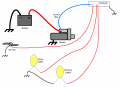
In the two lights below, they're tied together and connected to ground. You described something like 20 circuits sharing one ground. Well, if the place where it makes contact to the chassis and there's a corroded connection - yes, something could back-feed into the computer and make the computer sense a safe condition when the door is open, and start the engine.

Bad ground is exactly that - a bad ground. Not a short, not a long, not an apple or pair. It's a connection that is weak due to whatever reason - be it corrosion, loose, paint, dirt or anything else that limits the ability for the ground to make contact - hence, a bad ground. A short - as described beautifully by some engineer is exactly that - a pathway that does not follow the long circuit.

The word "Circuit" is related to the word "Circle". And if you think of a circuit as a circle - see the second drawing. The circle represents the circuit. A short is a pathway back to the power source (or can bypass a fuse or a control, doesn't have to be back to ground) the pathway the current takes is a short-cut back to the source. That's a short. Not a corroded (bad) ground. Not a malfunctioning computer where when it sees a light on for, whatever reason, it interprets it as a signal that it's safe to start the engine. It can be caused by something that has yet to be determined (oh, wait - you said it was a corroded ground).

Nevertheless, several circuits may be connected to a common point that eventually goes to ground. The point where it makes contact with the chassis (G201) is the chassis ground.

1586463555775.png
1586464339900.png
 

shortbus

Joined Sep 30, 2009
10,050
All I can say is after working where GM wiring harnesses were made is, don't expect all things to be grounded where YOU would put them. Many of them are in the last place YOU would do it. Some of the reason for that being done the way it is, is due to weight savings where we wouldn't think a 5 foot piece of 16 or 14 gauge wire weighs much the engineers doing the harness do. That and copper is expensive.

My last "bad ground" was in a Chevy S10 4x4 a few years ago. Thinking the fuel pump was bad(a known problem in GM vehicles) I dropped the tank and put in a new pump. Everything back together and still no fuel. So I start the trace process. power to the pump good, the fuel gauge worked so thought the ground was good. But the pump uses another ground but where? Just exactly where I would never put it, back near the rear bumper, right where any water coming from the tires hits it and the salt in the winter. The same ground for the tail lights and brake lights, which I didn't know didn't work. Instead of just cleaning the frame to harness connection, it got a new wire ran along the frame up to a main grounding point, the one for all of the front lights.
 

Eyecue

Joined Jan 4, 2020
1
I'm hoping I can get some help with a disagreement concerning "ground" on an automotive forum. My opinion is too many people write off whatever they don't understand is happening with a circuit as a bad ground. In this particular instance the vehicle owner has to turn the interior dome light on to start the vehicle. Most everyone is saying "bad ground," which doesn't make sense to me. If vehicle ground is a "zero voltage reference," then Kirchhoff's Law states the circuit voltage necessary to start the vehicle has to has to be recognized before ground or the zero voltage reference. My opinion is this has to be a short circuit somewhere in the circuit and has nothing to do with ground. Others are adamant that somehow the voltage necessary to start the vehicle is making a "detour" (as they put it) through ground to complete the circuit. It doesn't make sense to me that ground can both be a zero voltage reference and at the same time allow a circuit to find continuity through ground to complete the ignition circuit. This means ground can be both a zero voltage reference and voltage circuit simultaneously. Anyone have any thoughts on this to share? Thank you.
In an automotive dome light, the bulb is hot all the time and the door switch closes the ground to the chassis and the bulb turns on. Since you did not post the year, make and model of the car, I am assuming this is a newer vehicle and has a BCM. The BCM has failed.
 

Thread Starter

Back to school

Joined May 22, 2019
106
No - that's not a bad ground - that's a "Short To Ground".
Well put.
G201 was corroded. THAT is a bad ground. A ground with high resistance.
I asked earlier if it was just semantics to differentiate "bad ground" and "bad connection to ground?" Does a bad connection to ground make the ground bad? I don't know and why I asked.

You've stated well my question all along. If there is a bad connection to ground in a circuits intended path, the long, and yet the ignition still works through another circuit, the dome light, there are obviously multiple issues involved. But, is the ignition active because of a bad ground connection at G201 or because of a short to ground through another circuit?

Once the entire problem was identified after almost a week I didn't question the bad connection to ground. I questioned the ignition working because of a bad ground connection. That suggests a good or bad ground connection is irrelevant. You still have ignition. Or is there ignition because of a short to ground through another circuit? Regardless of how continuity to ground is completed, it's a short to ground (even longer) and that's not the intended or normal operation.

The question is, does the truck start because of a bad ground connection or because of a short to ground through another circuit? Again, the original problem, "Why does my dome light have to be on to start my truck?" (I don't remember if I stated this or not?) Is it because of a bad ground connection or because of a short to ground through another circuit? If you had to define how or why the truck starts how would you do it?

Great post by the way.
 

narkeleptk

Joined Mar 11, 2019
586
The question is, does the truck start because of a bad ground connection or because of a short to ground through another circuit? Again, the original problem, "Why does my dome light have to be on to start my truck?" (I don't remember if I stated this or not?) Is it because of a bad ground connection or because of a short to ground through another circuit? If you had to define how or why the truck starts how would you do it?
I'd consider it a bad ground because the module/sensor was badly grounded. Either completely open to ground or too poorly connected to ground. Either way, its ground and bad.

I'd say it like this to a customer:
The truck did not start because of a bad ground for XXX(which ever sensor or module it was they fixed), This module being down caused the pcm to not allow the crank command to the starter (starter relay). Which caused the no start situation. Turning your dome light on caused a short to ground in xxx module and was enough to fool the pcm into allowing the crank signal to be sent. Its a good thing we found it since the ground for your dome light is not designed to handle the extra load and would have led to more problems possibly even a fire!
 
Last edited:

samples69

Joined Feb 2, 2019
9
Yes, Having a customer at a Buick dealer tell there was a short in the electrical system because windows roll down, radio stays on and it stops when you open the door...short. No, it’s inadvertent power that remains on after shut off, but door not opened. This is a feature Grandpa, who had golf clubs in the trunk next to his oxygen tank. So the answer is yes, I have heard it a thousand times. I don’t lye, or hide in the bathroom when the customer wants to see the part that is bad. Chances are, I called them to come in.

As for as you G102 being corroded/ high resistance was your problem and using voltage drop would have found it quickly. You never said year, make & model in the first post, if it was explained later, sorry. No, I did not read all 512 post on this simple subject. I have a life a other stuff to do.
I have no idea what the talk about bat & baseball or Kirchohoff’s Law has anything to do with fixing a car. Unless you are designing the electrical system, then forget it. Techs work on flat rate, not clock time or % of parts. I won’t ever work at those places ever. You are doing your customer a disservice and I refuse.
They had a dealer contest of 9 techs for lowest “Come-Backs”, after 12 months I had none. This is Buick and the only Isuzu tech in a city larger than St. Louis and my wife & I went to Cancun for 6 days.
If you have questions about several things, start with one at a time. I others wise most tech hate electrical, auto transmissions next and differentials next. Did all! Take care kid.
 

MisterBill2

Joined Jan 23, 2018
27,584
@samples69,

Much of what you said has been covered through the entire thread. The biggest being after the fact finding out the truck owner's father added an aftermarket keyless entry. Also as I said, the point of this question was not to fix this truck. It's not mine and I have no clue of who the owner is or where he's at.

I do have questions about some of what you've said though. I don't doubt you've heard "short" a lot and you've have a lot of dollars for hearing it. That doesn't mean they don't happen though. As for fuses blowing? I've seen my fair share of vehicles burn to the ground from shorts where no fuse blew. Also correct me if I'm wrong but shorts can exist within a series circuit?

As was also said, the ground to the effected circuits was lost due to corrosion. If you have an explanation other than a short about how the trucks ignition worked through dome light I'd like to hear it. An explanation of how automotive ground works is what my question was about. As you bring up the history of jumping to the conclusion of shorts, the current trend is "bad ground." No explanation to bad ground other than, "I've been doing this for 40 years and I know." Of course this 40 year mechanic never once mentioned following the workshop manual procedures for chasing the circuits involved. I've know plenty of 40 year mechanics and I can name a fair share of them that suck as mechanics. "I learn nothing from "a bad ground and I know." That's what brought me here and I've learned a lot from the thoughts that have been shared and I'm grateful for it. I'm retired also but the desire to still learn is what keeps this all interesting.

Also since you taught automotive electricity, although I never work specifically with automotive electrical circuits from my schooling days we were taught, "There is no such thing as a bad ground. There are only bad connections to ground." There is a ground or there isn't. A bad ground isn't a ground anymore. The example given to us all those years ago was this, a baseball bat isn't bad because nobody can connect with it. It's just a bat. I've also heard because an engine runs rich or lean doesn't mean the gas is bad. That's just lazy thinking. Going back to the early days of testing magnetic suspensions we also had multiple grounds. The suspension ground was isolated from chassis ground because it operated at 24v. There were even attempts at operating the suspension with switched + and - voltage. It wasn't successful. The concept was great. Just not practical.

I do appreciate your input. It's insightful and thought provoking.

Following the entire thread leads to the fix but it's not something I had any part in.
Bad connections to a theoretical common wind up tying assorted circuits together and causing a wide variety of problems, often beyond what we can imagine. "Shorts" in a car wiring usually pop fuses.
An interesting safe experiment is to look at a circuit diagram of some piece of equipment and try to figure what would happen if a couple points that go to "ground" symbols were instead connected together. Don't actually do it because it may break or burn things or be unsafe. But just tracing out what might happen is really interesting. That is why my one old car has a few wired grounds, because rust is a poor conductor at 12 volts.
 
Top