Facebook
 Google
 GitHub
 Linkedin
KeepItSimpleStupid
- Joined Mar 4, 2014
- 5,088
Programming keys: Did one on a 2000 Solara. Use brake accelerator and master ignition key. Visual UI was security light. I only added keys. Dealer provided key and cut it for me for $18.00.
Here's a scenario.I'm hoping I can get some help with a disagreement concerning "ground" on an automotive forum. My opinion is too many people write off whatever they don't understand is happening with a circuit as a bad ground. In this particular instance the vehicle owner has to turn the interior dome light on to start the vehicle. Most everyone is saying "bad ground," which doesn't make sense to me. If vehicle ground is a "zero voltage reference," then Kirchhoff's Law states the circuit voltage necessary to start the vehicle has to has to be recognized before ground or the zero voltage reference. My opinion is this has to be a short circuit somewhere in the circuit and has nothing to do with ground. Others are adamant that somehow the voltage necessary to start the vehicle is making a "detour" (as they put it) through ground to complete the circuit. It doesn't make sense to me that ground can both be a zero voltage reference and at the same time allow a circuit to find continuity through ground to complete the ignition circuit. This means ground can be both a zero voltage reference and voltage circuit simultaneously. Anyone have any thoughts on this to share? Thank you.
It is obvious that what you have is a bunch of people with NO information except hearing the complaint. And then spouting off with the hundred year old statement that is occasionally accurate.Here's a scenario.
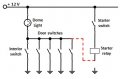
View attachment 203818
Could be a case of starter relay coil earth jumper, disconnected from a ground terminal block, wrongly plugged on to a door switch terminal block.
Any of those door switches or the interior switch of the dome light could provide the ground path when actuated.

#4 I believe I did cover. Doors closed and light on by switch was the same as light on from wither door being open. I did not know about the bulb being removed.Some missing information:
1. we are assuming old school auto wiring i.e. no CAN or other busses
2. details of ignition switch wiring including the relay that cuts power to all non essential loads e.g. coutesy light
3. courtesy light 3 position wiring where a mechanical sw fault could be fooling the ignition sw logic. Try again with bulb removed
4. what do you mean about turn on courtesy lamp? by having door open? manual sw on? both? or having light shining?
5. All trouble shooting suggested in forum to date is figuring out why the starter does not work for normal conditions . It may be quicker to resolve by understanding why it can work with courtesy light "on" (back to 4)
Hope this helps.
The semantics often get in the way instead of communicating effectively. Many words in common usage have different meanings to different people. Technical terms tend to have more narrow definitions but it's always a challenge to communicate with precision. That's one reason we always ask for schematics and/or photos. Words just aren't as effective.Finding a path to ground through another circuit, which seems to be the only explanation, is a short to another circuit. Is this just semantics or is this difference a necessary understanding to analyze what's going on with the circuit?
Here's a scenario.
View attachment 203818
Could be a case of starter relay coil earth jumper, disconnected from a ground terminal block, wrongly plugged on to a door switch terminal block.
Any of those door switches or the interior switch of the dome light could provide the ground path when actuated.
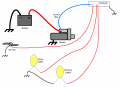
I have shown, in my earlier post, how the starter could have got disabled but then enabled after putting the courtesy light on.Some missing information:
1. we are assuming old school auto wiring i.e. no CAN or other busses
2. details of ignition switch wiring including the relay that cuts power to all non essential loads e.g. coutesy light
3. courtesy light 3 position wiring where a mechanical sw fault could be fooling the ignition sw logic. Try again with bulb removed
4. what do you mean about turn on courtesy lamp? by having door open? manual sw on? both? or having light shining?
5. All trouble shooting suggested in forum to date is figuring out why the starter does not work for normal conditions . It may be quicker to resolve by understanding why it can work with courtesy light "on" (back to 4)
Hope this helps.
No - that's not a bad ground - that's a "Short To Ground".In my opinion, if you want to claim bad ground and then go to "detour" to ground that's a accurate description of what claimed to be a short or "unintentional path."
Well put.From a website from PE Electrical Engineers this is said:
""A short circuit is simply an unwanted connection between two points in a circuit. This unwanted connection will usually cause the overall circuit to misbehave in some way.""
And another:
""In simple and practical terms, a short circuit is an unwanted or unintentional path that current can take which bypasses the routes you actually want it to take.""
G201 was corroded. THAT is a bad ground. A ground with high resistance.Further update. The vehicle owner says he has fixed the problem. Grounding point G201 was corroded. G201 is a connection to ground point for at least a half a dozen circuits. After taking the G201 apart and removing the corrosion everything worked normally once back together.

In an automotive dome light, the bulb is hot all the time and the door switch closes the ground to the chassis and the bulb turns on. Since you did not post the year, make and model of the car, I am assuming this is a newer vehicle and has a BCM. The BCM has failed.I'm hoping I can get some help with a disagreement concerning "ground" on an automotive forum. My opinion is too many people write off whatever they don't understand is happening with a circuit as a bad ground. In this particular instance the vehicle owner has to turn the interior dome light on to start the vehicle. Most everyone is saying "bad ground," which doesn't make sense to me. If vehicle ground is a "zero voltage reference," then Kirchhoff's Law states the circuit voltage necessary to start the vehicle has to has to be recognized before ground or the zero voltage reference. My opinion is this has to be a short circuit somewhere in the circuit and has nothing to do with ground. Others are adamant that somehow the voltage necessary to start the vehicle is making a "detour" (as they put it) through ground to complete the circuit. It doesn't make sense to me that ground can both be a zero voltage reference and at the same time allow a circuit to find continuity through ground to complete the ignition circuit. This means ground can be both a zero voltage reference and voltage circuit simultaneously. Anyone have any thoughts on this to share? Thank you.
I asked earlier if it was just semantics to differentiate "bad ground" and "bad connection to ground?" Does a bad connection to ground make the ground bad? I don't know and why I asked.No - that's not a bad ground - that's a "Short To Ground".
Well put.
G201 was corroded. THAT is a bad ground. A ground with high resistance.
I'd consider it a bad ground because the module/sensor was badly grounded. Either completely open to ground or too poorly connected to ground. Either way, its ground and bad.The question is, does the truck start because of a bad ground connection or because of a short to ground through another circuit? Again, the original problem, "Why does my dome light have to be on to start my truck?" (I don't remember if I stated this or not?) Is it because of a bad ground connection or because of a short to ground through another circuit? If you had to define how or why the truck starts how would you do it?
Bad connections to a theoretical common wind up tying assorted circuits together and causing a wide variety of problems, often beyond what we can imagine. "Shorts" in a car wiring usually pop fuses.@samples69,
Much of what you said has been covered through the entire thread. The biggest being after the fact finding out the truck owner's father added an aftermarket keyless entry. Also as I said, the point of this question was not to fix this truck. It's not mine and I have no clue of who the owner is or where he's at.
I do have questions about some of what you've said though. I don't doubt you've heard "short" a lot and you've have a lot of dollars for hearing it. That doesn't mean they don't happen though. As for fuses blowing? I've seen my fair share of vehicles burn to the ground from shorts where no fuse blew. Also correct me if I'm wrong but shorts can exist within a series circuit?
As was also said, the ground to the effected circuits was lost due to corrosion. If you have an explanation other than a short about how the trucks ignition worked through dome light I'd like to hear it. An explanation of how automotive ground works is what my question was about. As you bring up the history of jumping to the conclusion of shorts, the current trend is "bad ground." No explanation to bad ground other than, "I've been doing this for 40 years and I know." Of course this 40 year mechanic never once mentioned following the workshop manual procedures for chasing the circuits involved. I've know plenty of 40 year mechanics and I can name a fair share of them that suck as mechanics. "I learn nothing from "a bad ground and I know." That's what brought me here and I've learned a lot from the thoughts that have been shared and I'm grateful for it. I'm retired also but the desire to still learn is what keeps this all interesting.
Also since you taught automotive electricity, although I never work specifically with automotive electrical circuits from my schooling days we were taught, "There is no such thing as a bad ground. There are only bad connections to ground." There is a ground or there isn't. A bad ground isn't a ground anymore. The example given to us all those years ago was this, a baseball bat isn't bad because nobody can connect with it. It's just a bat. I've also heard because an engine runs rich or lean doesn't mean the gas is bad. That's just lazy thinking. Going back to the early days of testing magnetic suspensions we also had multiple grounds. The suspension ground was isolated from chassis ground because it operated at 24v. There were even attempts at operating the suspension with switched + and - voltage. It wasn't successful. The concept was great. Just not practical.
I do appreciate your input. It's insightful and thought provoking.
Following the entire thread leads to the fix but it's not something I had any part in.