Question about a power supply circuit

Thread Starter

Lamate

Joined May 22, 2019
12
Hey there!

I've got a Voltcraft power supply and I had the idea to upgrade it with an Arduino.
The power supply contains a transformer which takes 230V@50Hz on the primary coil and outputs 20V-0V-20V on 3 connections on the second coil.
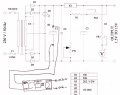
This is the schematic of the power supply.

Now I'd like to know, if the voltage "after" the diodes(D1-D4) is 20V DC.
If so, is it safe to connect directly to a voltage regulator and then to an Arduino?

I'm sorry if this post is hard to understand, as English is not my primary language.
Thanks!
 

Zeeus

Joined Apr 17, 2019
616
H
Hey there!

I've got a Voltcraft power supply and I had the idea to upgrade it with an Arduino.
The power supply contains a transformer which takes 230V@50Hz on the primary coil and outputs 20V-0V-20V on 3 connections on the second coil.
This is the schematic of the power supply.

Now I'd like to know, if the voltage "after" the diodes(D1-D4) is 20V DC.
If so, is it safe to connect directly to a voltage regulator and then to an Arduino?

I'm sorry if this post is hard to understand, as English is not my primary language.
Thanks!
Hmm, that schematic looking weird..The diodes part..converts AC to DC?

Please explain the 4 diodes (D1 - D4)
Thanks
 

Thread Starter

Lamate

Joined May 22, 2019
12
H


Hmm, that schematic looking weird..The diodes part..converts AC to DC?

Please explain the 4 diodes (D1 - D4)
Thanks
Well I don't know if it does, it's not my schematic, it's the official one.
All I that I know of, that is not mentioned in the schematic, is that the secondary coil delivers 20V-0V-20V on those 3 connections.
I don't know anything else.
 

Thread Starter

Lamate

Joined May 22, 2019
12
You cannot use a voltage divider to power your Arduino. You need a regulator. The voltage after the diodes will be closer to 27V if the transformer is indeed 20-0-20.

Bob
I've never mentioned a voltage divider, but thanks for the quick reply!
Quick follow-up question though: Is a voltage regulator the most efficient solution I can use, to step the voltage down to about 10V?
The transformer can only deliver 1.5A and I'd like most of that to go to the actual power supply, instead of being lost by the regulator
 

dendad

Joined Feb 20, 2016
4,637
The voltage will be 20 x 1.4 = 28V, and maybe higher. The cap will charge to the peak voltage of the 20VAC.

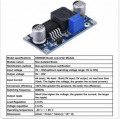
If you want to run an Arduino, look for a small switch mode regulator on Ebay or similar, like...
3A buck converter.jpg
Some off these are preset, and others are variable.
 

Thread Starter

Lamate

Joined May 22, 2019
12
The voltage will be 20 x 1.4 = 28V, and maybe higher. The cap will charge to the peak voltage of the 20VAC.

If you want to run an Arduino, look for a small switch mode regulator on Ebay or similar, like...
View attachment 180427
Some off these are preset, and others are variable.
Thanks! Should I connect it directly to the diodes, the capacitor, or somewhere else?

And where did you get the 1.4 you used in your calculation?
 

dendad

Joined Feb 20, 2016
4,637
Thanks! Should I connect it directly to the diodes, or somewhere else?
Connect the input to the reg across C1, which is the output from the rectifier.
But, I just checked and the max input V is 28V. That may be too close to what you are getting.
There are other boards that a higher input volts.
LM2577 Buck .png
This one is a bit better but I would go higher to be safe.

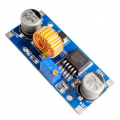
Search for "XL4015 5A DC-DC Adjustable Buck Converter".
XL4015 5A buck.png
It has a 36V max input.
 
Last edited:

Audioguru

Joined Dec 20, 2007
11,248
I notice the odd symbols for the large electrolytic capacitors C1 and C3 are backwards (upside down). Also the normally marked "+" wire of an electrolytic capacitor is missing.
 

dendad

Joined Feb 20, 2016
4,637
I notice the odd symbols for the large electrolytic capacitors C1 and C3 are backwards (upside down). Also the normally marked "+" wire of an electrolytic capacitor is missing.
Good pickup.
I don't use those symbols myself. On my circuits, I always add a "+" to avoid confusion. Electrolytic caps don't appreciate being connected reverse.
I remember in my training, we are given a 1000uF electro to use on the 50V stuff we were working on. The instructor called our attention to a waste bin on the floor. He then turned on the power and BANG!
A small electro was hanging in the bin. He had hooked it up reverse, and it was a low volts one too boot.
We all jumped! Then he showed us the tiny cap he had used and impressed upon us that our cap was much larger, so be careful. It was a good demo that I remember 50 years on.

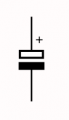
This is the symbo I use...
electro.png
 

MrChips

Joined Oct 2, 2009
34,807
AC voltages are quoted using RMS value. RMS stands for Root Mean Square.
For example, when you see 230VAC sine wave, the amplitude is not 230V.
The amplitude is 230V x 1.414 = 325V
Where did the 1.414 come from? The square root of 2 is 1.414.

Why do they do this?
They want to indicate equivalent power.
That is a sine wave with amplitude of 325V will supply the same power as a DC voltage of 230V. Hence the call it 230VAC. The peak value is actually 325V.

VRMS = VPK / √2
VRMS = 0.707 x VPK

VRMS x √2 = VPK
VRMS x 1.414 = VPK


For another example, 20VAC sine wave has an amplitude of 20 x 1.414 = 28.28V
Hence 20VAC has peak amplitude of 28.28V and will supply the same power as 20VDC.
When you rectify 20VAC and store the rectified voltage in a capacitor, you will capture the peak amplitude minus the voltage drop across the rectifier diodes. Hence the voltage across the storage capacitor will be about 27VDC.
 

SamR

Joined Mar 19, 2019
5,487
It's being fed into an LM317 regulator and the rated output per the PDF is 1.5 - 15VDC? The diodes and caps are rectifying, filtering and smoothing the transformer AC output to input DC to the regulator??? The regulator has some biasing pots to adjust the output. What am I missing here? It does use some archaic pot and cap symbols.
 

SamR

Joined Mar 19, 2019
5,487
If I understand your question correctly you want to use this to supply the voltage for your Arduino? The input voltage range for the power jack on the Arduino is from 7 - 16V. Adjust the regulator output voltage to 10 - 12V and you are good to go with it.
 

SamR

Joined Mar 19, 2019
5,487
That is a full wave rectifier using a center tapped secondary. There are 2 diodes in parallel, presumably to handle the required current
Yep the double diodes threw me at first to thinking bridge except they are both biased the same. 4002 diodes good for 100V @ 1A each and C1 @ 35V. LM317 good for 40V input to output differential voltage. I don't see any problem here. Assume the disk caps are good for 50V.
 
Last edited:
Top