question about 1w/1m

Thread Starter

Green Bean

Joined Mar 31, 2017
126
I have a speaker that says it produces 91 db at 1w/1m. As far as I know, this means that it will produce 91 db 1 meter away when it's taking 1 watt of signal. But is this relationship linear? So, if I fed it a 10 watt signal, would I get 910 db from 10 meters away? I'm asking because it's rated 110 watts RMS, and 110 watts would make a lot of db if this is true lol.
 

crutschow

Joined Mar 14, 2008
38,503
The output sound versus power is basically linear but dB's are logarithmic.
So increasing the power by 10 times (1w to 10W) increases the sound level by 10dB (at 1 meter, not 10 meters).
The intensity drops off as 1/r so at 10 meters the sound pressure would be 20dB lower than at 1 meter.
 

Audioguru

Joined Dec 20, 2007
11,248
Also, our hearing's sensitivity to loudness is also logarithmic. Twice the power sounds only a little louder. 10 times the power sounds twice as loud.
 

Thread Starter

Green Bean

Joined Mar 31, 2017
126
Ok. Well all I have is an LM386 (which is 1 watt max, anyway, as far as I know). I have a 2.5vpp signal that I want to send to the speaker (which is 4 ohms). I'd like to amplify the signal to 1 watt, nice and loud (91 db apparently). How should I set up the LM386 here (running on 5 volts).
 

crutschow

Joined Mar 14, 2008
38,503
I have a 2.5vpp signal that I want to send to the speaker (which is 4 ohms). I'd like to amplify the signal to 1 watt, nice and loud (91 db apparently). How should I set up the LM386 here (running on 5 volts).
2.5Vpp into 4 ohms is only 0.2Wrms.
If you use two LM386's in a bridge circuit (inverting the input audio signal to one of them) you would get 4 times the power or 0.8W.
For more power you need a higher power amp running from a higher supply voltage.

And note that 92dB is at a 1 meter distance.
Is that how close you are going to sit from the speaker?
 

Audioguru

Joined Dec 20, 2007
11,248
The datasheet for the LM386 has a graph that shows battery voltage, speaker impedance and resulting maximum peak-to-peak output voltage.
With a 5V supply the output into your 4 ohm speaker is only 2.5V p-p which is 0.88V RMS. Then the power in the speaker is only (0.88) squared)/4 ohms= 0.14W.
The graph shows that with a supply that is 9V to 12V the output power does not change, another graph shows that only the heating in the IC changes. With a 9V to 12V supply the maximum output into 4 ohms is 3.5V p-p producing 0.38W. The peak current is (3.5V/2)/4 ohms= 0.44A.

If you connect two power amplifiers in a bridge then the p-p output voltage tries to double and the output current also tries to double. With a 5V supply the maximum peak output voltage into 4 ohms is 1.25V but the bridging doubles it to 2.5V. Then the peak output current is 2.5V/4 ohms= 0.625A which is impossible because it is more than the maximum available output current of 0.44A above.

A 12V supply and an 8 ohm speaker produces a maximum of 6.5V p-p which is 0.66W. The peak current cannot go higher than 0.41A.
Bridged, a peak current of 0.41A is produced when the maximum output is 3.25V peak which can be done with a 5V supply.

Therefore an LM386 can produce a maximum of 0.66 Watt, or 1 fake What.
 

Audioguru

Joined Dec 20, 2007
11,248
The value is frequency dependent. I think the frequency used is 1 kHz.
I agree. The amplifier does not work well at 2Hz nor at 2MHz.
Oh, the speaker? Any half-decent speaker produces a fairly flat frequency response from 60Hz to 15kHz.
Oh, the impedance of the speaker? it is the lowest at about 400Hz.
 

Thread Starter

Green Bean

Joined Mar 31, 2017
126
2.5Vpp into 4 ohms is only 0.2Wrms.
If you use two LM386's in a bridge circuit (inverting the input audio signal to one of them) you would get 4 times the power or 0.8W.
For more power you need a higher power amp running from a higher supply voltage.

And note that 92dB is at a 1 meter distance.
Is that how close you are going to sit from the speaker?
That is about how close I'd be. Do you have a schematic for this circuit? If I need to, I can use a higher voltage power supply.
 

Audioguru

Joined Dec 20, 2007
11,248
The LM386 amplifier does not produce enough output current to drive a 4 ohm speaker bridged. A higher supply voltage simply produces more heat in the IC, not more output power.
If I need to, I can use a higher voltage power supply.
No. The LM386 is designed for driving an 8 ohm speaker with a 9V supply to produce 0.45W maximum. With a 4 ohm speaker and/or with a higher supply voltage it simply gets hotter but with the same maximum output power. Bridging it will just make almost 4 times the heat.

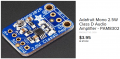
Try a more modern Class-D amplifier like the PAM8302 that is already bridged. It produces 2W (the ad says 2.5 Whats) into 4 ohms at low distortion with a 5V supply and it barely gets warm. Fixed the typo.
An assembled amplifier board is available from Adafruit for only $3.95US.
 

Attachments

Top