Quantum entanglement, can anyone untangle the conflicting "science"?

Thread Starter

ballsystemlord

Joined Nov 19, 2018
253
Out of curiosity, I was looking into quantum entanglement. And so, I opened up about 40 articles on the subject. But when I read them all, I found that their "science" conflicted. Even more confusing is that these articles all link in or are referencing scientific papers to back up their claims. Can anyone untangle the conflicting "science" of quantum entanglement?

Here are the two major conflicts I have noticed.


Let's talk about the distance particles can be entangled. Some say that the maximum distance doesn't matter.

"Einstein famously called entanglement “spooky action at a distance”, as altering one particle in an entangled pair affects its twin instantaneously – no matter how far away it is." another reads, "It [quantum entanglement] occurs when pairs of particles become so closely connected that one can no longer be described without the other, no matter how far apart they may be. Even more strange, changing one will instantly trigger a change in its partner, even if it was on the other side of the universe."

Others say that there's a firm limit, "Record-setting quantum entanglement connects two atoms across 20 miles"


The other conflict that I noticed is regarding the temperature at which particles can become entangled. (EDIT: nsaspook "solved" this one. See below.)

"Such entanglement is very hard to observe. It requires cooling microscopic objects down to within a degree of absolute zero – the coldest possible temperature," if you prefer a paper claiming the same, "Computer Scientists Prove That Heat Destroys Quantum Entanglement."

Yet, others claim to have achieved quantum entanglement at 'high temperatures'. "It's a Quantum World Record: 15 Trillion Smokin' Hot Atoms Entangled."


So, which is it? Does entanglement not work at 'high temperatures' or does it? Does distance cause particles to become untangled or doesn't it?

Thanks!
 
Last edited:

nsaspook

Joined Aug 27, 2009
16,275
What you see is the typical theoretical QM interpretation vs experimental data gap. Both are correct and there really is no conflicting "science", only a mystery that seems to have no classical solution. It's IMO a lack (it's a complex subject) of understanding of the subject that's causing most the confusion.

Look at the actual papers instead of POP-SCI articles for what's really happening.
https://www.nature.com/articles/s41467-020-15899-1
Quantum technologies use entanglement to outperform classical technologies, and often employ strong cooling and isolation to protect entangled entities from decoherence by random interactions. Here we show that the opposite strategy—promoting random interactions—can help generate and preserve entanglement. We use optical quantum non-demolition measurement to produce entanglement in a hot alkali vapor, in a regime dominated by random spin-exchange collisions. We use Bayesian statistics and spin-squeezing inequalities to show that at least 1.52(4) × 1013 of the 5.32(12) × 1013 participating atoms enter into singlet-type entangled states, which persist for tens of spin-thermalization times and span thousands of times the nearest-neighbor distance. The results show that high temperatures and strong random interactions need not destroy many-body quantum coherence, that collective measurement can produce very complex entangled states, and that the hot, strongly-interacting media now in use for extreme atomic sensing are well suited for sensing beyond the standard quantum limit.
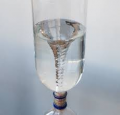
A fancy way of saying they used a form of non-random energy to generate some entanglement in matter that's normally random. As a analogy, like spinning water with a spoon in a consistent manner to make a vortex.
1728490277232.png
 

BobTPH

Joined Jun 5, 2013
11,489
Theory says entanglement remains at any distance. The longest distance an experiment has verified it at is 20 miles.

There is no conflict between these two statements.
 

Thread Starter

ballsystemlord

Joined Nov 19, 2018
253
What you see is the typical theoretical QM interpretation vs experimental data gap. Both are correct and there really is no conflicting "science", only a mystery that seems to have no classical solution. It's IMO a lack (it's a complex subject) of understanding of the subject that's causing most the confusion.
Theory says entanglement remains at any distance. The longest distance an experiment has verified it at is 20 miles.

There is no conflict between these two statements.
But if you can't prove something normally that means that you don't say, "X is true," rather, you say, "Theoretically X is true," or "Based on the best current working hypothesis, X is true."

EDIT: As I've learned more and more about science, the one thing that remains constant is the reminder to never assume anything and to test every theory that you have lest you make a big mistake because you're wrong.
 

Thread Starter

ballsystemlord

Joined Nov 19, 2018
253
<snip>
Look at the actual papers instead of POP-SCI articles for what's really happening.

A fancy way of saying they used a form of non-random energy to generate some entanglement in matter that's normally random. As a analogy, like spinning water with a spoon in a consistent manner to make a vortex.
After thinking this over, are you saying that their ability to generate quantum entanglement at 'high temperatures' was due to them operating outside of the normal method? Like, normally you can't combine oil and water, but if you have dish detergent mixed in then you can.
 

nsaspook

Joined Aug 27, 2009
16,275
But if you can't prove something normally that means that you don't say, "X is true," rather, you say, "Theoretically X is true," or "Based on the best current working hypothesis, X is true."

EDIT: As I've learned more and more about science, the one thing that remains constant is the reminder to never assume anything and to test every theory that you have lest you make a big mistake because you're wrong.
The fact that QM is still a theory means "Theoretically X is true". The proof is experimental data to confirm the theory to X conditions. It might also be true in all possible physical conditions but the data set is limited to what we can currently test.
 

nsaspook

Joined Aug 27, 2009
16,275
After thinking this over, are you saying that their ability to generate quantum entanglement at 'high temperatures' was due to them operating outside of the normal method? Like, normally you can't combine oil and water, but if you have dish detergent mixed in then you can.
Sort of but it's only a very limited analogy. You don't have pure ground states to measure so the main question is how practical this will be. It's far beyond my capability to judge.
 

Thread Starter

ballsystemlord

Joined Nov 19, 2018
253
The fact that QM is still a theory means "Theoretically X is true". The proof is experimental data to confirm the theory to X conditions. It might also be true in all possible physical conditions but the data set is limited to what we can currently test.
Forgive me if I recall incorrectly, but I thought that QM was proven to be true by the double slit experiment and similar. Are parts of it unproven? Or perhaps it's posited as a theory until we can verify that there is not something else going on and currently QM just happens to "fit" how the universe works well enough to fool smart people? (Because even smart people don't know what they don't know.)
 

BobTPH

Joined Jun 5, 2013
11,489
No theory is ever proved in science. Experiments can disprove, but not prove anything. There is always another experiment that might disprove a theory. In fact, falsifiability is a requirement for all scientific theories.
 

nsaspook

Joined Aug 27, 2009
16,275
Forgive me if I recall incorrectly, but I thought that QM was proven to be true by the double slit experiment and similar. Are parts of it unproven? Or perhaps it's posited as a theory until we can verify that there is not something else going on and currently QM just happens to "fit" how the universe works well enough to fool smart people? (Because even smart people don't know what they don't know.)
QM predicts the results of the double slit experiment just like the Standard Model predicts the Higgs what was found in the LHC. Both theories/models are very likely incomplete but won't ever be really wrong (they are complete as possible but still make incorrect predictions like SM with neutrino mass and QM with gravity) as they both make correct predictions over a wide area of physical processes.

Even Flat Earth is true (gives the correct predictions) within a narrow constraints of conditions like a several acre corn field in Kansas.

There is no fooling. QM fits because it works. Find a better theory that works better (does all that QM does and more), it will supersede QM overnight.
 
Top