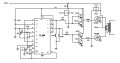
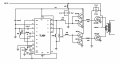
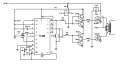
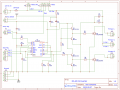
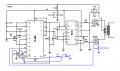
Here is the revised version, although I still don't understand what is wrong around the 10R. As far as I know, Vcc and the 12V shown in the link image are the same thing.
Do you have any sense of its maximum potential power output?
I finally got my head in gear so this should be correct. I will also look over a datasheet and see if anything stands out. I'm going for the TL494CN, assuming it's readily available.
In the transformer you have chosen, the primary and secondary windings are placed quite far apart from each other.This means that there is a large leakage inductance in the transformer.
In case the secondary winding is shorted, the current in the primary should not be very high.
Imho, overcurrent protection is not mandatory in this case.
Another error in the circuit diagram. Pin 6 .Wrong combination of resistor and potentiometer, because if you turn the potentiometer all the way, pin 6 will be shorted to GND.
Replace these two components with a single resistor, 6.8 kOhm
In the transformer you have chosen, the primary and secondary windings are placed quite far apart from each other.This means that there is a large leakage inductance in the transformer.
In case the secondary winding is shorted, the current in the primary should not be very high.
Imho, overcurrent protection is not mandatory in this case.
Another error in the circuit diagram. Pin 6 .Wrong combination of resistor and potentiometer, because if you turn the potentiometer all the way, pin 6 will be shorted to GND.
Replace these two components with a single resistor, 6.8 kOhm
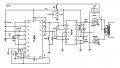
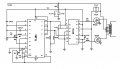
It has been suggested by a friend that it would work even better (faster and cleaner switching) if I used a dedicated FET driver, such as the IR2110, instead of the pairs of transistors. So I will post later today a draft of that circuit for any comment.
That wont work, that's the arrangement for a lo-side/hi-side driver.. Remove the diode and the capacitor between pins 5 & 6. Connect VS to ground and VB to VCC.
That wont work, that's the arrangement for a lo-side/hi-side driver.. Remove the diode and the capacitor between pins 5 & 6. Connect VS to ground and VB to VCC.
With no current sense on the MOSFETs how do you plan to control drain current at higher duty cycles? Why the IRFZ44N? Do you have any idea on the transformer?
With no current sense on the MOSFETs how do you plan to control drain current at higher duty cycles? Why the IRFZ44N? Do you have any idea on the transformer?
I was assuming that current drain was determined by the transformer impedance up to the limit of the circuit for which I have included a 10A fuse. The IRFZ44 seems as good as any. What would you suggest otherwise?
Well sort of, depends on what frequency/pulse width you drive it with..and the actual inductance of the winding. Its DC resistance will be a few milliOhms - if you're using a 12v car battery which can supply 10's of amps the MOSFET will fry in under 1mS - long before the fuse will blow. A 'fast' fuse can take >0.1sec to blow at 10x overload - they are intended to protect cables not MOSFETs. Pin 16 to error amp 2 +ve input is duty cycle control for current limit.
Have you any idea of the number of turns on the primary (each side) and the resulting inductance?
Well sort of, depends on what frequency/pulse width you drive it with..and the actual inductance of the winding. Its DC resistance will be a few milliOhms - if you're using a 12v car battery which can supply 10's of amps the MOSFET will fry in under 1mS - long before the fuse will blow. A 'fast' fuse can take >0.1sec to blow at 10x overload - they are intended to protect cables not MOSFETs. Pin 16 to error amp 2 +ve input is duty cycle control for current limit.
Have you any idea of the number of turns on the primary (each side) and the resulting inductance?
The transformer secondary has 2400 turns on it, and each of the two halves of the primary might have 50 turns (wound in the same direction) and so an educated guess for each half of the primary might be 25 - 50uH.
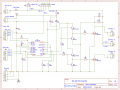
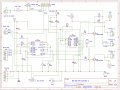
Here is my suggestion for current sensing with the additions in blue, so please correct as required. I'm not sure if a high-sided position of the sensing resistor would be better.

 Facebook
 Google
 GitHub
 Linkedin