PWM AC Induction Motor Control

Bordodynov

Joined May 20, 2015
3,431
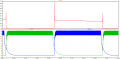
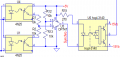
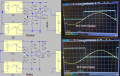
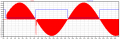
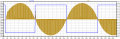
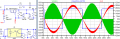
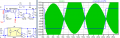
You may be interested in controlling the gates with modulated high frequency pulses. The modulation signal is 2 kHz and the carrier signal is 1 MHz. I did not like the simple shutter control. Strongly correct control is hindered by dispersion inductances. Dimming the AC motor with field-effect transistors. I put a cheap, 500 volt transistor in the circuit (in my model for the LTspice, the breakdown voltage is 578 V as in the factory model), so the breakdown did not come to that. Here, we had to find a compromise between through-current and outlet voltage. The difference between on and off is done by two R-C-D circuits. But the selected transistor STP12N50M2 allows to work in the breakdown mode, the main thing is not to exceed the energy of inductive ejection. The ejection is short - about 300 ns. Filling factor for this calculation is 0.5 at 2 kHz. Through the pulse transformers in the calculation goes 1 MHz (although better than 3 MHz). I have reduced the frequency to speed up the calculation.
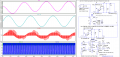
2020-10-02_10-27-14.png
 

Attachments

Last edited:

Thread Starter

nekojita

Joined Nov 19, 2010
170
Hi Danko,

Will try out your suggestions. :)
Thanks,

Neko
Hi Danko,

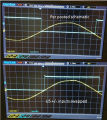
If the gate should be positive when the AC cycle is positive, it is not based on the currently posted sim schematic and the starting phase of the AC line. Please see the photo below:

1601771727412.png

Swapping the U5 +/- opamp inputs gives us the proper polarity for the synchro signal. Two next steps:
• Check each FET out of circuit for correct switching
• Add 10k gate resistors before applying AC Line voltage

If the polarity inversion was the main problem, the circuit should function like the simulation, right?

Thoughts? Comments?

Thanks,

Neko
 

Thread Starter

nekojita

Joined Nov 19, 2010
170
You may be interested in controlling the gates with modulated high frequency pulses. The modulation signal is 2 kHz and the carrier signal is 1 MHz. I did not like the simple shutter control. Strongly correct control is hindered by dispersion inductances. Dimming the AC motor with field-effect transistors. I put a cheap, 500 volt transistor in the circuit (in my model for the LTspice, the breakdown voltage is 578 V as in the factory model), so the breakdown did not come to that. Here, we had to find a compromise between through-current and outlet voltage. The difference between on and off is done by two R-C-D circuits. But the selected transistor STP12N50M2 allows to work in the breakdown mode, the main thing is not to exceed the energy of inductive ejection. The ejection is short - about 300 ns. Filling factor for this calculation is 0.5 at 2 kHz. Through the pulse transformers in the calculation goes 1 MHz (although better than 3 MHz). I have reduced the frequency to speed up the calculation.

View attachment 218588
Hi Bordodynov,

Thanks for your post! This looks very interesting and so simple. Could you please post the sim circuit and associated models. (motor)

I'd like to explore this further.

Thanks,

Neko
 

Danko

Joined Nov 22, 2017
2,172
Hi Neko,

If the gate should be positive when the AC cycle is positive, it is not based on the currently posted sim schematic
Review my post #114, where I said: "Pay attention to values of R14, R15 and to changes in U6 input connections (file PWM-test.asc in attachment)."
So, all is OK with sim schematic.
 
Last edited:

Thread Starter

nekojita

Joined Nov 19, 2010
170
Hi Neko,


Review my post #114, where I said: "Pay attention to values of R14, R15 and to changes in U6 input connections (file PWM-test.asc in attachment)."
So, all is OK with sim schematic.
Hi Danko,

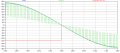
From that post, it shows that Vsynchro is negative when AC cycle is positive:

1601782875320.png

Other post shows this:

1601783384557.png

If that is correct as you indicate in your last post, what is correct?

Thanks,

Neko
 

Danko

Joined Nov 22, 2017
2,172
Hi Neko,
From that post, it shows that Vsynchro is negative when AC cycle is positive:
........
If that is correct as you indicate in your last post, what is correct?
Both are correct.
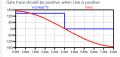
V(synchro) is signal at pin #3 of U6 (file PWM-test.asc). It is negative when Line is positive.
V(G,Neut) of M4 is positive, when Line is positive.
1601788776107.png

If the polarity inversion was the main problem, the circuit should function like the simulation, right?
Circuit in real world not always works as in simulation. Only you can compare them and answer your question.
 
Last edited:

Thread Starter

nekojita

Joined Nov 19, 2010
170
Hi Neko,


Review my post #114, where I said: "Pay attention to values of R14, R15 and to changes in U6 input connections (file PWM-test.asc in attachment)."
So, all is OK with sim schematic.
Hi Danko,

From that post, it shows that Vsynchro is negative when AC cycle is positive:

View attachment 218705

If that is correct as you indicate in your last post,
Hi Danko,

If the gate should be positive when the AC cycle is positive, it is not based on the currently posted sim schematic and the starting phase of the AC line. Please see the photo below:

View attachment 218696

Swapping the U5 +/- opamp inputs gives us the proper polarity for the synchro signal. Two next steps:
• Check each FET out of circuit for correct switching
• Add 10k gate resistors before applying AC Line voltage

If the polarity inversion was the main problem, the circuit should function like the simulation, right?

Thoughts? Comments?

Thanks,

Neko
Hi Danko,

I have solved at least part of the mystery between sim and breadboard. Somehow, sometime, I miscopied the sim circuit to the schematic that I built the breadboard from.

The photo below shows that my sync drive at M4 gate is inverted from yours based on the circuit differences:

1601857698811.png

Tomorrow, I will make a simple test fixture to test the FET headers. If all looks good with the FETS, I'll put them back on the breadboard and with the Danko version of the gate drive (positive when AC cycle positive), use the variac to apply line voltage.

Will also point to point check connections on the FET breadboard.

Thoughts? Comments?

Neko
 

Thread Starter

nekojita

Joined Nov 19, 2010
170
Hi Danko,

From that post, it shows that Vsynchro is negative when AC cycle is positive:

View attachment 218705

If that is correct as you indicate in your last post,

Hi Danko,

I have solved at least part of the mystery between sim and breadboard. Somehow, sometime, I miscopied the sim circuit to the schematic that I built the breadboard from.

The photo below shows that my sync drive at M4 gate is inverted from yours based on the circuit differences:

View attachment 218779

Tomorrow, I will make a simple test fixture to test the FET headers. If all looks good with the FETS, I'll put them back on the breadboard and with the Danko version of the gate drive (positive when AC cycle positive), use the variac to apply line voltage.

Will also point to point check connections on the FET breadboard.

Thoughts? Comments?

Neko
Hi Danko,

Am making progress! Made a simple fixture to plug in the FET SIP boards. Was finding that the FETs would turn on, but not turn off until I added 10k gate-source resistors to the test fixture. Turns out I had three shorted FETs.

Next was to add 10k gate-source resistors to the breadboard. The result when I applied Line voltage with a 750Ω load is shown below:

1601940455222.png

• I still did not apply full line voltage (am being cautious)
• There is an obvious delay between the Synchro signal and the PWM, is this critical?

Do you have any suggestions as to what to do next?

Thanks,

Neko
 

Thread Starter

nekojita

Joined Nov 19, 2010
170
Hi Danko,

Am making progress! Made a simple fixture to plug in the FET SIP boards. Was finding that the FETs would turn on, but not turn off until I added 10k gate-source resistors to the test fixture. Turns out I had three shorted FETs.

Next was to add 10k gate-source resistors to the breadboard. The result when I applied Line voltage with a 750Ω load is shown below:

View attachment 218852

• I still did not apply full line voltage (am being cautious)
• There is an obvious delay between the Synchro signal and the PWM, is this critical?

Do you have any suggestions as to what to do next?

Thanks,

Neko
Hi Danko,

I should have Identified the blue trace better in the PWM test today. It is the output of U5 (pin 1) the input to U6 pin 3. This is what you labeled as Synchro.

In the comparison circuit posted earlier, both M4 gate drive signals were made at pin 6 of U6.

Sorry about any confusion.

Neko
 

Thread Starter

nekojita

Joined Nov 19, 2010
170
Hi Danko,

Am making progress! Made a simple fixture to plug in the FET SIP boards. Was finding that the FETs would turn on, but not turn off until I added 10k gate-source resistors to the test fixture. Turns out I had three shorted FETs.

Next was to add 10k gate-source resistors to the breadboard. The result when I applied Line voltage with a 750Ω load is shown below:

View attachment 218852

• I still did not apply full line voltage (am being cautious)
• There is an obvious delay between the Synchro signal and the PWM, is this critical?

Do you have any suggestions as to what to do next?

Thanks,

Neko
cmartinez, thanks, :)
 

Thread Starter

nekojita

Joined Nov 19, 2010
170
Hi Danko,

I should have Identified the blue trace better in the PWM test today. It is the output of U5 (pin 1) the input to U6 pin 3. This is what you labeled as Synchro.

In the comparison circuit posted earlier, both M4 gate drive signals were made at pin 6 of U6.

Sorry about any confusion.

Neko
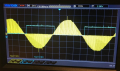
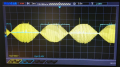
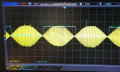
Today was a big surprise with the fan connected to the PWM output after the resistive load looked good yesterday. The waveform looked more like double sideband than PWM:

1602019724021.png

Anyone have any thoughts or comments?

Thanks,

Neko
 

Danko

Joined Nov 22, 2017
2,172
Hi Neko,

I forget all of the specs after the length of this project, but you may have some problems with this being on a breadboard. "Breadboard is commonly rated for five volts at one amp or fifteen volts at one-third of an amp, both of which have a power dissipation of five watts. Since these specifications vary depending on manufacturer and the type of breadboard, you should check the data sheet before purchasing your breadboard. Due to the temporary nature of the contacts, most breadboard has a current limit of one amp or less."
Through power components flows 10kHz pulse current up to 20A amplitude.
This current periodically breaks breadboard contacts that provoke irregular voltage pulses.
These irregular voltage pulses easily can destroy transistors.
It is why they use solderable breadboard for power part of circuit:
1602036605980.png
At least Line, L1, R21, C1, M1, M2, R5, M3, M4, R6, D1, D2, R16, Neut should be soldered.

• There is an obvious delay between the Synchro signal and the PWM, is this critical?
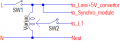
Synchro module should be connected to full L voltage, before variac,
so delay will eliminated:
1602039039256.png
To prevent damage of transistors, follow this procedure:

Turning ON:
1. Set variac to position V out = 0.
2. Turn Sw1 ON.
3. Wait 1...2 sec.
4. Turn Sw2 ON.
5. Smooth and slow set variac to position V out = nominal.

Turning OFF:
1. Smooth and slow set variac to position V out = 0.
2. Turn Sw2 OFF.
3. Wait 1...2 sec.
4. Turn Sw1 OFF.

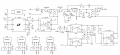
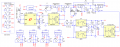
Here is the latest full schematic:
........................................
If anything looks not right, please feel free to comment or correct it.:)
There should be resistor 10 Ω in series with capacitor C1.
1602101235354.png
1602101421083.png
1602104374036.png
 

Attachments

Last edited:

Thread Starter

nekojita

Joined Nov 19, 2010
170
Hi Neko,


Through power components flows 10kHz pulse current up to 20A amplitude.
This current periodically breaks breadboard contacts that provoke irregular voltage pulses.
These irregular voltage pulses easily can destroy transistors.
It is why they use solderable breadboard for power part of circuit:
View attachment 218909
At least Line, L1, R21, C1, M1, M2, R5, M3, M4, R6, D1, D2, R16, Neut should be soldered.


Synchro module should be connected to full L voltage, before variac,
so delay will eliminated:
View attachment 218911
To prevent damage of transistors, follow this procedure:

Turning ON:
1. Set variac to position V out = 0.
2. Turn Sw1 ON.
3. Wait 1...2 sec.
4. Turn Sw2 ON.
5. Smooth and slow set variac to position V out = nominal.

Turning OFF:
1. Smooth and slow set variac to position V out = 0.
2. Turn Sw2 OFF.
3. Wait 1...2 sec.
4. Turn Sw1 OFF.


There should be resistor 10 Ω in series with capacitor C1.
View attachment 218996
View attachment 218997
View attachment 219000
Hi Danko,

Thanks for your response and comments. Tomorrow, I'll set up the switching sequence you recommended. Today, I brought the variac up to full Line voltage. As I raised the Line voltage, I could see the variac wiper noise that you mentioned in an earlier post.

I missed the 10Ω series resistor in the schematic because I included it in the capacitor model and forgot to add it to the proto schematic. I suspect that a 1W resistor should be OK. I'll add to the breadboard tomorrow.

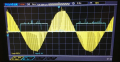
Today I was brave enough to bring the variac up to full line voltage with a 300Ω resistive load. Was able to vary the pulse width with the pot and the PWM output looked good except for spikes. Also, the syncro delay looked better, much less. Tomorrow, I'll set up the switching sequence that you recommend. This is the PWM output at full Line voltage into the 300Ω resistor:

1602116111364.png

Oh, also if you could, please post your potentiometer model, .asy and .subcircuit that you use in your sims? When I open your sim models, the potentiometer is always stripped out of the schematic because my potentiometer model is different. :)
Thanks,

Neko
 

Thread Starter

nekojita

Joined Nov 19, 2010
170
Hi Danko,

Thanks for your response and comments. Tomorrow, I'll set up the switching sequence you recommended. Today, I brought the variac up to full Line voltage. As I raised the Line voltage, I could see the variac wiper noise that you mentioned in an earlier post.

I missed the 10Ω series resistor in the schematic because I included it in the capacitor model and forgot to add it to the proto schematic. I suspect that a 1W resistor should be OK. I'll add to the breadboard tomorrow.

Today I was brave enough to bring the variac up to full line voltage with a 300Ω resistive load. Was able to vary the pulse width with the pot and the PWM output looked good except for spikes. Also, the syncro delay looked better, much less. Tomorrow, I'll set up the switching sequence that you recommend. This is the PWM output at full Line voltage into the 300Ω resistor:

View attachment 219011

Oh, also if you could, please post your potentiometer model, .asy and .subcircuit that you use in your sims? When I open your sim models, the potentiometer is always stripped out of the schematic because my potentiometer model is different. :)
Thanks,

Neko
Hi Danko,

Maybe you missed it but could you please pot your potentiometer asy and sub files?

Thanks,

Neko
 

Thread Starter

nekojita

Joined Nov 19, 2010
170
Hi Danko,

Thanks for the files. Today I made a switch box to implement your power up sequencing scheme. Just need to add two wires and it's done.

Thanks for your suggestions,

Neko
Hi Danko,

I tested out the switch box and sequencing today after adding the 10Ω resistor in series with the filter cap. The PWM does not work with the fan load. Again the waveform was:

1602454174081.png

I measured the motor resistance at 257Ω with an inductance of 79mH. I have no idea where to go from here. Do you have any suggestions?

Thanks,

Neko
 

Danko

Joined Nov 22, 2017
2,172
Top