Hi Alex,
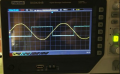
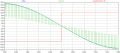
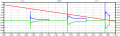
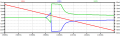
Thanks for your response and comments. So, where can I get a crystal ball? You are about the load current. Any thoughts as to the load voltage looks so crazy? In the plots below, I added the 80mH series inductor: View attachment 213564
Since the load current appears as expected, I'll build up the circuit to see how it performs.
Thanks again,
Neko
A cheap trick is to see if you can find a light bulb that when put in series with the fan causes a drop in power to the fan. You can try different wattage light bulbs, which will depend on the wattage of the fan and how slow you want it to go. Personally with all that effort, for a silent solution, I would have sought out a low voltage DC solution such as a Radiator fan motor from an automotive wrecker.
View attachment 216937
and diodes
Next step will be to order the CME DC-DC isolated 5V- 12V converters, the FETs, diodes, and input filter components to test out the driver.
Hi, I am planning on building up two versions of the complete circuit PWM circuit, one with Danko's homebrew isolated supplies and one with the CME isolated modules.
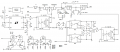
The attached is a schematic, not a simulation that I'll use to build from. The first version is shown below and is also attached:
Comments and corrections invited.
Hi, I am planning on building up two versions of the complete circuit PWM circuit, one with Danko's homebrew isolated supplies and one with the CME isolated modules.
The attached is a schematic, not a simulation that I'll use to build from. The first version is shown below and is also attached: View attachment 217066
Comments and corrections invited.
I ordered the isolated DC-DC modules so I may build this version first: Below is the schematic of this version; the LTSPICE schematic is also attached:
Pay attention to capacitor C1:
Its Rser = 10Ω, so in series with C1 should be connected resistor 10Ω, 1W.
Better - wirewound, because of big pulse current.
Test setup:
Lamp prevents circuit components from damage because of possible short circuits and overcurrents.
Turning ON:
1. Turn Sw1 ON.
2. Wait 1...2 sec.
3. Turn Sw2 ON.
Pay attention to capacitor C1:
Its Rser = 10Ω, so in series with C1 should be connected resistor 10Ω, 1W.
Better - wirewound, because of big pulse current.
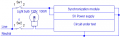
Test setup: View attachment 217201
Lamp prevents circuit components from damage because of possible short circuits and overcurrents.
Turning ON:
1. Turn Sw1 ON.
2. Wait 1...2 sec.
3. Turn Sw2 ON.
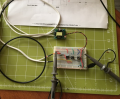
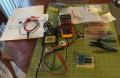
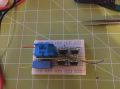
Today, wired up the power module- of course will recheck all connections before applying any line power to the circuit; but, it's moving along:
Am still waiting on the HCPL-3140 opto. After I check the Power Module, will start the control module. A question I had though is whether the delay through the LC filter will be a problem since the sync circuit runs on the raw, not filtered line input. I was thinking that to prevent cross conduction, the sync input should be the filtered line not the raw line.
I forget all of the specs after the length of this project, but you may have some problems with this being on a breadboard. "Breadboard is commonly rated for five volts at one amp or fifteen volts at one-third of an amp, both of which have a power dissipation of five watts. Since these specifications vary depending on manufacturer and the type of breadboard, you should check the data sheet before purchasing your breadboard. Due to the temporary nature of the contacts, most breadboard has a current limit of one amp or less." From - https://www.circuitspecialists.com/blog/common-breadboard-specifications/
A question I had though is whether the delay through the LC filter will be a problem since the sync circuit runs on the raw, not filtered line input. I was thinking that to prevent cross conduction, the sync input should be the filtered line not the raw line.
It is undesirable use filtered line V(d_m1) for synchronization, because of its noise.
How big is delay between raw line and filtered line, you can see below:
Pay attention to values of R14, R15 and to changes in U6 input connections (file PWM-test.asc in attachment).
ADDED:
There is chain of delays: Optocoupler U4(U1) + OpAmp U5 + Gate Drive Optocoupler U6 + Transistor M3(M4).
In summary delay time is 285μs (R1 = 51.1k, R14 and C9 are absent).
Plot below shows shorted PWM pulses during time from 4ms (line zero crossing) to 4.285ms (when transistors M3 and M4 are switched).
With R1 = 51.1k, R14 = 155.1k, C9 = 6.8nF transistors M3 and M4 are switching without delay at time 4ms.
I forget all of the specs after the length of this project, but you may have some problems with this being on a breadboard. "Breadboard is commonly rated for five volts at one amp or fifteen volts at one-third of an amp, both of which have a power dissipation of five watts. Since these specifications vary depending on manufacturer and the type of breadboard, you should check the data sheet before purchasing your breadboard. Due to the temporary nature of the contacts, most breadboard has a current limit of one amp or less." From - https://www.circuitspecialists.com/blog/common-breadboard-specifications/
You are right, this thread is long. Thanks for your comments. When I decided to construct a proof of concept prototype, I wanted to get it together quickly. Over the years, I've done a lot of mixed signal prototyping on these boards for first cut.
It was either a plug-in board or hard wired on a FR-4 breadboard. I decided to go the plug-in route because I didn't expect to run at full line voltage. If you recall, this was a proof of concept exercise to see if my fan would hum at low speeds with a PWM controller, hence lower line voltage.
I'll be using a variac to set the line voltage, so I'll keep the voltage as low as I need to. If the concept proves out, and I decide to cut copper, I'll adhere to proper creepage and clearance distances when laying out the board.
It is undesirable use filtered line V(d_m1) for synchronization, because of its noise.
How big is delay between raw line and filtered line, you can see below: View attachment 217526
Pay attention to values of R14, R15 and to changes in U6 input connections (file PWM-test.asc in attachment).
It is undesirable use filtered line V(d_m1) for synchronization, because of its noise.
How big is delay between raw line and filtered line, you can see below: View attachment 217526
Pay attention to values of R14, R15 and to changes in U6 input connections (file PWM-test.asc in attachment).
ADDED:
There is chain of delays: Optocoupler U4(U1) + OpAmp U5 + Gate Drive Optocoupler U6 + Transistor M3(M4).
In summary delay time is 285μs (R1 = 51.1k, R14 and C9 are absent).
Plot below shows shorted PWM pulses during time from 4ms (line zero crossing) to 4.285ms (when transistors M3 and M4 are switched). View attachment 217694
With R1 = 51.1k, R14 = 155.1k, C9 = 6.8nF transistors M3 and M4 are switching without delay at time 4ms. View attachment 217695
It is undesirable use filtered line V(d_m1) for synchronization, because of its noise.
How big is delay between raw line and filtered line, you can see below: View attachment 217526
Pay attention to values of R14, R15 and to changes in U6 input connections (file PWM-test.asc in attachment).
ADDED:
There is chain of delays: Optocoupler U4(U1) + OpAmp U5 + Gate Drive Optocoupler U6 + Transistor M3(M4).
In summary delay time is 285μs (R1 = 51.1k, R14 and C9 are absent).
Plot below shows shorted PWM pulses during time from 4ms (line zero crossing) to 4.285ms (when transistors M3 and M4 are switched). View attachment 217694
With R1 = 51.1k, R14 = 155.1k, C9 = 6.8nF transistors M3 and M4 are switching without delay at time 4ms. View attachment 217695
It is undesirable use filtered line V(d_m1) for synchronization, because of its noise.
How big is delay between raw line and filtered line, you can see below: View attachment 217526
Pay attention to values of R14, R15 and to changes in U6 input connections (file PWM-test.asc in attachment).
ADDED:
There is chain of delays: Optocoupler U4(U1) + OpAmp U5 + Gate Drive Optocoupler U6 + Transistor M3(M4).
In summary delay time is 285μs (R1 = 51.1k, R14 and C9 are absent).
Plot below shows shorted PWM pulses during time from 4ms (line zero crossing) to 4.285ms (when transistors M3 and M4 are switched). View attachment 217694
With R1 = 51.1k, R14 = 155.1k, C9 = 6.8nF transistors M3 and M4 are switching without delay at time 4ms. View attachment 217695
Was about to go live tomorrow with R14 at 3.92K and C9 at =6.8nF. The primary drive signals from the LTC6992 look good and the output of the HCLP-3140 looks good.
Based on you sim, I will make the change to R14, thanks.
Didn't see this post. Was about to go live tomorrow with
Hi Danko,
Was about to go live tomorrow with R14 at 3.92K and C9 at =6.8nF. The primary drive signals from the LTC6992 look good and the output of the HCLP-3140 looks good.
Based on you sim, I will make the change to R14, thanks.
Thanks for your support. Like I said in earlier posts, I just have to know if this PWM concept shows proof of concept in eliminating motor hum for reduced speeds for fans.
Am going to the finish line on this one and will report new results.
Thanks for your support. Like I said in earlier posts, I just have to know if this PWM concept shows proof of concept in eliminating motor hum for reduced speeds for fans.
Am going to the finish line on this one and will report new results.
In an earlier post, you suggested using the Line vs. the filtered line for the sync circuit where you said that there was more noise on the filtered circuit. Did I misunderstand this? Seems the filtered Line should be less noisy than the "raw" Line.

 Facebook
 Google
 GitHub
 Linkedin
(You can tune zero crossing by value of capacitor C1)