Putty to measure enclosure inside dimension?

panic mode

Joined Oct 10, 2011
5,008
that was illustration explaining which caliper feature is used to measure depth.
the link you quoted and called antiquated was a $25CAD (or $18.75USD) digital caliper - from Amazon. ;)
 

Thread Starter

AlbertHall

Joined Jun 4, 2014
12,628
There is the compound used in the Electrical Distribution industry called Duct-Seal, it is pliable, non-hardening and non stick.
I have used this on occasion.
The only thing is you have to be careful removing it as it remains soft so take care if needed to retain the dimension.
The only source I could find was Amazon - 1lb for £23 - way more than I need and definitely not cheap.
 

ThePanMan

Joined Mar 13, 2020
922
Depends on how much space you're starting with. An approximation would be of help.

Assuming there are, say, 7 inches. Take two empty toilet paper cardboard rolls. Pinch one so it fits inside the other. Stand it vertically and close the lid. The lid will push the tube down and hold its position. Then you can remove it without damaging anything and measure it. If the space is significantly smaller, consider using some large diameter soda straws. Cut them so the combined length is a little longer than the anticipated space. Pinch one and slide it into the other. You may have to use something to hold it vertical, but after you've put the lid on and back off you have a representation of how much space you have.

Don't forget to account for heat expansion and cold contraction. Leave yourself some room. Depending on the materials and the size you may need 1/8 inch clearance to possibly 1/4" clearance. But that's up to you. Knowledge is power.
 

Thread Starter

AlbertHall

Joined Jun 4, 2014
12,628
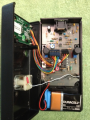
The image below shows the inside of the box when open. I want to add a small PCB near the top right of the bottom to the right of the DIN connector (there are a couple of transistors, tantalum capacitors and resistors. In the other half of the case you can see an LCD display. .


1707003138413.png
 

ApacheKid

Joined Jan 12, 2015
1,762
The image below shows the inside of the box when open. I want to add a small PCB near the top right of the bottom to the right of the DIN connector (there are a couple of transistors, tantalum capacitors and resistors. In the other half of the case you can see an LCD display. .


View attachment 314329
OK I get what your describing. Well, why not put the new PCB anywhere that it will physically fit? It's physical location is not dictated by circuit function, so long as thew new board electrically connects to the existing system, it'll be fine. You could perhaps situate the new board into the other half of the case, between the relay (?) and the LCD display.
 

Thread Starter

AlbertHall

Joined Jun 4, 2014
12,628
OK I get what your describing. Well, why not put the new PCB anywhere that it will physically fit? It's physical location is not dictated by circuit function, so long as thew new board electrically connects to the existing system, it'll be fine. You could perhaps situate the new board into the other half of the case, between the relay (?) and the LCD display.
Well, maybe but the circuit can operate at up to 30MHz so I want as little extra wire length as possible.
The 'relay' I think you mean is actually a small panel meter.
 

strantor

Joined Oct 3, 2010
6,875
There is silly putty available at the Dollar General that would likely be within walking distance of your house if you were in the US. I assume there is something like that in the UK.
 

Jon Chandler

Joined Jun 12, 2008
1,599
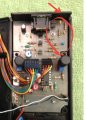
Are you talking about the area circled in red?

There are a couple options:

○ The end panel looks to be removable, if it will come free of the connector(?) – if so remove it and use the telescoping gauges I described. You could also set the gauge to the height your board will require, and move it around to check for clearance.

○ If the end panel is not easily removable, lay a straight edge across the enclosure split, and use a caliper to measure between the enclosure split and the tallest components and repeat the process with the top of the enclosure and add the numbers together. Subtract a bit to account for the enclosure meshing together.

Screenshot_20240203_202936_Edge.jpg
 
Top