Putty to measure enclosure inside dimension?

Thread Starter

AlbertHall

Joined Jun 4, 2014
12,625
I have a gadget which I would like to modify. I need to check the available space inside the box and design the additional PCB/components to fit he available space. I thought of a soft putty like substance that I could put inside and then assemble and open it and measure the resulting putty. It would need to be fairly soft so as not to damage the existing circuitry, it would need to keep its shape when removed, and it should not stick to the eixting circuit board.

Does any such substance exist, or do you have any other suggestions how to do this?
 

BobTPH

Joined Jun 5, 2013
11,515
Here is an iterative solution:

Take a piece of cardboard that is too large in both dimensions, the keep cutting it until it just fits. The lovely wife Morticia uses this method often for fitting things to odd shaped spaces. If you cut too far, tape it back.

When you are done, you have a nice template for the pcb.
 

Jon Chandler

Joined Jun 12, 2008
1,595
These telescoping gaiges may not work in this case, but they're a handy thing to know about....

If you're trying to measure the inside height of an enclosure where you have some kind of access hole through the side (hole for a switch, battery door) these gaiges are simple to use. The legs on the top of the tee telescope, and lock into place when the vertical post of the tee is twisted. Press on legs to collapse them and turn the post to lock them in place. Insert the top of the tee through the opening and rotate the tee to orient the legs the direction to be measured. Loosen the post to allow the spring loaded legs to expand, then twist to lock the measurement in place.

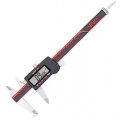
Then disassemble the enclosure, and measure the length of the tee with a caliper

Screenshot_20240203_050322_Edge.jpg
 

MisterBill2

Joined Jan 23, 2018
27,508
Certainly a telescoping gage could work, BUT you still need a measuring device.
My advice for determining the dimensions for a circuit board are to not plan on that close of a fit, because it will be inconveniently close when the board is fully loaded with components.
There does exist a material that is used for that sort of application. The intended use is producing accurate measurements of mechanical items. Unfortunately that observation was a while back, but it would give you a realm to look into. It was silicone based, I think, and rather flexible. It may also have been used for checking dies used for producing cast parts. So it would be a dis-checking material.
 

MaxHeadRoom

Joined Jul 18, 2013
30,655
There is the compound used in the Electrical Distribution industry called Duct-Seal, it is pliable, non-hardening and non stick.
I have used this on occasion.
The only thing is you have to be careful removing it as it remains soft so take care if needed to retain the dimension.
 

Thread Starter

AlbertHall

Joined Jun 4, 2014
12,625
Here is an iterative solution:

Take a piece of cardboard that is too large in both dimensions, the keep cutting it until it just fits. The lovely wife Morticia uses this method often for fitting things to odd shaped spaces. If you cut too far, tape it back.

When you are done, you have a nice template for the pcb.
Nice try but it is the height I really need to know.
 

Thread Starter

AlbertHall

Joined Jun 4, 2014
12,625
These telescoping gaiges may not work in this case, but they're a handy thing to know about....

If you're trying to measure the inside height of an enclosure where you have some kind of access hole through the side (hole for a switch, battery door) these gaiges are simple to use. The legs on the top of the tee telescope, and lock into place when the vertical post of the tee is twisted. Press on legs to collapse them and turn the post to lock them in place. Insert the top of the tee through the opening and rotate the tee to orient the legs the direction to be measured. Loosen the post to allow the spring loaded legs to expand, then twist to lock the measurement in place.

Then disassemble the enclosure, and measure the length of the tee with a caliper
The problem is that there is no access with the case closed and it is the height inside that I need to know.
 

Jon Chandler

Joined Jun 12, 2008
1,595
The problem is that there is no access with the case closed and it is the height inside that I need to know.
Yes, as I stated in the first sentence of my reply. I still thought it worth mentioning because people may not be aware of these measuring tools.

If there's a small clear area on the board, you might use spacers like 3mm fender washers and thin double-sided tape to create a spacer. Make a guesstimate on height, tape it to the board and see if the enclosure fits together. Add or remove a washer until the enclosure fits together and measure the stack.

Once you know the distance from board to enclosure cover, you can measure the height of components to determine clearance.
 

panic mode

Joined Oct 10, 2011
4,978
why would you have to measure insides when the box is closed?
MAKE is accessible by opening it. then measure each side (box and cover).
distance can be added and subtracted.

ever saw mechanical drawings of something? all measurements are relative to some reference (datum), one need to derive the rest.

if the goal is to see inside closed box, use X-Ray
 
Last edited:

ApacheKid

Joined Jan 12, 2015
1,762
I have a gadget which I would like to modify. I need to check the available space inside the box and design the additional PCB/components to fit he available space. I thought of a soft putty like substance that I could put inside and then assemble and open it and measure the resulting putty. It would need to be fairly soft so as not to damage the existing circuitry, it would need to keep its shape when removed, and it should not stick to the eixting circuit board.

Does any such substance exist, or do you have any other suggestions how to do this?
Could you please elaborate with a photograph or two?
 
Top