proteus simulation analog bms

Thread Starter

ji___ha

Joined Mar 21, 2026
16
1774101873492.png 1774101908813.png


i am making a fully analog bms , using the following components,
ICs (Must be DIP / Through-Hole type)*

* 1x LM358 (Dual Op-Amp)
* 1x uA741 (Single Op-Amp)
* 1x NE555 (Timer IC)

*Sensors & Controls (For Breadboard)*

* 4x 10k Potentiometers (Small "Trim Pot" or "Preset" type works best for breadboard)
* 1x 10k NTC Thermistor (Temperature Sensor)

*Transistors & Diodes*

* 5x BC547 NPN Transistors
* 10x 1N4007 Diodes

*Outputs*

* 1x 12V Relay (5-pin "Sugar Cube" type)
* 1x 12V DC Fan (Small size)
* 5x Red LEDs
* 5x Green LEDs
* 1x Small 12V Bulb (or DC Motor) for load

*Resistors (1/4 Watt)*

* 20x 1k Ohm
* 10x 10k Ohm
* 5x 22k Ohm
* 10x 220 Ohm (or 330 Ohm)

*Capacitors*

* 2x 10uF Electrolytic Capacitor (16V or higher)

*General / Power*

* 1x Breadboard (Standard size)
* 1x Bundle of Single Strand Wires (or Jumper Wires Male-to-Male)
* 1x 12V DC Adapter (1 Amp) + DC Jack connector (Female)


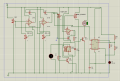
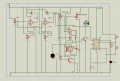
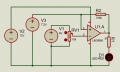
so i am doing this simulation and i am not getting the results i need , like i think connection errors but i can, figure them out.
the project idea is simple , it takes 2 inputs temp and voltage, compares it against a threshold.
working principle
Stage 1 — Voltage monitoring (LM358 dual op-amp)
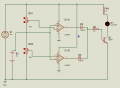
The LM358 (U1) is used as two independent voltage comparators. U1:A compares the battery voltage (set via potentiometer RV1) against a 4.2V reference (REF_4.2, set by another trim pot). If battery voltage exceeds 4.2V (overvoltage), the output goes HIGH. U1:B does the same for the undervoltage threshold of 3.3V (REF_3.3) — if the battery drops below this, its output goes HIGH. Diodes D1 and D2 on the outputs act as an OR gate — either fault condition triggers the relay driver transistor Q2 (BC547), which pulls in relay RL2 to disconnect the load. D3 is a freewheeling/flyback diode across the relay coil to suppress the voltage spike when the relay de-energises.
Stage 2 — Temperature monitoring (uA741 + NE555)
The NTC thermistor forms a voltage divider with a fixed resistor. As temperature rises, the thermistor resistance drops, pulling the voltage at the uA741's (U2) inverting input higher. When this crosses the TEMP_REF threshold, the 741 output goes HIGH, which triggers the NE555 (U3) in monostable mode. The NE555 output then drives transistor Q1 (BC547), which switches on the 12V DC fan and lights the red LED alarm.
Stage 3 — Output stage
All outputs are transistor-driven (BC547 is an NPN — a HIGH signal at its base turns it ON). The relay switches the main load (bulb/motor). The fan cools the battery. LEDs give visual status.
 

dl324

Joined Mar 30, 2015
18,216
Welcome to AAC!
The LM358 (U1) is used as two independent voltage comparators.
Why are you using an opamp as a comparator? LM393 would be better.

so i am doing this simulation and i am not getting the results i need , like i think connection errors but i can, figure them out.
What are the supplies for the uA741?

Your schematic is essentially unreadable due to the unnecessary wire jogs, unnecessary wire crossings, misplaced connection dots, and poor flow.

What is the purpose of RL2? It switches ground to L1, but the other terminal of L1 is also connected to ground.

*Transistors & Diodes*

* 5x BC547 NPN Transistors
* 10x 1N4007 Diodes
The schematic shows 2 transistors and 4 diodes being used. Why are you using 1N4007?
 

crutschow

Joined Mar 14, 2008
38,316
As noted, your schematic is a lazy-drawn mishmash and very difficult to read.
So please redraw it to address these issues if you want us to understand it.

Look at well-drawn schematics if you need to know how its done.
They have a minimum of dot connections, wire jogs, and crossed wires. while yours has an abundance of those.

I do see that D1 and D2 are back-to-back (although not immediately obvious the way it's drawn) so they do nothing.
 
Last edited:

Thread Starter

ji___ha

Joined Mar 21, 2026
16
As noted, your schematic is a lazy-drawn mishmash and very difficult to read.
So please redraw it to address these issues if you want us to understand it.

Look at well-drawn schematics if you need to know how its done.
They have a minimum of dot connections, wire jogs, and crossed wires. while yours has an abundance of those.

I do see that D1 and D2 are back-to-back (although not immediately obvious the way it's drawn) so they do nothing.
i took multiple days to do this fr. I am a beginner, this like my first time using proteus and also first time creating a fully analog circuit , so i am not very good at it. I can't figure out how to do it, i have been doing it for days now i still can't figure out.
 

Thread Starter

ji___ha

Joined Mar 21, 2026
16
What is the purpose of RL2?
well the purpose of rl2 is it to safely cut off the battery if the voltage is not in desired range.but i think that part in this circuit has some major connection errors so i had to make it separately , now that works. ig the relay part was the easiest so i could figure that out but the voltage sensing area is driving me nuts, like can you recommend somewhere i can refer to understand making comparator circuit
 

ericgibbs

Joined Jan 29, 2010
21,390
hi ja,
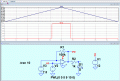
This is what LTSpice shows when your OPA inputs are corrected.

I have used a vin sweep voltage to replace the 10k Pot.
E

EG 2057.gif
 

Thread Starter

ji___ha

Joined Mar 21, 2026
16
1774248925752.png
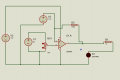
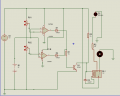
i am trying add the relay circuit to it. like the relay should cut off the load when battery voltage is not desired.but the motor always rotates.
 
Top