Proper Meter Test For Personal Grounding?

Thread Starter

russwr

Joined Aug 29, 2017
123
Questioning the setting on multimeter for measuring voltage on body, due to insulation from pure ground as outdoors. Who do you know who has had the so called "BENEFITS" from using a wrist grounding strap, bare feet touching sheet metal / copper screen, or shoe metal strap inside and out, that relates to the outdoors grounding? There should be a wire connecting the driven copper pipe near house for the opposite electrode!,- not ground hole on wall socket that's contaminated with low volts and frequencies. (Earthing book and Clint Ober YouTube videos) My body constant 3.5V AC on meter setting goes to zero with touching proper ground. People way back in time went barefoot. Then leather shoes were on market, which were partially conductive. Then came composite plastic soles, which insulate humans from our natural earth. Lots of growing different types of illness and arthritis pains. Has anyone already done their testing over a time period?
 

Tonyr1084

Joined Sep 24, 2015
9,744
Is there a question here?

Static charges can build up on the human body simply from their clothing rubbing against their skin. Triboelectric effect can generate charges as high as 50KVS (KV Static). When grounding you want to ground through a resistor. Typically 1 MEGΩ to 10 MEGΩ. You never want a direct connection to earth. You could come in contact with a lines energized circuit and complete the path to ground and your day is done. As for YouTube videos - take them with a grain of salt. Especially with AI running rampid. You never know just how much mis-information you're getting.

As for the ground at the electric socket, as long as it's properly grounded to earth ground your ESD station can be connected to that. As for the 3.5VAC you're seeing - I think you're seeing some sort of "Antenna" effect where your body is acting like an antenna and you're reading some voltage that is induced from the electrical wiring in your house.

As for a meter - a regular meter won't measure static voltages. You need a special "Field" meter to measure the static field present in anything you put it close to. If memory serves, 12 inches away from a charged surface and the meter should read correctly. I used to use one as part of ESD Auditing in the shop.
Who do you know who has had the so called "BENEFITS" from using a wrist grounding strap,- - - that relates to the outdoors grounding?
It's not "Who has benefited," it's "Who's aware of damage due to not being properly grounded?" I've seen a satellite on the test stand go dark just because a cart with a dragging chain wheeled by within 3 feet of the ship. The chain had rusted and was not dissipating static properly. Hence the static field around the cart was strong enough to blow out a component. That set the schedule back 6 weeks. I guess you could say the satellite did not benefit from proper grounding.
 

ulms

Joined Mar 19, 2024
179
Is there a question here?

Static charges can build up on the human body simply from their clothing rubbing against their skin. Triboelectric effect can generate charges as high as 50KVS (KV Static). When grounding you want to ground through a resistor. Typically 1 MEGΩ to 10 MEGΩ. You never want a direct connection to earth. You could come in contact with a lines energized circuit and complete the path to ground and your day is done. As for YouTube videos - take them with a grain of salt. Especially with AI running rampid. You never know just how much mis-information you're getting.

As for the ground at the electric socket, as long as it's properly grounded to earth ground your ESD station can be connected to that. As for the 3.5VAC you're seeing - I think you're seeing some sort of "Antenna" effect where your body is acting like an antenna and you're reading some voltage that is induced from the electrical wiring in your house.

As for a meter - a regular meter won't measure static voltages. You need a special "Field" meter to measure the static field present in anything you put it close to. If memory serves, 12 inches away from a charged surface and the meter should read correctly. I used to use one as part of ESD Auditing in the shop.

It's not "Who has benefited," it's "Who's aware of damage due to not being properly grounded?" I've seen a satellite on the test stand go dark just because a cart with a dragging chain wheeled by within 3 feet of the ship. The chain had rusted and was not dissipating static properly. Hence the static field around the cart was strong enough to blow out a component. That set the schedule back 6 weeks. I guess you could say the satellite did not benefit from proper grounding.
Wow, things can be that sensitive. How do you rely on that equipment?
 

dl324

Joined Mar 30, 2015
18,264
It would be helpful if you used paragraphs to organize your thoughts.
Who do you know who has had the so called "BENEFITS" from using a wrist grounding strap, bare feet touching sheet metal / copper screen, or shoe metal strap inside and out, that relates to the outdoors grounding? There should be a wire connecting the driven copper pipe near house for the opposite electrode!,- not ground hole on wall socket that's contaminated with low volts and frequencies. (Earthing book and Clint Ober YouTube videos)
It sounds like you've been consuming a fair amount of misinformation.

Metal pipes aren't necessarily connected to earth ground. I have sections of galvanized pipe connected with CPVC.

The ground hole on an electrical outlet is a fine place to get earth ground (if the outlet is actually grounded). In my house, the neutral line is bonded to earth ground at my power panel and is connected to 2 grounding rods near my foundation.

Take the time to learn about what ESD is and what appropriate mitigations to take.

If you have an ESD mat, connecting a ground strap to that mat is sufficient to avoid problems with ESD. It's not the absolute voltage that matters, it's the relative voltage.
 

Tonyr1084

Joined Sep 24, 2015
9,744
Screenshot 2024-07-10 at 7.07.15 AM.png
Screenshot 2024-07-10 at 7.07.48 AM.png

Screenshot 2024-07-10 at 7.08.27 AM.png
Screenshot 2024-07-10 at 7.08.42 AM.png

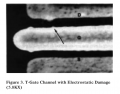
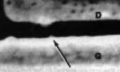
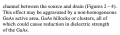
This is ESD damage. Note: It is not an ESD failure, the component can still be tested and the defect may not be known until it finally fails. The last statement is reflective of EOS (Electrical Over Stress). The component was designed to handle X amount of current. Because the black trace has been compromised it can no longer carry the full amount of current it was originally designed to handle. Properly handling static sensitive devices is critical. Even if you don't blow them out they can still be compromised.

In my account of the failed satellite you asked how something could be so sensitive. The answer comes in the fact that satellites operate at extremely low power levels. Many of the components sent into space are sensitive to static events as low as 50 volts. No, not 50K volts, Fifty Volts! The cart, which was composite material with rubber wheels had a conductive coating on it making it safe as long as it was in contact with earth ground. That ground was provided by a chain dragging on the ground. Due to corrosion that chain became insufficient in conducting static charges away from the cart. As the cart was moved around it had a static charged field around it. Getting close to it meant you or the satellite, which would have been grounded, a means for that field to find a discharge path. Further exacerbating the problem was that the conductive flooring was not properly cleaned. You don't just wash a conductive floor, it has to be washed with the proper cleaners and properly restored to its full conductive rating. Had either of those two factors been by themselves the satellite would not have been the ultimate pathway for the field effect of the charge to discharge to ground. Had the operator been grounded while moving the cart the charge would have been discharged to ground.

There can be a myriad of issues when proper grounding is not followed. And unfortunately for the satellite under test simply getting the cart near to a test cable could have, and likely may have been the reason for the failure.

HOME USE:
In the hobbiest world of electronics most devices are far more robust than that of a satellite. Far less susceptible to ESD. Many chips have a built in circuit to mitigate any inadvertent exposures to ESD. A simple grounding mat and wrist strap are effective methods to control ESD. But someone mentioned "potential" voltage. If you are working on an old computer simply touching the metal frame will likely bring both you and the computer to the same potential. Even if you're at 30KVS, if the computer is at the same potential then there will be no transference of the static field. You won't harm anything if you stay in contact with the metal frame. Even if it's not grounded. If it IS grounded then as soon as you touch it - you're grounded and discharged to ground.

Others have complained about me being "verbose" so I'll drop it here. Hopefully you now realize you may be way over thinking ESD. The Hewlett Packard document is a sweet explanation of what you need to know about ESD and EOS.
 

MrChips

Joined Oct 2, 2009
34,698
Why anti-static protection is critical

Devices can be immediately destroyed, yes. The real concern is when internal structures are weakened or compromised while the device still passes all functional tests. Then a $1 component fails in the field and costs $1000 to be replaced or results in more than a few thousands of dollars in damage or even death due to catastrophic failure of total systems.
 

dl324

Joined Mar 30, 2015
18,264
The real concern is when internal structures are weakened or compromised while the device still passes all functional tests.
I can't count the number of times AAC members have claimed that they never take precautions for ESD and have never damaged a device.

I'm usually mindful of ESD and still managed to damage several 2N7000 several years ago. Took me a while to figure out that high leakage currents were causing the circuit using them to not work as expected. Naturally, that was the last thing I suspected.
 
Questioning the setting on multimeter for measuring voltage on body, due to insulation from pure ground as outdoors. Who do you know who has had the so called "BENEFITS" from using a wrist grounding strap, bare feet touching sheet metal / copper screen, or shoe metal strap inside and out, that relates to the outdoors grounding? There should be a wire connecting the driven copper pipe near house for the opposite electrode!,- not ground hole on wall socket that's contaminated with low volts and frequencies. (Earthing book and Clint Ober YouTube videos) My body constant 3.5V AC on meter setting goes to zero with touching proper ground. People way back in time went barefoot. Then leather shoes were on market, which were partially conductive. Then came composite plastic soles, which insulate humans from our natural earth. Lots of growing different types of illness and arthritis pains. Has anyone already done their testing over a time period?
You've got some interesting points there. Measuring body voltage can be tricky due to insulation from the ground. I've heard a few folks swear by grounding methods like wrist straps and barefoot walking on conductive surfaces. For accurate results, definitely connect to a proper outdoor grounding rod instead of a wall socket. There are some anecdotes out there about reduced pain and improved health from grounding, but it's always good to look for more scientific testing and long-term studies to back it up.
 

Tonyr1084

Joined Sep 24, 2015
9,744
For accurate results, definitely connect to a proper outdoor grounding rod instead of a wall socket.
In the standards, IPC-A-610 rev G and since its inception grounding to a properly grounded outlet has always been acceptable. Grounding to a rod may not be the easiest or most practical thing to do. Unless you're working with Satellites then grounding to an outlet that is properly grounded there will be no problems.

The purpose of grounding is to give static charges a place to go. They don't need to go there in less than 0.1 femto second, they just need to go to ground. Hence that's part of the reason why grounding is done through a 1 MEG Ω minimum resistance (100 MEG Ω max wrist strap, 1000 MEG Ω Table and Floor mat). The purpose of these values is to drain off static charges without causing discomfort to the operator and to protect the worker from accidental contact with a live source.

You want to "Drain off" the static charge you don't want to drive it full force to ground. Ever get out of your car on a cold dry winter morning and turn to close the door? You get that static snap that hurts all the way up your arm and causes you to curse? That's the kind of discharge you want to avoid. But you do want to discharge to ground. That's why an outlet is a perfectly acceptable ground connection. As long as you connect through the recommended resistance.

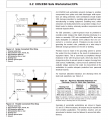
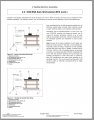
This is from IPC-A-610 rev D (Draft Document for Industry Consensus Vote only). Transitioning from rev C to E is done using rev D for industry feedback only. This is section 3.2: Note that item 6 is a common ground point, not necessarily a grounding rod. Though I've seen places with grounding rods sunk right through the floor. But in multi-level buildings that's not practical. Grounding is allowed through a common grounding point such as a "Properly Grounded Outlet".
1720710685211.png
And I'm just now seeing that IPC-A-610 may be up to rev J. And I haven't seen anything higher than G. (Note: rev I (i) is skipped because it can be confused with the number 1 or the lower case L. It's natural progression to go from G to H to J)
 

Tonyr1084

Joined Sep 24, 2015
9,744
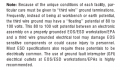
Just pulled out my copy of IPC-A-610 rev G. Here's a couple screen captures to consider:

Screen Shot 2024-07-11 at 4.17.59 PM.png

Screen Shot 2024-07-11 at 4.19.14 PM.png

In this case the note last sentence recommends use of a GFCI outlet.
 

graybeard

Joined Apr 10, 2012
118
I suspect that the TS is trying to determine if grounding his body will prevent "Lots of growing different types of illness and arthritis pains. "...
 
Last edited:
Top