Proper LED current

Thread Starter

Simon Larsen

Joined Feb 22, 2015
31
I have bought some led's with the following specs:
Color: Red
- Wave length: 620~625nm
- Direct voltage: 1.9~2.1V
- Counter current: < / = 10uA
- Brightness: 800~1000MCD
- Lighting angle: 30 degree

without really thinking much about it I used them in a project where I had 5V and a 22o ohm resistor for each. So that would give I = 3/220=13mA pr. led. All was fine...

...then I started a new project and randomly used a 470 ohm resister - and brightness was actually fine! so my question is: how can I know which current-value is appropriate for a led?
 

AnalogKid

Joined Aug 1, 2013
12,057
The relationship between current in and light out is not linear. Also, the relationship between light out and perceived brightness is not linear. Combine these, and just looking at an LED is not a good indicator of what is going on inside it. Start with the datasheet and it's nominal or test current value. This is the manufacturer's opinion of the LED's sweet spot. From there, you can increase the current up to the max value if you need more brightness, or decrease it if you want less brightness or lower power operation. Vision is the most subjective of our five senses, so whatever looks best is the best answer as long as it is within the datasheet limits.

ak
 

dl324

Joined Mar 30, 2015
18,226
how can I know which current-value is appropriate for a led?
Anything less than manufacturer maximum average power dissipation is appropriate. LEDs are typically spec'ed at 10-20mA (Vf, brightness, color, etc). The datasheet will also give a maximum forward current; this and maximum average PD are what you need to observe.
 
Last edited:

#12

Joined Nov 30, 2010
18,224
I keep telling people that you don't have to run your LEDs at the labeled maximum current. That's the MAXIMUM on the label. Whatever looks good to you is sufficient.
 

mcgyvr

Joined Oct 15, 2009
5,394
I keep telling people that you don't have to run your LEDs at the labeled maximum current. That's the MAXIMUM on the label. Whatever looks good to you is sufficient.
Absolutely +1 for "indicator" LEDs..


For "high current" LEDs used for "usable" light.. I drive it like I stole it :D
(but I also heatsink it properly)
 

WBahn

Joined Mar 31, 2012
32,714
I second all of the above. As long as you aren't pushing the datasheet limits, use whatever current works for your needs. The lower the current the less power and the longer the LED will last.
 

ian field

Joined Oct 27, 2012
6,536
I have bought some led's with the following specs:
Color: Red
- Wave length: 620~625nm
- Direct voltage: 1.9~2.1V
- Counter current: < / = 10uA
- Brightness: 800~1000MCD
- Lighting angle: 30 degree

without really thinking much about it I used them in a project where I had 5V and a 22o ohm resistor for each. So that would give I = 3/220=13mA pr. led. All was fine...

...then I started a new project and randomly used a 470 ohm resister - and brightness was actually fine! so my question is: how can I know which current-value is appropriate for a led?
Usually the manufacturers data sheet indicates the current to use - if they're no-name unbranded parts; all you've got is guesswork.

LEDs can't stand heat - if its running even perceptably warm, you're close to its limit.
 

wayneh

Joined Sep 9, 2010
18,090
The relationship between current in and light out is not linear. Also, the relationship between light out and perceived brightness is not linear.
While this is strictly true, it's worth pointing out that they are both nearly linear. The linear approximation is worthwhile in almost all situations.

LEDs have a great property of not changing color (much) when dimmed. Incandescent bulbs change dramatically when dimmed.
 

WBahn

Joined Mar 31, 2012
32,714
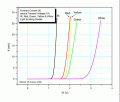
Check this graph, it shows a typical LEDs current vs forward voltage according to its color:


View attachment 84821

http://engineering.stackexchange.co...nse-to-have-a-12v-lighting-circuit-in-a-house
The last time this was posted it caught my attention because it looks like the voltage for the Green is actually curving back on itself and starts decreasing with increasing current. I thought that this was just an optical illusion, but I just used a triangle on it and it sure looks like it's going back to lower voltages.
 

Stuntman

Joined Mar 28, 2011
222
Of course so much of this is situational. I have one of those little battery operated LED tester, which is excellent for checking brightness at different currents.

You may be surprised how much variation there is from color to color to get the same perceived brightness. You may also be surprised how little current it takes to get a very visible light.
 

cmartinez

Joined Jan 17, 2007
8,727
The last time this was posted it caught my attention because it looks like the voltage for the Green is actually curving back on itself and starts decreasing with increasing current. I thought that this was just an optical illusion, but I just used a triangle on it and it sure looks like it's going back to lower voltages.
Now that you mentioning it... yeah! it sure looks that way... but is there a commercially available green LED capable of consuming 60mA ?
 
Top