Problem with Gas Sensor and Bridge wheatstone

Thread Starter

qwwe

Joined Jul 18, 2017
31
Hello
I want to make the nap50a gas sensor, which is a catalytic gas sensor, and
The problem is that when the sensor is connected to the circuit, there is a potential difference of 0.2 volts between the ground. And also for positive nutrition, 0.2 volts of potential difference are created. I first thought that the problem was with the regulator, so I supplied the voltage required by the 2.5V sensor directly to the power supply, but that's the same. Of course, for example, the reference voltage of the lm4040, which I connect to the circuit, generates a potential difference of about 0.01 volts between the ground connected to the lm4040 of the power supply.
 

ericgibbs

Joined Jan 29, 2010
21,412
hi qwwe,
Welcome to AAC.
How long is the connection from R7 to the 0V line.?
That Vdrop sounds excessive.
Are you using the Bridge connections correctly.?

E
EDIT:
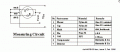
Checking the d/s, the sensor requires a INA Instrumentation amplifier

ESP1 05-Mar-18 18.14.gif
 
Last edited:

Thread Starter

qwwe

Joined Jul 18, 2017
31
Thanks for welcoming and responding
I locked the circuit exactly like the one you put it, but it's still the same.
The length of the wire is 2 or 3 cm.
The bridge circuit is well balanced and the outputs increase with increasing gas in the environment. But only the problem I mentioned.
Of course, as I said when adding other parts to the circuit, like the lm4040, there is a potential difference between their ground and the power supply, which is greatly reduced by the stellar ground method.
 

ericgibbs

Joined Jan 29, 2010
21,412
hi,
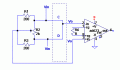
Your circuit is not wired correctly, you are connecting 'D' to 0V.
The sensor is expecting a differential amplifier or INA which has a differential input.
I will post a quick diagram.
E
 

ericgibbs

Joined Jan 29, 2010
21,412
hi,
This is a basic circuit.
E
EDIT:
My original circuit was incorrectly copied from d/s, deleted
Will repost corrected version.

Update:
Corrected drawing.
ESP1 06-Mar-18 10.23.gif
 
Last edited:

Thread Starter

qwwe

Joined Jul 18, 2017
31
The circuit I use to amplify is the following circuit:

When connecting the sensor to this circuit, the output of the amplifier is 100 millivolts offset when the bridge is in a balanced state.
I thought the problem was a amplifier. So I connected the two inputs to the ground and I saw that there is still the same amount of offset. But when I plugged the sensor completely out of the circuit and then connected the amplifier inputs to the ground, it only had 5 millivolts offsets. This meant that the sensor would create a problem in circuit. I used a 5 volt amplifier for positive and 0 volts for a negative base. Should the negative base of the amplifier be sure to connect to the negative voltage.
Meanwhile, I connected a sensor pin pin D to the ground, and the other end to the pin.
Should Pin D be connected to negative voltage.
Is this a natural drop in the potential between the ground connected to the LM4040 and the ground power supply.
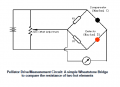
There is a potential difference between the ground plane of the WHEATSTONE BRIDGE and the ground power supply even when I have not used the amplifier in the circuit. That is, I've just closed the simple circuit that you put in the previous section.
 
Last edited:

ebp

Joined Feb 8, 2018
2,332
Why is there a potential difference between the grounds? How can that possibly be if the connections are only a few centimetres? Either a connection is lacking or there is substantial current from some other source. There can be no other explanation.

We need to see a schematic showing exactly how things are connected.
 

sghioto

Joined Dec 31, 2017
8,634
This is how it should be connected. The amp only has a gain of 2 as shown unless R5 is greatly reduced.
EDIT: reversed inputs from sensor/bridge to amp.
SG
EEE Nap Gas sensor INA.png
 
Last edited:

ebp

Joined Feb 8, 2018
2,332
That sensor requires a very large amount of current (typical of the type). The current, if not properly managed, could cause noticeable voltage drop. I now suspect that even with just a few centimetres of connection length that that is where the problem lies - not necessarily in the conductors along but also in the connections.
I can't figure out from the badly-done data sheet if the 200 ohm resistors are internal to the part or external. If they are external they are stupidly low if a half-way decent amplifier is used.

An LM4040 may or may not be suitable. Its rated current is only 15 mA. We haven't been shown how it is connected. The current spec for the sensor is ±10 mA so that doesn't leave much room for variation in the (presumed) 5 volt supply. If the series resistor is selected so that the LM4040 current is guaranteed to be at least a milliamp or two at the absolute lowest voltage of the 5 V supply at the lowest sensor current (160 mA), it may be OK, but the numbers need to be confirmed.
 

sghioto

Joined Dec 31, 2017
8,634
Those resistors are external and are not that low in value compared to the sensor which is about 15 ohms.
Agree about the LM4040 unless he use it as the reference for a voltage regulator.
SG
 

ebp

Joined Feb 8, 2018
2,332
You're absolutely right about the resistors being a non-issue relative to the sensor. The current through them is far below the uncertainty in the sensor current.

This really isn't a bridge sensor. I suspect one could do an entirely adequate job with an LM358A - use one section to buffer the offset voltage so trimming the offset wouldn't mess with the gain of the second section used as a simple amp with offset.
If the reference, offset components and the sensor were remoted, an IA would be better for common-mode noise rejection, but I would hate to have to put that thing very far away. It would take some extra bits of circuitry to manage the voltage drop & consequent gain error in the common wire. Or very heavy wires! It would be better to remote the whole circuit and receive its output with an IA.
 

sghioto

Joined Dec 31, 2017
8,634
Speaking of an IA , the design the TS posted is almost identical to the INA126. Probably will work fine using 1% resistors. I tested the circuit as shown and it does work.
SG
 

Thread Starter

qwwe

Joined Jul 18, 2017
31
I also applied a negative voltage opamp to the VSS, but it did not matter, but I think it was a problem to close the bridge, where the problem of the difference in the amount of ground was almost over and reached 100 mV to 7 mV.Of course, there are about 20 millivolts offset in the amplifier output.

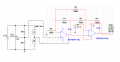
Now, using the two remaining op amps inside the mcp604, as shown below, which closes the circuit you see in the direction of the sensor's current source, this circuit runs correctly in the software, but in practice, for example, if the reference voltage is 0.5 volts In the output of the second amplifier, which has a current-to-voltage converter, there is a voltage drop of 0.3 volts, which decreases the voltage drop by lowering the resistance of the feedback. What seems to be the problem of what I am confused about, because I have the same circuit I'm packed with the ad8572 IC and worked really hard without any problems.
 

sghioto

Joined Dec 31, 2017
8,634
You got me confused as well. I don't understand why you don't just connect the circuit as shown in post 10 with the sensor connected and see how that works. As stated before I have tested the circuit and it does work. With the zero offset pot adjusted correctly the output will be zero or within a few millivolts.
SG
 

Thread Starter

qwwe

Joined Jul 18, 2017
31
I do not have a problem with Bridge now. It's a problem with the following circuit, which in practice is a voltage drop resistance of 1 M. The circuit of a current-to-voltage converter is working correctly on the software. In this circuit, we set the reference voltage to the first apomp and give the second opamp input to be used as the basis. But this 0.5 volt voltage is dropping 0.3 volts on resistance 1M, and the output of the second opamp is 0.2 volts. However, with a decrease in feedback resistance from 1M to 10k, this voltage drop is largely eliminated, but I need a 1M ginear. This problem occurs when using the MCP604 , but with the help of the AD8572 , this problem does not exist.
Even when the amplifier is only positive with a power source, this problem is not awesome in the AD8572.
 

ebp

Joined Feb 8, 2018
2,332
[see second edit - bias current seems unlikely; this is a CMOS amp]
The amplifier input bias current is not zero and your circuit produces an offset voltage due to bias current.
Put a resistor of 1M between pin 1 and pin 5. This will approximately balance the offset voltage due to bias current. The alternative is to use an amplifier with lower input bias current.


[EDIT:] If the simulator does not show this effect then the op amp model being used is not correct for the actual amplifier.

[Second Edit] Something else must be wrong. I checked the input bias current specification for that amplifier and it is extremely low, typically 1 pA at 25°C, 60 pA max for industrial temp range version at 85°C. What is the output impedance of the current source you are using.

I am beginning to suspect you have a noisy power supply and/or your construction technique is bad. Have you looked at signals with an oscilloscope? Are you using good decoupling for the amp power right at the amps?
 
Last edited:
Top